Post-Match Recovery in Football: A Practical 48-Hour Protocol
A step-by-step post-match recovery protocol for football, from the first minutes to 48 hours later: hydration, nutrition, sleep and regenerative work.
Written by
João Araújo
Physical Education Teacher (FADEUP – University of Porto) · Futsal Coach – Level II · UEFA B License · Master’s in Physical Education
15 years teaching Physical Education in schools, 20 years coaching futsal at youth development level and 5 years coaching football. Federated and amateur football and futsal player.
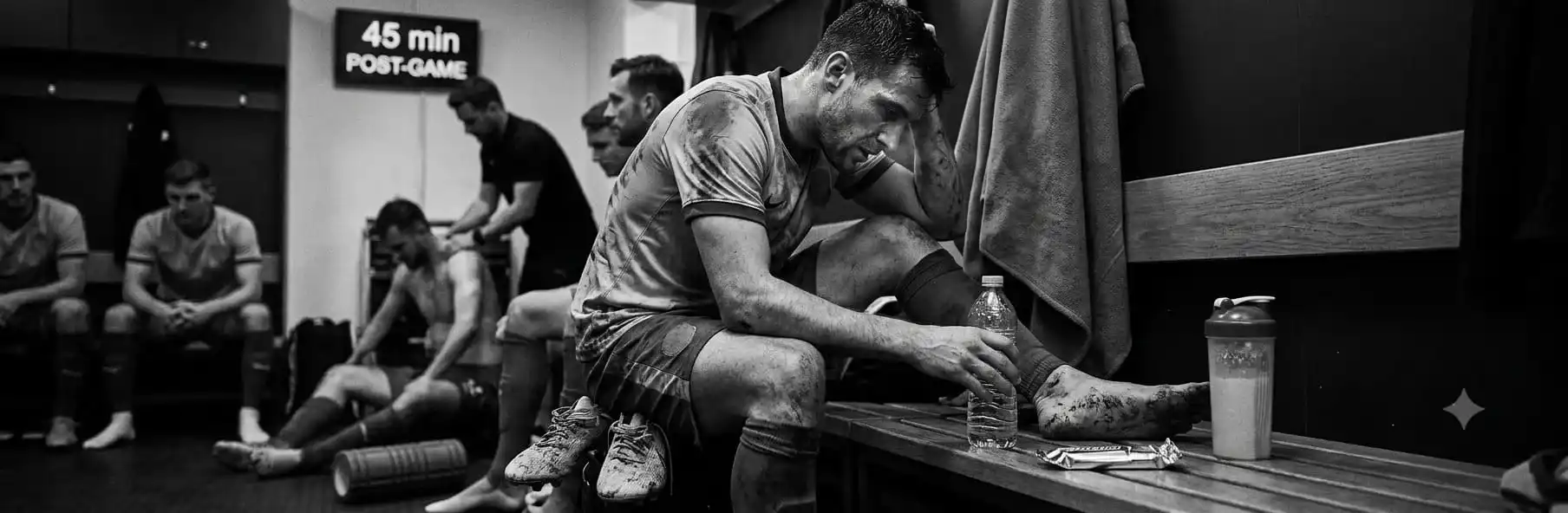
The first 30 minutes after the final whistle largely determine how well a player recovers over the following 48 hours. That’s the window when the body is most receptive to replenishing muscle glycogen and kick-starting repair processes. and it’s exactly the moment most grassroots players skip entirely, opting for a quick shower and the drive home instead.
A well-structured post-match recovery protocol doesn’t require professional-club resources. It requires discipline and a clear sequence of priorities across the first 48 hours.
Why the First 48 Hours Are a Different Kind of Challenge
A competitive football match places a far heavier neuromuscular and metabolic load on the body than a normal training session. repeated eccentric actions (braking, changes of direction, duels) cause muscle micro-damage that, without proper management, extends fatigue and raises injury risk in the next match or session. The 48-hour window isn’t arbitrary: it corresponds to the minimum time needed for most muscle fatigue markers to return close to baseline.
The Plan: Recovery Protocol from 0h to 48h
| Time | Priority | Main action |
|---|---|---|
| 0-30 min post-match | Immediate replenishment | Hydration + simple carbohydrates |
| 30 min-2h post-match | Structured nutrition | Meal with protein and complex carbs |
| Match night | Sleep | 8h+ of sleep, dark and cool environment |
| Next day (24h) | Active recovery | Mobility, light regenerative work |
| 48h | Reassessment | RPE and subjective fatigue signs logged |
Phase 1: The First 30 Minutes
Hydrate immediately with water or an isotonic drink, and take in fast-absorbing carbohydrates (fruit, an energy bar) to kick-start muscle glycogen replenishment. This window is the most efficient of the whole day for that purpose, delaying intake until after the shower and the journey home significantly reduces replenishment efficiency.
Phase 2: The Post-Match Meal (30 Minutes to 2 Hours)
A full meal with quality protein (meat, fish, eggs, legumes) and complex carbohydrates (rice, pasta, potato) within two hours of the match maximises muscle protein synthesis and energy replenishment. Avoid alcohol at this stage. it directly interferes with protein synthesis and with the quality of the sleep that follows.
Phase 3: Sleep on Match Night
Sleep is the most underrated recovery factor in grassroots football. Residual match-day adrenaline makes falling asleep harder, but prioritising a dark, cool, screen-free environment in the hour before bed significantly improves sleep quality, even when total hours are limited by kickoff time.
The Most Common Post-Match Mistakes
- Skipping the first-30-minutes window. the biggest loss of recovery efficiency happens right here
- Training at normal intensity the next day. the body is still in repair mode; the session should be strictly regenerative
- Drinking alcohol on match night. directly harms muscle recovery and sleep quality
- Not logging subjective fatigue signs. without data, it’s impossible to know whether a player is ready for the next session or needs extra management
🔧 Useful Tool
Tracking each player’s recovery needs a consistent log, not isolated perception. SportsLabTools Athlete Journal lets you log sleep, hydration and post-match RPE per player, surfacing who needs more recovery time before the next session.
Adjusting the Protocol in Two-Match Weeks
When the next match is less than 4 days away, the 48-hour protocol has to be even more rigorous. there’s no margin to skip the first-30-minutes window or neglect sleep. In these weeks, recovery stops being a recommendation and becomes a mandatory part of the weekly plan, just like a tactical session.
See also: Periodisation in Football Pre-Season: The 4 Phases to Reach Peak Shape by Kickoff. where the recovery capacity that sustains this routine across the season is built.
Checklist: Post-Match Recovery Protocol
- Hydration and simple carbohydrates within the first 30 minutes
- Structured meal with protein and complex carbs within 2 hours post-match
- Alcohol avoided on match night
- Sleep environment optimised (dark, cool, screen-free)
- Next-day session limited to regenerative work
- RPE and subjective fatigue signs logged through the 48-hour window
- Protocol reinforced during two-match weeks
Conclusion
Post-match recovery isn’t luck. it’s a deliberate technical sequence that starts in the first 30 minutes after the final whistle. Teams that treat this window with the same discipline they apply to tactical training arrive at the next match with less accumulated fatigue and fewer injuries across the season.
Log every player’s recovery consistently across the season. Use SportsLabTools Athlete Journal to make sure nobody arrives at the next session without being properly recovered.