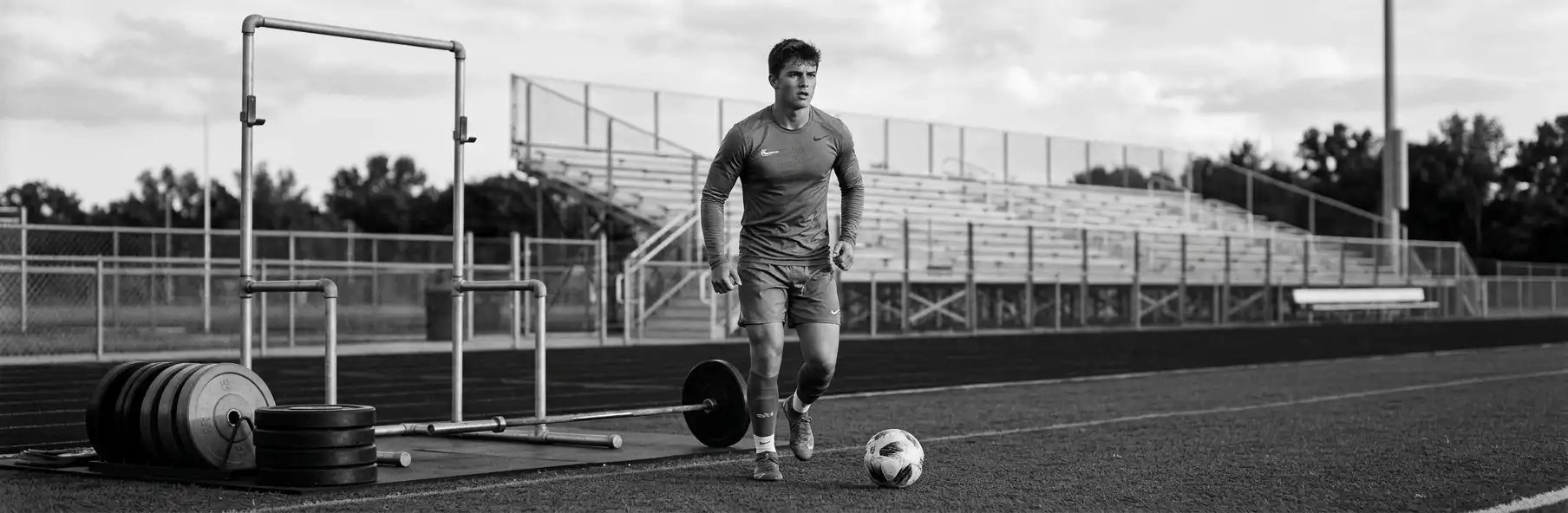
I'm 16 and Play Football: Can I Start Weight Training?
An under-17 football player asks whether he can start lifting weights. A straight answer on safety, speed, where to begin and how to fit it into the week.
Written by
João Araújo
Physical Education Teacher (FADEUP – University of Porto) · Futsal Coach – Level II · UEFA B License · Master’s in Physical Education
15 years teaching Physical Education in schools, 20 years coaching futsal at youth development level and 5 years coaching football. Federated and amateur football and futsal player.
I got this message two weeks ago from an under-17 football player at a club in Nottinghamshire: “I’m 16, I play on the wing and I’m the lightest in the team. I lose nearly every duel. I want to go to the gym but my dad says it’ll stunt my growth and my coach says it’ll make me slow. Can I lift weights or not?”
I’m answering here because I get a version of this question almost every month. And because the two answers he heard at home and at the club are, with all due respect, myths that have been around for decades.
Will lifting weights really stop me growing?
No. This is probably the most stubborn myth in youth sport, and there’s no science behind it.
The idea comes from a fear of damaging the growth plates, the areas of cartilage at the ends of bones where growth happens. Injuries to those areas do exist, but the ones linked to strength training almost always happen without supervision, with maximal loads and terrible technique. Not with well-coached training. The main sports science bodies, including the NSCA in the US and the UK Strength and Conditioning Association, have had public positions for years saying supervised strength training is safe and beneficial for young people.
Think about it: in a single match you make dozens of decelerations, jumps and landings that put forces of several times your body weight through your legs. A well-executed squat with a moderate load is far more controlled than that.
At 16, most lads have already been through their peak growth spurt. If you’re still shooting up quickly (more than 7 or 8 centimetres in a year), talk to your coach or a physio, because at that stage you need to be more careful with coordination and with knee and heel pain. But even then, the answer isn’t “don’t train”. It’s “train with more care”.
(I’m not a doctor, and there are individual cases where it’s worth asking one. But for a healthy 16-year-old, the risk of not training strength is usually bigger than the risk of training it.)
So is my coach right that I’ll get slower?
Also no, at least not the way he thinks.
Sprint speed depends largely on how much force you can put into the ground in a short time. More strength, trained properly, means more acceleration. Studies with young footballers show improvements in 10 and 20-metre sprints and vertical jump after 8 to 12-week strength programmes. You don’t get worse. You get better.
What can make you slower is something else: training like a bodybuilder. Lots of sets to failure, just to grow muscle, only on machines, with no power or speed work. If you put 6 kilos of muscle on your arms and chest, you’ll carry that weight for 90 minutes without gaining anything on the pitch. That’s probably what your coach has seen happen before, and that’s what he’s worried about.
Your goal isn’t to get big. It’s to get strong for your size, stable in duels and quicker over the first five metres. Those are different things, and the training is different too.
There’s another benefit nobody talks about at 16: injury prevention. Stronger muscles around the knee, hip and ankle protect those joints better when you brake and change direction. The wingers who reach senior football without ever doing strength work tend to be the ones spending the most time in the treatment room at 19 and 20.
Right, so where do I start?
Start by talking to your coach, even if he said no. Show him you don’t want to be a bodybuilder and ask him to help you fit this into the week. If the club has a strength and conditioning coach, even better.
Then, for the first 6 to 8 weeks, the priority is technique with bodyweight or light loads. Two sessions a week, 40 to 45 minutes each. Something like this:
| Exercise | Sets x reps | What it’s for |
|---|---|---|
| Goblet squat (kettlebell or dumbbell) | 3 x 8-10 | Leg strength and base position |
| Dumbbell Romanian deadlift | 3 x 8 | Hamstrings and glutes, protection when sprinting |
| Bulgarian split squat | 2 x 8 each leg | Single-leg strength and balance |
| Press-ups | 3 x max with good form | Upper body, holding your own in duels |
| Dumbbell row | 3 x 10 | Balance between front and back |
| Side plank / Copenhagen | 2 x 20-30 s each side | Adductors and trunk |
On every set you should finish feeling you could have done two or three more good reps. No sets to failure. No max tests in the first few months.
As for which days: never the day before a match. If you play on Saturday, one session on Monday or Tuesday and another on Wednesday or Thursday works well, always after checking with your coach about the load of the pitch sessions.
If it were me, I’d ask you for one thing before you start: log every session. Exercises, weights, how you felt, how you slept and how your legs were at the next training. Use the SportsLabTools Athlete Journal, which was built for exactly this. After two months you’ll have something worth more than any argument: proof, in numbers, that you got stronger without getting slower. And that’s what wins over coaches and parents.
And after the first 8 weeks?
If your technique is solid and nothing hurts, you can start nudging the loads up. A simple rule: when you complete every set of an exercise with clean technique and still have three reps in the tank, add 2 to 5% next session. No more than that.
This is also when power work comes in, and it’s what carries over most to the pitch. Box jumps, standing broad jumps, medicine ball throws against a wall. Few reps, high intensity, full rest between sets. Three or four sets of three to five jumps, at the start of the session while you’re fresh.
The barbell can come later, with someone who knows how to teach it. There’s no rush at all. The players I see improve most between 16 and 18 aren’t the ones lifting the heaviest. They’re the ones who train strength twice a week for two years straight without missing.
In weeks with two matches, cut it to one short session or skip the week. You won’t lose anything.
A quick word on pain, because it matters. Muscle soreness the day after a session is normal, especially in the first fortnight. Sharp pain during an exercise, pain in a joint rather than a muscle, or pain that’s still there three days later isn’t. Stop that exercise and tell your coach or physio. Pushing through at 16 is how a two-week niggle becomes a two-month layoff.
What about supplements, protein shakes, creatine?
At 16 you don’t need any of that to get started. The protein you need is in food: eggs, milk, yoghurt, meat, fish, beans and lentils. Three or four meals a day with a protein source in each is plenty.
Creatine has good evidence in adults, but most bodies don’t recommend it before 18, and that isn’t where your gains are right now. They’re in consistency, sleep and eating enough. A light winger who does strength work but under-eats won’t gain anything. Your body needs energy to adapt.
And sleep. Seriously. Eight to nine hours a night will do more for your body at 16 than any powder in a tub.
And if my coach keeps saying no?
It happens. Not every academy coach has had access to the latest information, and some have had bad experiences with players who overdid it.
If so, don’t go against him. Keep giving 100% in club training and suggest starting with bodyweight at home: squats, lunges, press-ups, planks, glute bridges. Show him for a month that it isn’t doing you any harm. Then talk to him again, with your log in hand.
With your dad, the conversation is similar. Parents worry because they don’t want to see their son injured. Explain that you’ll train with supervision, with light loads and a plan. If it helps, take him along to the first session.
See also: Strength Training for Footballers: What to Do in the Gym During the Season: how strength work evolves once you reach senior football.
To the lad who wrote to me: yes, you can and you should lift. Train to get stronger, not bigger, with supervision and without rushing. A year from now you’ll be winning the duels you’re losing today.
Start logging your strength and pitch sessions today. Use the SportsLabTools Football Athlete Journal to show your coach how you’re progressing week by week.
*This question is based on a real message, but the player's identity has been protected and some details of the setting have been recreated for illustrative purposes.*