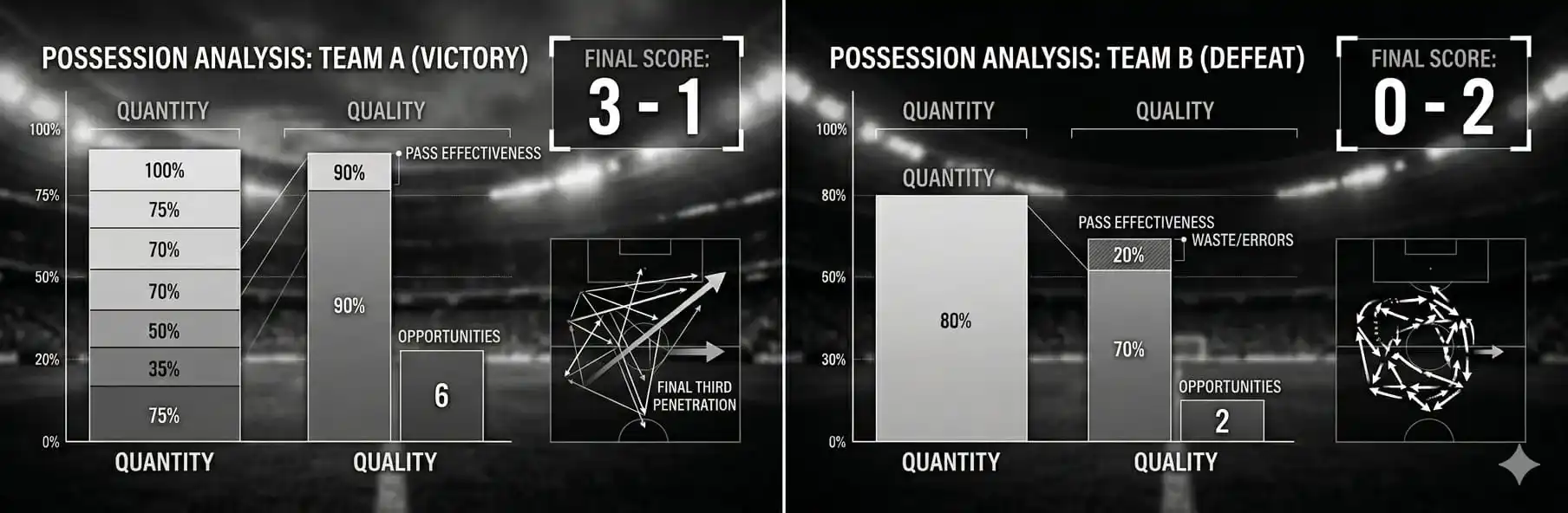
Ball Possession Analysis: Quality vs. Quantity
Having the ball for a long time does not mean playing well. and it depends on your team's objective. Discover the difference between quantitative and qualitative possession, and how to analyse each.
Written by
João Araújo
Physical Education Teacher (FADEUP – University of Porto) · Futsal Coach – Level II · UEFA B License · Master’s in Physical Education
15 years teaching Physical Education in schools, 20 years coaching futsal at youth development level and 5 years coaching football. Federated and amateur football and futsal player.
In an under-12 tournament, the team that won the championship finished matches with less ball possession than their opponents. Meanwhile, in the senior league at the same club, the team with the highest possession was also the one scoring the most goals. Two contexts. Two objectives. Two completely different readings of the same number.
Ball possession analysis is one of the most discussed metrics in team sports. and one of the most misunderstood. Knowing how to distinguish between quantitative and qualitative possession is essential for coaches at every level.
What Is Quantitative Possession?
Quantitative possession is what everyone knows: the percentage of time with the ball. If Team A has the ball for 60% of the match, Team B has 40%.
This number, in isolation, says very little. A team can have 70% possession with sideways and backwards passes without creating a single goal-scoring opportunity. Another can have 30% possession with quick, effective transitions that result in 5 clear chances.
The number itself is not the problem. what you do with the ball is what matters.
What Is Qualitative Possession?
Qualitative possession measures what happens during the time with the ball:
- Progression: does possession advance into more dangerous zones?
- Creation: does possession generate finishing opportunities?
- Efficiency: does the ball move forward with few touches and quick decisions?
- Territory: does possession happen in the opponent’s half or your own?
A team with 45% possession but 65% of that possession in the final third of the opponent’s half has far superior qualitative possession to a team with 65% possession spread across the whole pitch.
Context 1: Youth Development (Under-8 to Under-15)
In a development context, ball possession serves a different purpose: the technical and cognitive development of the player. Quantity matters. but not for the sake of immediate results.
The goal here is for each player to touch the ball as many times as possible, make decisions under pressure, and learn to keep the ball in adverse situations. A youth team that always plays direct and rarely possesses the ball is depriving its players of essential technical repetitions. For example, an Under-10 player getting 15 touches per game develops far less than one getting 40 touches, even if that player’s team loses.
Relevant metrics for youth development:
- Touches per player per match
- Passes completed per player
- Technical actions (dribbles, receptions, first touches) per player
- Percentage of ball losses due to pressure vs. technical errors
The objective is not to have more possession. it is for more players to touch the ball and make decisions in varied situations.
Context 2: Senior Level (Results)
At the senior competitive level, possession is a means to an end: the result. And different tactical philosophies use possession differently.
Control style (similar to Barcelona or Manchester City): possession is used to wear down the opponent, control the rhythm of the game, and create numerical superiorities. The key metric is not the percentage of possession, but the percentage of possession in advanced zones and the number of chances created.
Transition style (similar to counter-attacking teams): possession is deliberately conceded in certain phases to create space behind the opponent’s defence. Low possession can be a sign of strategy, not weakness.
Relevant metrics for senior level:
- Final third possession (territorial)
- Passing sequences ending in a goal-scoring opportunity
- PPDA (Passes Allowed Per Defensive Action). defensive pressure
- Transition efficiency: average time between ball recovery and first chance created
The Right Question for the Coach
Before analysing possession data, a coach must answer one question: what is this team’s objective when they have the ball?
If the answer is to develop players, individual involvement metrics matter more than the overall percentage.
If the answer is to win, the location and end product of possession is worth more than the raw number.
Possession that does not serve the objective is not an asset. it is an illusion of control.
To go beyond the numbers and understand the real context behind each possession sequence, the SportsLabTools Futsal Video Analysis lets you review plays, annotate key moments and connect what happened on the pitch with the match’s statistical data.
Having the ball is not the same as using the ball. The data shows the difference.
Optional accelerator · the tool is always free
Start tagging matches without spending hours building categories
An analysis model with 12 categories and more than 60 actions organised by game moment, already carrying individual/collective context and pitch and goal location. Import it and tag your first clip right away.