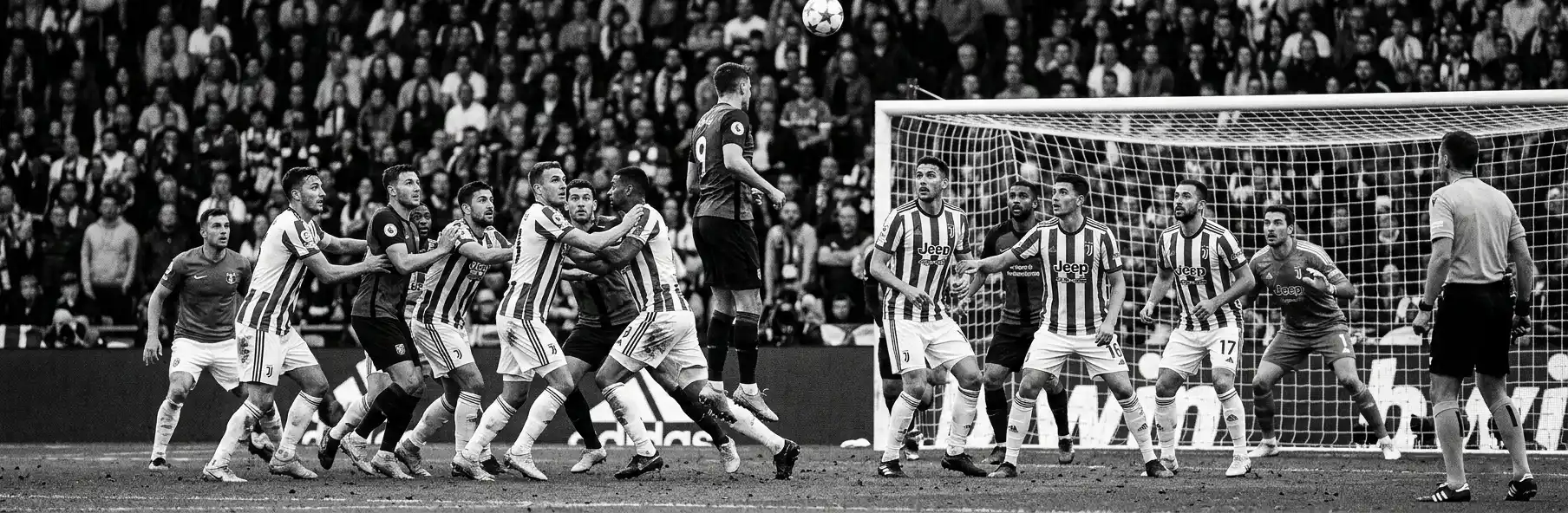
Defensive Set Pieces in Football: Zonal vs. Man Marking at Corners
Comparing zonal and man marking at defensive corners in football: advantages, limitations, and criteria for choosing the right system.
Written by
João Araújo
Physical Education Teacher (FADEUP – University of Porto) · Futsal Coach – Level II · UEFA B License · Master’s in Physical Education
15 years teaching Physical Education in schools, 20 years coaching futsal at youth development level and 5 years coaching football. Federated and amateur football and futsal player.
There’s no universally superior corner-marking system. there’s the one that best fits your squad’s height, the opposition’s delivery quality, and your team’s own record of conceding. Nearly a third of goals conceded by amateur sides come from set pieces, and most of those goals stem from a system poorly matched to the context, not an isolated individual error.
Zonal Marking
Characteristics and Advantages
Each player occupies and defends a fixed zone in the box, regardless of who the opposition places there. This eliminates the advantage the opposition gains from blocking runs or individual decoy movement. with zonal marking, the space is always covered, no matter who attacks it.
Limitations
It demands high collective discipline and total clarity on each zone’s boundaries. a player who hesitates between “is this my zone or my teammate’s” creates exactly the space the opposition is looking for. It’s also more vulnerable to players with a strong shot from range outside the covered zones.
When to use it: against opponents with good delivery and strong aerial players operating through coordinated blocking runs.
Man Marking
Characteristics and Advantages
Each defender tracks a specific attacker, exploiting individual physical advantages (height, jump) against the right player. It allows you to directly neutralise the opposition’s main aerial threat by assigning him a dedicated marker.
Limitations
It’s vulnerable to blocking runs and decoy crosses. one of the most common attacking corner tactics. if the marker loses visual contact for even a second, the attacker gains a decisive positional edge.
When to use it: when the opposition relies on one or two specific players as their main aerial threat, and your squad has defenders physically comparable to those players.
Mixed System
Characteristics and Advantages
It combines man marking on the biggest aerial threats with zonal coverage of the other critical areas (near post, rebound zone). It’s the most widely used system at the professional level precisely because it reduces the limitations of each pure system.
Limitations
It demands more dedicated training time to automate the hybrid responsibilities. not always feasible at amateur clubs with few weekly sessions devoted to set pieces.
When to use it: when there’s enough training time to automate specific responsibilities and the opposition combines concentrated aerial threat with good deliveries into rebound zones.
How to Choose: Decision Criteria
- Does the opposition’s aerial threat concentrate in one or two players, or spread across several points in the box?
- Does your squad have defenders physically competitive enough for direct man marking?
- How much weekly training time is available to automate mixed-system responsibilities?
Practical example: an amateur team facing a single tall, dominant aerial threat gets more out of man-marking that one player and covering the rest of the box zonally than trying a pure system the squad has no time to automate in training.
🔧 Useful Tool
Identifying the next opponent’s blocking patterns and most dangerous delivery takers is the first step to choosing the right system. The SportsLabTools Video Analysis tool lets you catalogue the opposition’s attacking corners and pinpoint exactly where your defence needs to reinforce coverage.
Comparison Table: Corner Defence Systems
| Criterion | Zonal | Man Marking | Mixed |
|---|---|---|---|
| Vulnerability to blocking runs | Low | High | Moderate |
| Requires collective discipline | High | Moderate | High |
| Neutralises specific aerial threat | Moderate | High | High |
| Training time required | Moderate | Low | High |
See also: Attacking Set Pieces in Football: Building a Corner-Kick Playbook. the same systems logic applied to the attacking moment of the game.
Conclusion
Choosing between zonal, man marking or mixed isn’t an abstract tactical philosophy question. it’s a concrete decision based on the opponent in front of you and the resources you have available to train for it. Analyse the next opponent before deciding on a system, and defending set pieces stops being a weak point and becomes a trained competence.
Prepare your corner defence on evidence, not gut feel. Use the SportsLabTools Video Analysis tool to identify the next opponent’s patterns before the match.
Optional accelerator · the tool is always free
Start tagging matches without spending hours building categories
An analysis model with 12 categories and more than 60 actions organised by game moment, already carrying individual/collective context and pitch and goal location. Import it and tag your first clip right away.