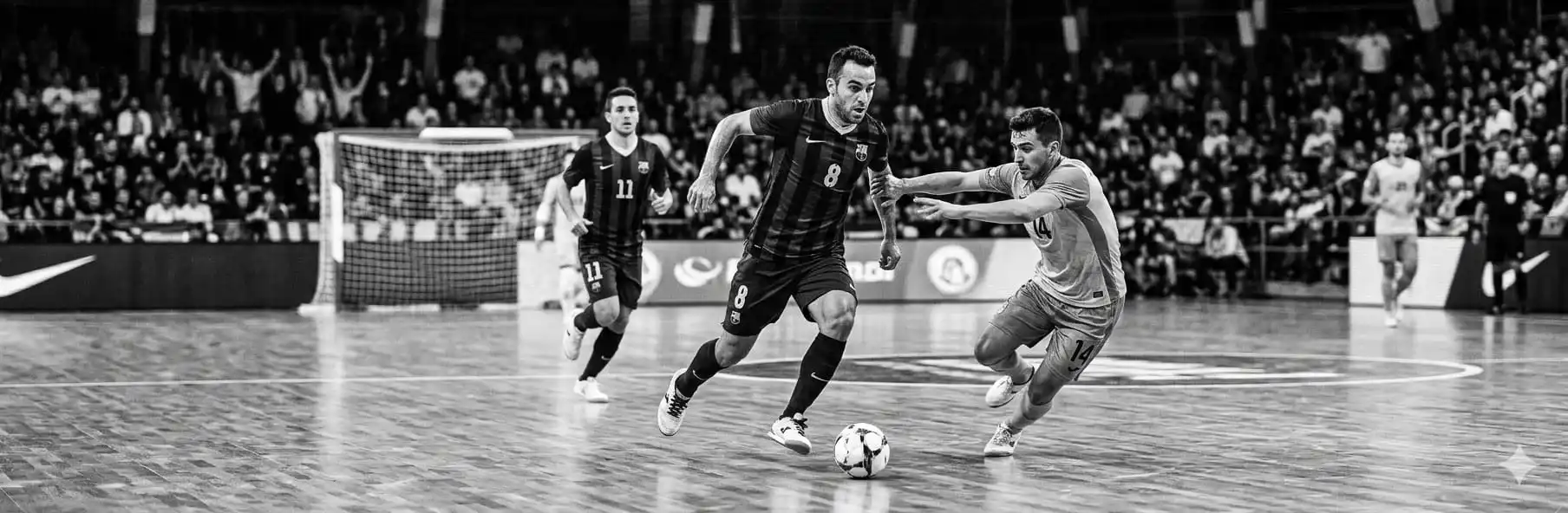
Fast Transition Analysis: The Secret Behind Goals in Modern Futsal
How to analyse fast transitions in futsal frame by frame to identify the exact decision moment, improve attacking effectiveness and reduce decision-making errors.
Written by
João Araújo
Physical Education Teacher (FADEUP – University of Porto) · Futsal Coach – Level II · UEFA B License · Master’s in Physical Education
15 years teaching Physical Education in schools, 20 years coaching futsal at youth development level and 5 years coaching football. Federated and amateur football and futsal player.
Watch the last five matches from the highest level of futsal. the Portuguese Futsal League, the UEFA Futsal Champions League, or the Brazilian Liga Nacional. Most goals don’t come from long passing sequences or individual dribbling in tight spaces. They come from a ball recovery followed by a two-to-four touch transition, executed before the defence can reorganise.
The fast transition is the most effective attacking mechanism in modern futsal. and also the hardest to train, because it depends on a decision made in under one second.
Why Transitions Generate So Many Goals
Futsal is a game of spaces. When possession changes, there is a two-to-four second window where defenders are in motion to recover position and the spaces in the opposition half are still open. Teams that exploit this window with quick, correct decisions catch the defensive line at a numerical or positional disadvantage.
The difference between a good transition and a wasted counter-attack almost always comes down to a single decision: the first pass decision after winning the ball back.
The Frame-by-Frame Analysis of a Transition
Video analysis in slow motion allows you to break down what happened in those critical two to four seconds. What to look for:
Frame 1: The Moment of Ball Recovery
At the instant the ball is won, what is the position of the opposition? How many are between the ball and the goal? Is the direct route available? The best futsal players take this “mental photograph” instinctively. video analysis makes this process conscious and trainable.
Frame 2: The Pass Decision (0.5 to 1 second after recovery)
This is the most important frame. The ball-carrier chose: drive forward, pass right, pass left, or play directly into the box? In slow motion, it’s possible to see whether there was a better option available that wasn’t identified, or whether the decision taken was correct but poorly executed.
Frame 3: The Timing of Runs from Players Off the Ball
Were the teammates off the ball in a receiving position? Did they make their run at the right moment. before the passing window closed? In a 2v1 or 3v2, a player off the ball who doesn’t move at the right time eliminates the imbalance the transition created.
🔧 Useful Tool
Use the SportsLabTools Video Analysis Tool to analyse your last match’s transitions frame by frame. Tag clips where the pass decision was taken in the right second. and those where the window was missed. The comparison gives your group a clear reference of what the team needs to improve.
What Defines a Well-Executed Transition
An effective attacking transition has three components:
1. Recognition Speed
The ball-carrier identifies the defensive imbalance in under one second after winning the ball. No hesitation. They don’t drive forward waiting to see what happens. they act before the defence reacts.
Video indicator: time between ball recovery and the first pass or attacking action. In the best transitions, this time is under 1.5 seconds.
2. Decision Quality
The decision taken is the one that creates the most imbalance. not necessarily the easiest. A pass in depth to a teammate in full stride is more effective than a sideways pass to maintain possession, even if the second is technically simpler.
3. Final Third Execution
The transition can be perfect through to the last pass or movement. and fail at the finish due to lack of technical quality, rushing or the wrong position of the shooter. Video allows you to identify whether the problem is in the decision (phases 1 and 2) or the final execution.
How to Train Decision Speed in Transitions
| Drill | Description | Objective |
|---|---|---|
| Recovery + immediate transition | Defender wins ball and transitions 2v1 | Automate transition without hesitation |
| Game with “transition bonus” | Goal after transition in max 3 touches worth two points | Encourage rapid space exploitation |
| Clip analysis + replication | Show correct transition clip; replicate in training | Create a reference mental image |
| 4v3 with quick exit | Defending team wins ball and transitions immediately | Work both phases of transition |
Goal Patterns in Transition: What the Data Shows
Analysing transition goals in high-level futsal, two patterns emerge with frequency:
- 2v1 with wide pass: ball-carrier drives centrally, draws the defender and plays the lateral pass to the wide channel. the shooter receives at a favourable angle
- Depth pass after ball recovery on the halfway line: the turnover happens 20 metres from goal, the carrier plays directly to the teammate in full stride who reached the space behind the defensive line first
Both patterns share one thing in common: the pass decision was made before the carrier had stopped. A transition that stops to think ceases to be a transition.
Conclusion
Fast transitions are not an accident. they are the result of deliberate training of decision speed combined with systematic analysis of the moments the window was exploited or missed.
Video is the tool that makes this process concrete: it gives the player the image of the second when the decision was available and wasn’t taken, creating a reference memory that transforms behaviour in matches.
Analyse your match’s transition moments frame by frame. Use the SportsLabTools Video Analysis Tool to identify the quality of decisions at critical moments and build a specific improvement plan.
Optional accelerator · the tool is always free
Start tagging matches without spending hours building categories
An analysis model with 12 categories and more than 60 actions organised by game moment, already carrying individual/collective context and pitch and goal location. Import it and tag your first clip right away.