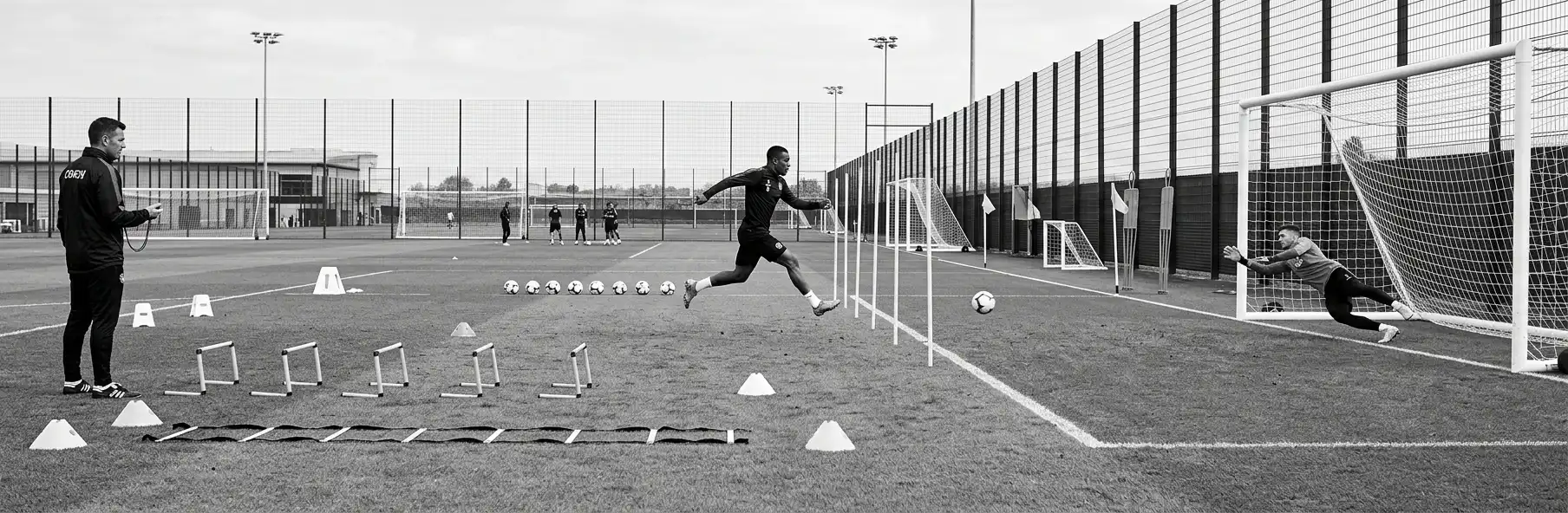
Finishing Training in Football: Drills to Boost Shooting Efficiency
How to structure finishing training in football to boost goal conversion: drill progression, constraints, and technical correction.
Written by
João Araújo
Physical Education Teacher (FADEUP – University of Porto) · Futsal Coach – Level II · UEFA B License · Master’s in Physical Education
15 years teaching Physical Education in schools, 20 years coaching futsal at youth development level and 5 years coaching football. Federated and amateur football and futsal player.
A team can dominate possession, create 15 shooting chances a game, and still only score one goal. because the problem isn’t creating chances, it’s the efficiency with which they’re finished. And yet few amateur teams dedicate structured training time specifically to finishing, treating it as a “bonus” tacked onto the end of the session.
Training finishing in isolation, with no competitive context, is one of the reasons match conversion numbers don’t match the individual quality shown in training. The fix is bringing the drill closer to the real pressure of a game.
The Problem: Finishing Without Pressure or Context
Smashing 20 balls into an empty net trains foot technique, but it doesn’t train decision-making under pressure, which is what’s actually missing from most players in a match situation. Without opposition, without accumulated fatigue, and without a time constraint, the drill doesn’t transfer to the competitive context.
Principles of Effective Finishing Training
- Complexity progression: start with no opposition, move to passive opposition, finish with active opposition and fatigue
- Repetition with variation: change the angle, the striking surface, and the type of assist each set
- Finishing under fatigue: introduce the shot after a prior physical effort, simulating minute 80
- Immediate feedback: correct the standing foot and the contact point on the ball right after each shot, not at the end of the drill
Practical Application: Progressive Finishing Drill
| Stage | Description | Objective |
|---|---|---|
| 1 | Unopposed shooting, various box positions | Consolidate base technique |
| 2 | Shooting with passive defender + cross | Introduce shot-selection decisions |
| 3 | 2v1 shooting with an active goalkeeper | Simulate real pressure |
| 4 | Finishing after a 30m transition under fatigue | Approximate match context |
Common Mistakes in Finishing Training
- Always training the same distance and shooting angle
- Not including an active goalkeeper in most repetitions
- Ignoring first-time finishing and shooting off the dribble
- Only judging whether the ball goes in, without correcting the technical process
🔧 Useful Tool
Logging shots, shots on target, and goals per player across the season lets you see whether finishing efficiency is actually improving with training. SportsLabTools Stats makes that tracking simple and comparable match by match.
Building the Finisher’s Confidence
Finishing efficiency is psychological too. A striker in a goal drought benefits from drills with guaranteed success at the start of the session, before moving to higher-pressure situations, rebuilding confidence before testing it.
See also: Expected Goals (xG) and xA in Football: What These Metrics Really Tell You. how to measure whether finishing efficiency is actually improving.
Checklist: Finishing Training in Football
- Drills with an opposition progression (unopposed → active opposition)
- Active goalkeeper included in most repetitions
- Finishing under simulated fatigue
- Variation in angles, distances, and types of assist
- Technical feedback given after every shot
- Shots and conversion logged per player across the season
Conclusion
Finishing improves when it’s trained under the same pressure, fatigue, and context as the real game. not as an isolated pure-technique drill. Structuring the progression and logging the numbers is what turns individual potential into actual goals.
Track your players’ finishing efficiency over time. Use SportsLabTools Stats to log shots and conversion match by match.
Optional accelerator · the tool is always free
Reliable stats as soon as the next match
An action taxonomy ready for live logging from the bench, with pitch and goal location already active — heat maps and shot maps without configuring anything.