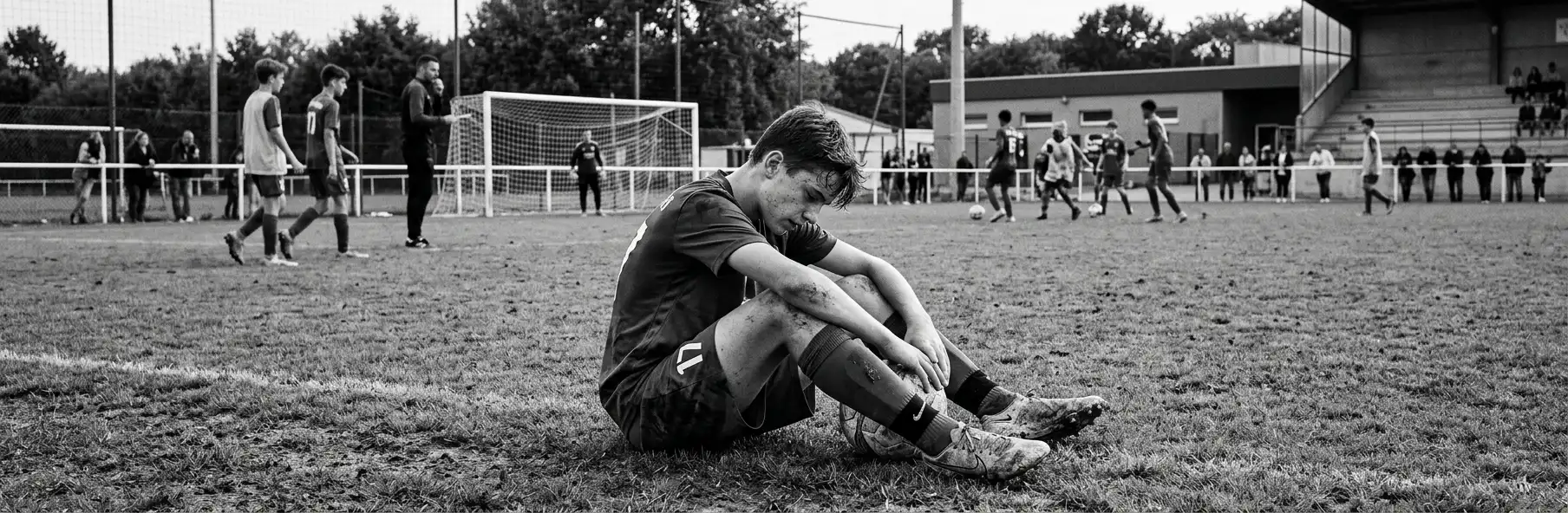
How I Survived My First Football Trial: A Young Player's Diary
Tuesday, 6:30pm, borrowed pitch, fifteen lads fighting for three spots. A first-person diary of my first football trial: nerves, mistakes, and what I learned.
Written by
João Araújo
Physical Education Teacher (FADEUP – University of Porto) · Futsal Coach – Level II · UEFA B License · Master’s in Physical Education
15 years teaching Physical Education in schools, 20 years coaching futsal at youth development level and 5 years coaching football. Federated and amateur football and futsal player.
Tuesday, 6:30pm. A borrowed pitch at a lower-league club, half-worn 3G, fifteen lads aged 14 to 15 lined up along the touchline. I was one of them. Three spots in the u15s, a coach with a clipboard and a stopwatch, and a feeling in my stomach I’d never had before, not even in league matches.
I didn’t know anyone’s name. I didn’t know what system they’d play. All I knew was I had 90 minutes to show I deserved one of the three football spots on that squad, and that most of the other fourteen were in exactly the same position I was.
The First 15 Minutes Were a Disaster
I started badly. Received the first ball with my back to goal, tried an overambitious pass to my weaker foot and lost possession in midfield. The coach said nothing, just wrote something on his clipboard, and that was the worst part: not knowing what he was writing. I spent the next five minutes playing scared instead of playing football, turning down balls I’d normally demand, just to avoid another visible mistake.
It was a teammate, also a trialist, who told me at the water break: “Stop worrying about what he’s writing. Play like you do at your club training.” I’m not entirely sure that’s what actually fixed it, but that’s when I started breathing normally again.
What I Changed Halfway Through
In the second half of the trial, I changed three concrete things, without anyone telling me to:
I started calling for the ball earlier instead of waiting for it to come to me, and that alone changed how the coach looked at me, because stopping the waiting is more visible than any single piece of skill. I simplified my decisions: a safe short pass instead of trying the perfect 30-yard ball that would only come off once in ten. And I communicated louder than usual, almost exaggeratedly, shouting “man on!” and “turn!”, because on a pitch full of strangers, communication is the one thing that separates someone who looks like they can play from someone who can actually play.
That’s roughly when I remembered something my club coach had said weeks earlier, about reviewing your own game on video instead of trusting memory alone. I didn’t have footage of that trial, but I promised myself that at the next one I’d ask someone to film at least the first 20 minutes, because that’s exactly where I lost the most time correcting myself instead of already knowing what had gone wrong. These days I use the SportsLabTools Video Analysis tool after every trial or big match, precisely so I’m not relying only on how it felt in my body.
What I Changed After That
The day after the trial, before I even knew the result, I wrote everything I remembered in a notebook: the three clear mistakes, the two moments I played well, and my teammate’s line about not worrying about the clipboard. I didn’t know if I’d made the squad, but I knew that next time I’d start the trial differently: no ten minutes of “warming up mentally”.
I got one of the three spots. I wasn’t the best of the fifteen that day, I’m fairly sure of that, but I was the one who adjusted fastest after a bad start. And it was that part, not the first fifteen minutes, that ended up counting most.
See also: Young Player’s Football Debut: Managing Pressure Early in the Season, what comes after earning your place: the pressure of your first real start.
If you’ve got a football trial coming up this week: the first ten minutes will feel like the worst of your life. They’re not. They’re just the first ten minutes.
Don’t let your game depend on memory alone. Use the SportsLabTools Video Analysis tool to review exactly where you adjusted your game and where you still need to improve.
*This account is based on a real case, but the person's identity has been kept private and some contextual details have been recreated for illustrative purposes.*
Optional accelerator · the tool is always free
Start tagging matches without spending hours building categories
An analysis model with 12 categories and more than 60 actions organised by game moment, already carrying individual/collective context and pitch and goal location. Import it and tag your first clip right away.