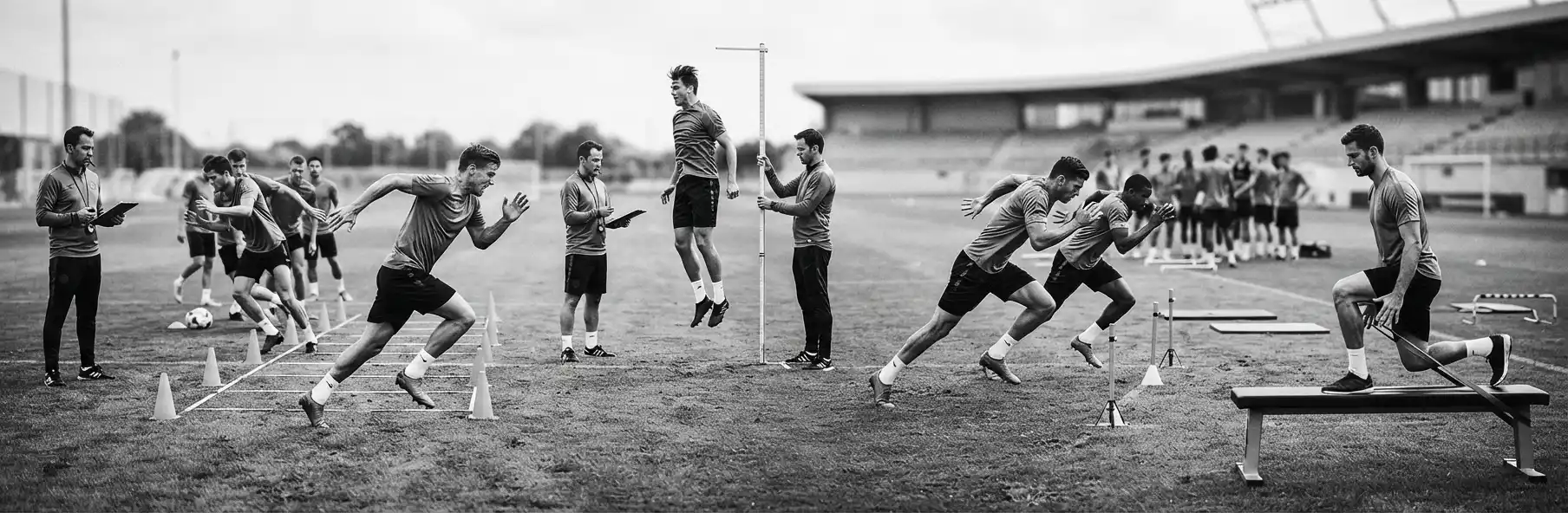
Pre-Season Fitness Testing in Football: Assessing Player Condition on Return
A pre-season fitness testing battery for the first days back: Yo-Yo IR1, RSA, jumps and strength. how to measure each player's real condition.
Written by
João Araújo
Physical Education Teacher (FADEUP – University of Porto) · Futsal Coach – Level II · UEFA B License · Master’s in Physical Education
15 years teaching Physical Education in schools, 20 years coaching futsal at youth development level and 5 years coaching football. Federated and amateur football and futsal player.
The first pre-season session isn’t for training. it’s for measuring. Every player returns from the summer break in a different state of condition, and setting week-one loads without objective data is a blind bet. A player who comes back undertrained and receives the same volume as a teammate who kept up a proper routine is one session away from a muscle injury.
The evidence is clear: eccentric hamstring strength deficits and low intermittent aerobic capacity are among the most consistent predictors of injury in the first three weeks back. Testing on day one or two isn’t red tape. it’s what decides whether your load progression is safe or a gamble.
Why Pre-Season Is a Different Challenge
Unlike a normal in-season week, you have no recent RPE or GPS history from your own club telling you where each player stands. All you have is what they bring in from outside: one who trained independently, another who jogged occasionally, a third who spent the last three weeks of last season out with an injury. Applying the same shock microcycle to everyone ignores this variability; that’s exactly where the muscle injuries that rule players out of the opening fixtures come from.
The Plan: Day 1-2 Testing Battery
| Day | Test | What it measures |
|---|---|---|
| Day 1 (AM) | Body composition + summer routine questionnaire | Individual starting point |
| Day 1 (PM) | Yo-Yo Intermittent Recovery Test (IR1) | Intermittent aerobic capacity |
| Day 2 (AM) | RSA (Repeated Sprint Ability): 6x30m, 20s recovery | Ability to repeat maximal efforts |
| Day 2 (PM) | Nordic hamstring curl + CMJ | Eccentric strength and lower-limb power |
Phase 1: Starting Point
Before any effort, log weight, body fat percentage and a short questionnaire on what the player actually did over the break (running, gym work, nothing). This qualitative context frames the numbers that follow. two players hitting the same Yo-Yo score may have arrived there by very different routes.
Phase 2: Intermittent Capacity
The Yo-Yo IR1 remains the most transferable field test for football, because it replicates the intermittent effort pattern of a match. No expensive kit needed. just space, cones and the protocol audio. The level reached gives you an objective baseline for calibrating week-one interval volume.
Phase 3: Strength and Power
The Nordic hamstring curl flags between-leg asymmetries; one of the most reliable early warning signs for muscle injury. Pair it with a simple CMJ (contact mat or even video timing) to get a lower-limb power reading before introducing maximal sprints.
The Most Common Testing Mistakes
- Testing on the same day as the first tactical sessions. accumulated fatigue skews the results
- Comparing only against the squad average. The real value is in each player’s change from last season
- Ignoring asymmetries. A good Yo-Yo score doesn’t cancel out a dangerous unilateral strength deficit
- Never retesting. A single day-1 battery doesn’t show whether the load progression is actually working
🔧 Useful Tool
Logging results on paper scatters them across folders nobody ever revisits. The SportsLabTools Stats Tool lets you centralise each player’s results and compare them directly against last season, player by player.
Communicating Results to the Squad
The numbers only matter if they drive visible decisions. Explain to each player what their result means for their individual load plan. not just the raw score, but the reasoning behind the progression they’ll follow over the coming weeks. This cuts down resistance when a player is held back from a higher-intensity drill in the first few days.
See also: Evaluating Players During Pre-Season and Settling the Final Squad. how to cross-reference this physical data with tactical and technical assessment.
Checklist: Pre-Season Testing Battery
- Body composition and summer routine questionnaire on day one
- Yo-Yo IR1 completed before the first high-intensity sessions
- RSA to measure repeated maximal-effort capacity
- Nordic hamstring curl to flag asymmetries
- CMJ as a lower-limb power baseline
- Results centralised and compared against last season
- Individual load plan communicated to each player
Conclusion
The day 1-2 testing battery isn’t a formality. it’s the map that decides whether your load progression protects players or exposes them. Measure before you train, and you’ll train afterwards with the numbers on your side, not against you.
Don’t set loads blind this pre-season. Use the SportsLabTools Stats Tool to compare each player’s condition against last season and adjust the plan accordingly.
Optional accelerator · the tool is always free
Reliable stats as soon as the next match
An action taxonomy ready for live logging from the bench, with pitch and goal location already active — heat maps and shot maps without configuring anything.