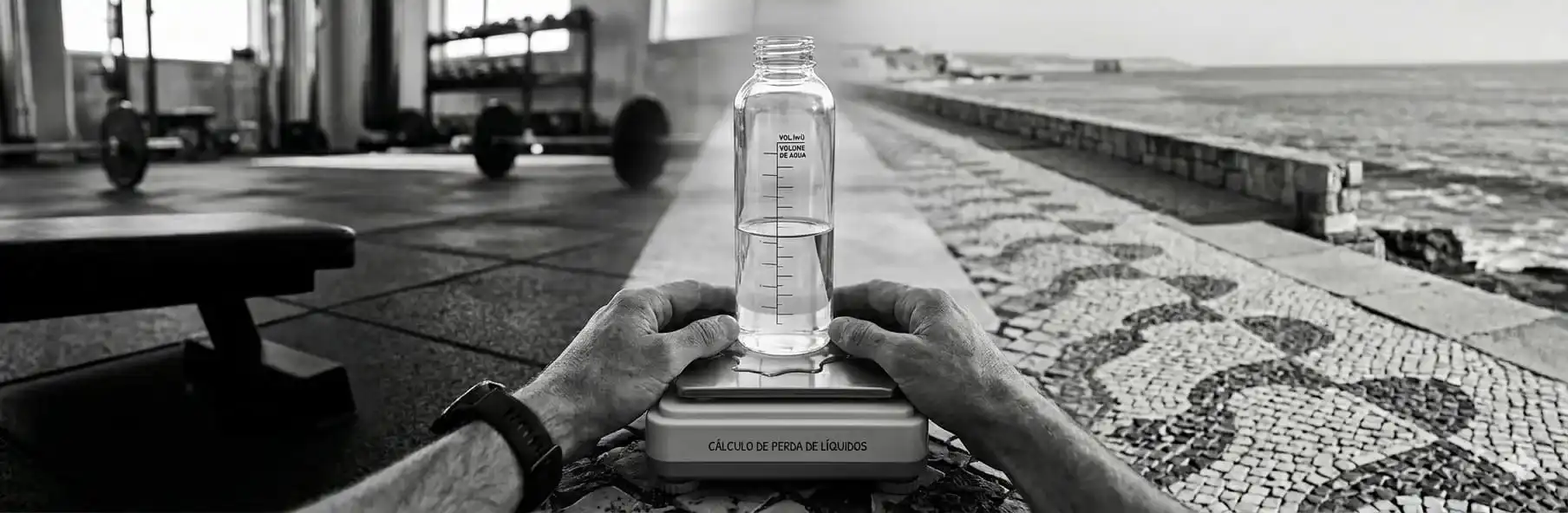
Hydration in Sport: How to Calculate Your Fluid Loss
Learn how to calculate your sweat rate, understand the impact of dehydration on performance, and build a practical hydration strategy for training and competition.
Written by
João Araújo
Physical Education Teacher (FADEUP – University of Porto) · Futsal Coach – Level II · UEFA B License · Master’s in Physical Education
15 years teaching Physical Education in schools, 20 years coaching futsal at youth development level and 5 years coaching football. Federated and amateur football and futsal player.
It was the second half. My legs felt heavy, my mouth was dry, and every step seemed to cost twice the effort. When the referee signalled half-time, I had the feeling my body had entered emergency mode. I later understood: I was dehydrated; I had ignored every warning sign.
This is not a rare story. It is the account any athlete has lived through, or will live through, if they do not learn to manage their hydration.
Why Hydration Is a Performance Factor
Water makes up between 60% and 70% of an adult’s body weight. In the muscles, that figure rises to nearly 75%. Any change in this balance directly affects both physical and cognitive capacity.
Research shows that dehydration of just 2% of body weight can cause:
- A 10 to 20% reduction in muscular strength
- A 20 to 30% drop in aerobic capacity
- Reduced concentration and reaction time
- A higher perceived effort at the same intensity
At 5%, the risk of collapse becomes real.
How Your Body Loses Fluids
The main route of fluid loss during exercise is sweating. The body uses perspiration to regulate its internal temperature. It is a survival mechanism. But the cost is hydric.
The amount of sweat varies considerably from one athlete to another, depending on:
- Ambient temperature and humidity
- Intensity and duration of exercise
- Physical conditioning (better-trained athletes begin sweating earlier and in greater quantities)
- Type of clothing and equipment
An athlete can lose between 0.5 and 2.5 litres of sweat per hour during moderate to intense exercise. In extreme heat, those figures can be even higher.
How to Calculate Your Sweat Rate
This is the most practical tool any athlete can use; no special equipment is required:
1. Weigh yourself before training (without clothing, with an empty bladder, after drying off any warm-up sweat)
2. Weigh yourself immediately after training (without drinking during the session, or recording exactly how much you drank)
3. Apply the formula:
Fluid loss (L) = Weight before (kg) − Weight after (kg) + Fluid consumed during (L)
For example:
- Weight before: 72.5 kg
- Weight after: 71.2 kg
- Fluid consumed: 0.5 L
Total loss = (72.5 − 71.2) + 0.5 = 1.8 L
If the session lasted 90 minutes, the sweat rate is approximately 1.2 L/hour.
With this figure, you can plan your fluid intake precisely for future training sessions and competitions.
The Signs Your Body Sends
When dehydration begins, the body communicates. often before you feel thirsty:
| Dehydration Level | Symptoms |
|---|---|
| 1% | Mild thirst, slight performance reduction |
| 2% | Increased fatigue, difficulty concentrating |
| 3–4% | Headaches, cramps, muscular weakness |
| 5%+ | Dizziness, nausea, risk of collapse |
Important: thirst is a late indicator. By the time you feel thirsty, you are already in a hydric deficit. Do not wait for thirst to drink.
A simple way to monitor hydration status is to observe the colour of your urine: it should be pale yellow. Dark urine signals dehydration; colourless urine may indicate over-hydration.
Hydration Strategy: Before, During and After
Before Training or Competition
Start well hydrated. In the 2 to 4 hours before exercise, consume 400 to 600 ml of water. In the 15 to 20 minutes beforehand, a further 200 to 300 ml.
During Exercise
For efforts lasting less than 60 minutes, water is sufficient. For longer efforts:
- Drink 150 to 250 ml every 15 to 20 minutes
- Do not wait for thirst
- Prefer cool drinks (10–15°C). They are absorbed more quickly
After Training
For every kilogram lost during exercise, replace 1.2 to 1.5 L of fluid in the hours that follow. not all at once, but gradually.
Beyond Water: The Role of Electrolytes
When you sweat, you lose more than water. You also lose electrolytes. primarily sodium, potassium, and magnesium. These minerals are essential for muscular and nervous function.
In long sessions (over 60–90 minutes) or in hot conditions, replacing only water can dilute plasma electrolytes and trigger hyponatraemia. A potentially serious condition.
In these contexts, consider drinks or foods with sodium and potassium content for a complete recovery.
Sodium and potassium losses through sweat are only part of the picture. magnesium plays an equally important role in muscle function and cramp prevention. Read our guide on the role of magnesium and potassium in athletic performance to see how these minerals work together with hydration.
The Equation Is Simple
Hydrating well is not complicated. It is consistent. Begin by knowing your sweat rate, adjust your fluid intake to the training or competition context, and monitor the signals your body sends.
Do not wait until the second half to realise you failed before kick-off.
Performance begins before the opening whistle. It begins with the bottle.