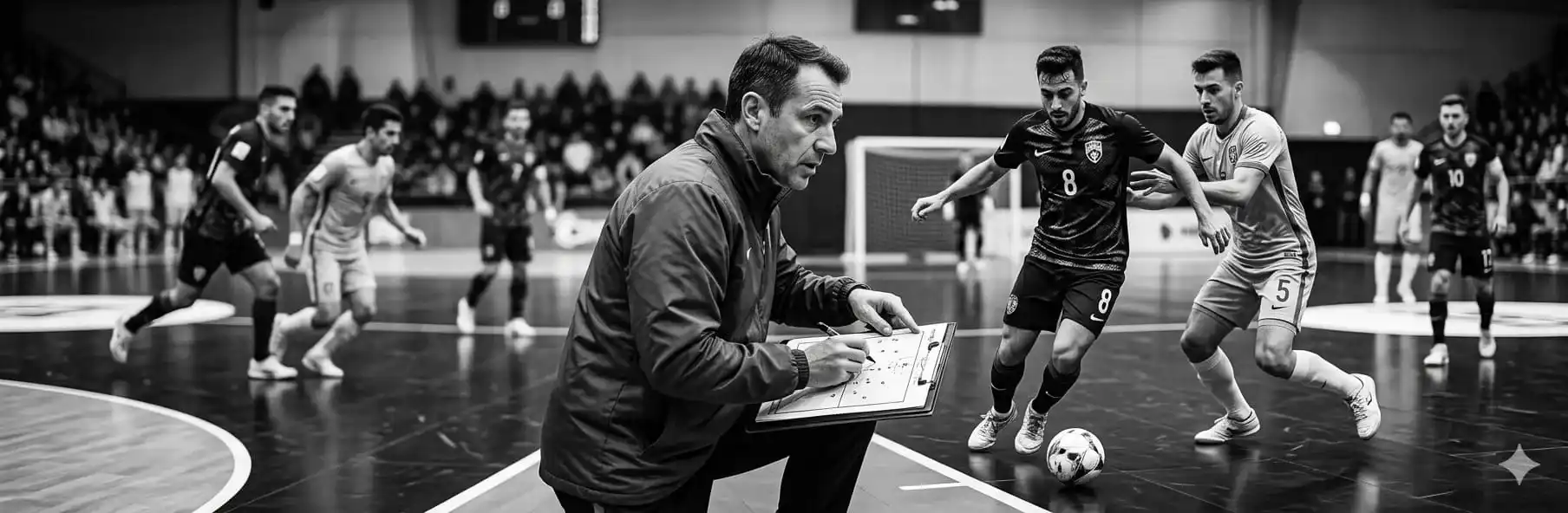
How to Identify Your Next Opponent's Attack Patterns in Futsal (Practical Scouting)
Practical scouting guide for amateur and youth futsal: how to observe and record your next opponent's offensive patterns with a focus on corners, the pivot and pressure exits.
Written by
João Araújo
Physical Education Teacher (FADEUP – University of Porto) · Futsal Coach – Level II · UEFA B License · Master’s in Physical Education
15 years teaching Physical Education in schools, 20 years coaching futsal at youth development level and 5 years coaching football. Federated and amateur football and futsal player.
You don’t need to be an analyst at a professional club to scout your next opponent. With a match recording, a clear framework of what to look for and a tagging tool, any coach can identify the recurrent offensive patterns of the opposition and prepare the team to stop them. The difference between winning and losing balanced futsal matches often comes down to this homework.
What Scouting Means in Amateur Futsal
Scouting doesn’t mean having a team of analysts and hours of footage. In youth or amateur futsal, practical scouting means:
- Identifying two to three offensive patterns the opposition use repeatedly
- Understanding how their pivot moves and which zones he’s most dangerous in
- Analysing one to two rehearsed set pieces (corners or kick-ins)
- Identifying how they build attacks (preferred channel, type of pressure exit)
Objective: it’s not about knowing every individual player. it’s about identifying collective habits and preparing the team to recognise and respond to them.
The 4 Priority Elements to Observe
1. Corners. The Most Predictable Set Piece
Corners are the easiest set piece to analyse because they occur in a fixed context and the opposition tend to repeat the same sequence of movements. By analysing two to three corners, identify:
- Is there a blocking run? Who makes it?
- Does the taker always deliver to the near post, far post, or short corner?
- Is there a player who always enters from the same direction?
With this information, you assign a specific marker for the far-post runner or prepare coverage of the block.
2. Pivot Movement
The pivot is the opposition’s offensive reference and the player who will most test your central defender. Observe:
- Preferred receiving position: does the pivot tend to receive to the right or left of the box?
- Type of movement: does he use a sole turn to create separation, or does he hold up play with his back to goal?
- Entry timing: does he enter the box when the anchor has the ball, or when a cross comes from the channel?
This information defines how your anchor (or the player with pivot-marking responsibility) should anticipate and shadow him.
🔧 Useful Tool
Use the SportsLabTools Video Analysis Tool to tag the moments where the opposition take corners or where the pivot receives in a finishing position. Create labels by pattern and build a short scouting report to share with your staff before the match.
3. System and Preferred Attacking Channel
Identify which channel the opposition most frequently use to build play:
- Left, right or central?
- Do they build from the GK with organised play, or do they prefer direct balls to the pivot?
- Which player takes the most offensive initiative?
With this knowledge, you position your players to cover the highest-danger zone and designate who presses the opposition’s main creator.
4. Pressure Exit. The Most Hidden Vulnerability
Many teams have pressure exit patterns that are vulnerable to specific pressing. Observe:
- Does the goalkeeper frequently receive under pressure? How does he react?
- Is there a preferred exit player (the one who always receives the first pass)?
- Is the exit always through the same channel?
If you identify a clear pattern, you can prepare a directed press that intercepts the opposition’s preferred passing line.
How to Record Your Scouting
The record doesn’t need to be complex. A simple, effective system:
| Element | Pattern Identified | Prepared Response |
|---|---|---|
| Corners | Short corner + delivery to far post | Defend delivery channel + cover far post runner |
| Pivot | Receives left of the box, sole turn | Central defender marks on the inside, doesn’t allow him to turn |
| Channel | Build-up through right channel with winger | Left winger closes passing zone + anchor covers central lane |
| Pressure exit | Always pass to the anchor in the centre | Double press on anchor from first touch |
How Much Time to Dedicate to Scouting
For amateur and youth futsal, 30 to 45 minutes of video analysis is enough to build an effective scouting report. You don’t need to watch the full match. focus on:
- All offensive corners and kick-ins (10 to 15 minutes)
- Situations where the pivot received in a finishing position (10 minutes)
- Three to four attacking transitions to identify the preferred channel (10 minutes)
Conclusion
Practical futsal scouting doesn’t require professional resources. It requires focus, a framework and a tool that allows you to tag and organise the relevant moments. With two to three patterns identified and communicated to the team, tactical preparation for a match improves significantly.
The opposition will have patterns. The only question is whether you’ll observe them beforehand or learn about them during the match.
Analyse your next opponent efficiently. Use the SportsLabTools Video Analysis Tool to tag offensive patterns, create thematic labels and build your scouting report before the match.
Optional accelerator · the tool is always free
Start tagging matches without spending hours building categories
An analysis model with 12 categories and more than 60 actions organised by game moment, already carrying individual/collective context and pitch and goal location. Import it and tag your first clip right away.