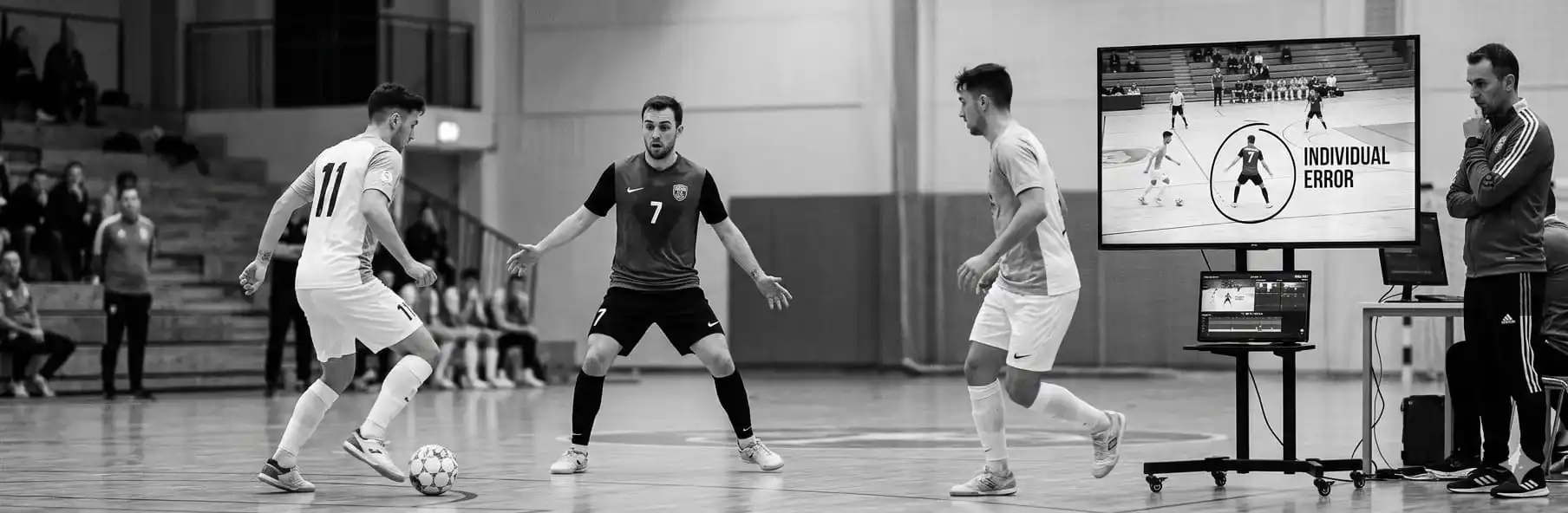
Individual Errors in Man-Marking in Futsal: How Video Can Help Your Winger
Identify the 4 most common winger errors in individual marking in futsal and learn how to use video analysis to correct them with precision and effectiveness in training.
Written by
João Araújo
Physical Education Teacher (FADEUP – University of Porto) · Futsal Coach – Level II · UEFA B License · Master’s in Physical Education
15 years teaching Physical Education in schools, 20 years coaching futsal at youth development level and 5 years coaching football. Federated and amateur football and futsal player.
The winger is one of the most demanding roles in futsal: attacking with width, defending with intensity, covering the wide channel and contributing to pressure exits. In individual marking, the winger is typically the most exposed: their direct opponent is usually the opposition’s most creative wide player, and one marking error in the channel opens the most direct route to goal.
The problem is that individual marking errors are subtle. Most of the time, a winger doesn’t lose their man through lack of effort. they lose them through a detail of positioning, reading or visual contact that is only visible when the video is frozen at the exact moment.
Why Video Is the Right Tool for This Problem
Verbal correction during training has its limits: the player hears the criticism but has no mental image of the error they committed. With video, the winger sees exactly the moment their position broke down, understands the direct consequence and has a concrete reference to correct from.
Frame-by-frame analysis allows precise identification of:
- When the defender lost visual contact with the ball
- When the gap to the opponent was incorrect
- The exact moment the passing lane opened because of the positioning
The 4 Most Common Winger Errors in Man-Marking
Error 1. Losing Visual Contact with the Ball
This is the most frequent error and the hardest to correct without video. The winger focuses too much on their direct opponent and momentarily loses awareness of where the ball is. At that moment, if the opponent makes a cut into the interior space, the winger cannot react in time.
On the video: find the frame where the winger turns completely to face their opponent and the ball is outside their field of vision. From that moment, the ability to anticipate movement is compromised.
Correction: individual marking should be held in a half-moon position. the winger must always be at an angle that allows them to see both the opponent and the ball simultaneously, without turning their back on either.
Error 2. Incorrect Marking Distance
There are two opposite distance errors:
- Too close: the opponent turns easily or spins away
- Too far: there is time and space to receive and turn before being pressured
On the video: visually measure the distance between the defending winger and their opponent at the moment the ball is arriving. The ideal distance allows pressing before the opponent controls, but not so close that a turn leaves you behind.
Error 3. Wrong Side of the Opponent
Depending on where the ball is, the defender should be on the danger side. between the opponent and the goal, or between the opponent and the incoming passing lane.
On the video: at the moment of the cross or pass, check whether the winger is between the opponent and the goal, or on the opposite side to the pass. If the pass arrives on the opposite side to the defender, the opponent receives with a full step’s head start.
Error 4. Not Tracking Screening Runs
In set pieces or rehearsed plays, the opponent may use a teammate to set a screen and create separation from the winger. If the winger doesn’t anticipate the screen, they lose their man completely for one to two seconds. enough time for a decisive shot or pass.
On the video: in opposition corners and kick-ins, watch whether the defending winger saw the screen forming. Most of the time, they were looking elsewhere.
🔧 Useful Tool
Use the SportsLabTools Video Analysis Tool to isolate the passages where your winger lost their marking. The frame-by-frame function allows precise identification of the exact moment of the positioning error, visual contact loss or distance problem. and shows the player the concrete image of what needs to be corrected.
How to Use Video in an Individual Correction Session
The video session focusing on the winger should be individual or in a small group (two to three players with similar defensive responsibilities). The ideal format:
- The error clip (10 to 12 seconds). no initial comment
- Question to the player: “What do you see here that could be improved?”
- Frame-by-frame analysis of the critical moment
- Positive reference clip. the same type of situation handled correctly
- Concrete proposal: “In the next session, we work on the half-moon position in 1v1 marking”
This approach transforms video into a tool for the player’s self-awareness, not just external criticism.
Checklist: Winger Individual Marking
| Element | Correct | Problem |
|---|---|---|
| Visual contact | Ball and opponent visible simultaneously | Turns completely to face opponent |
| Distance | 0.5–1 metre. pressure before control | Too far away or too tight |
| Lateral position | Pass side or goal side | Opposite to the danger |
| Screens | Anticipates and goes around | Doesn’t see screen forming |
| Transition | Immediate recovery after loss | Stands still after losing possession |
Conclusion
Individual marking in futsal is one of the hardest skills to correct through verbal instruction alone. Video. and specifically frame-by-frame analysis. gives the coach and player the precise visual evidence of what’s happening at the critical moment.
With four specific errors identified and addressed, the winger goes from a technically competent player to a reference defender in the wide channel.
Identify your winger’s marking errors with precision. Use the SportsLabTools Video Analysis Tool to isolate critical passages and show the player the exact moment the marking broke down.
Optional accelerator · the tool is always free
Start tagging matches without spending hours building categories
An analysis model with 12 categories and more than 60 actions organised by game moment, already carrying individual/collective context and pitch and goal location. Import it and tag your first clip right away.