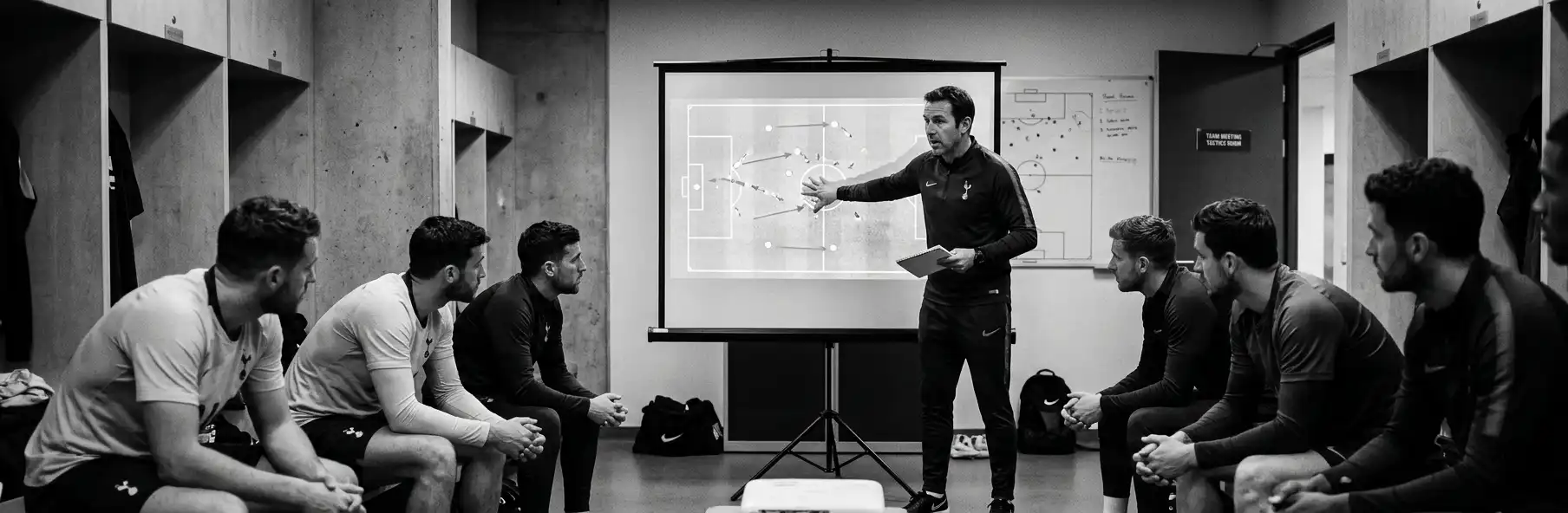
Pre-Match Video in Football: Weekly Plan, Unit Meetings and Set Pieces
How to spread football pre-match video across the week: the opponent presentation, unit meetings, set pieces with named marking jobs and the final 8 minutes on matchday.
Written by
João Araújo
Physical Education Teacher (FADEUP – University of Porto) · Futsal Coach – Level II · UEFA B License · Master’s in Physical Education
15 years teaching Physical Education in schools, 20 years coaching futsal at youth development level and 5 years coaching football. Federated and amateur football and futsal player.
A football team has 11 players on the pitch, several units to coordinate and, in every game, plenty of corners and free kicks to attack or defend. Trying to fit all of that into one video meeting before the warm-up always gives the same result: 30 minutes of clips, a squad that switches off by the fifth one and players who walk out without knowing who they mark at the first corner.
In football, pre-match video works better spread across the week. This guide shows how to split the preparation into short sessions, for the team, for each unit and for set pieces, and what is left for matchday.
In this article
- Why one meeting is not enough in football
- Video across the week
- How many clips and how long
- The opponent presentation
- Unit meetings
- Set pieces: marking jobs with names
- Matchday: the final 8 minutes
- Common mistakes
Why one meeting is not enough in football
Cognitive load theory starts from a simple principle: all new information first goes through working memory, which has limited capacity and duration, before it is stored in long-term memory (Sweller et al., 2019). If too much new information arrives at once, little of it stays. A player minutes before a game, with the anxiety of competition, has even less room.
Football combines three factors that fill that room quickly:
- Many players with different jobs. What the centre-back needs to know about the opposing striker is of no interest to the left winger.
- A big pitch, many scenarios. Build-up, mid block, transitions, runs in behind, play down the flanks.
- Many set pieces. Corners, wide free kicks, direct free kicks and long throws, attacking and defending.
A study of 14 England youth football coaches, who had used video for more than 3 years, built a model of how they deliver video. The model brings together three dimensions: the context, the delivery approach and the outcome the coach is looking for (Groom et al., 2011). That is the logic of the video week: each session has an audience and a goal, and the delivery changes with them.
Video across the week
Example for an amateur team that trains on Tuesday, Wednesday and Friday and plays on Sunday:
| Day | Session | Who | Length | Content |
|---|---|---|---|---|
| Tuesday | Last game review | Squad | 15 minutes | What went well and badly in the previous game |
| Wednesday | Opponent presentation | Squad | 15 minutes | System, build-up, pressing, strengths |
| Friday | Unit meetings | Defence, midfield, attack | 6 minutes each | Each unit’s duel with the opponent |
| Friday | Set pieces | Squad | 8 minutes | Opponent corners and free kicks, marking jobs |
| Sunday | Final meeting | Starting eleven and subs | 8 minutes | 3 messages and clips of the team’s own success |
Wednesday’s video is shown before training, so the players train straight away what they have seen. Friday’s unit meetings can run in parallel, if you have two assistants, or one after another while the others do the activation.
How many clips and how long
| Session | No. of clips | Length of each clip | Rule |
|---|---|---|---|
| Opponent presentation | 8 to 10 | 8 to 15 seconds | One pattern per clip, shown in 2 different games |
| Each unit meeting | 3 to 4 | 5 to 10 seconds | Only actions involving that unit |
| Set pieces | 6 to 8 | 5 to 8 seconds | The movement and the taker, never the whole play |
| Final meeting | 4 to 5 | 5 to 8 seconds | 3 messages and finish with 2 success clips |
Showing the same pattern in two different games of the opponent proves it is a habit and not chance. If you only find it once, it is not worth a clip.
The opponent presentation
On Wednesday, the squad sees the opponent for the first time. Organise the session by phases of play and close each phase with a sentence the players can repeat.
Example with a fictional opponent, Riverside United:
| Phase | What the video shows | Message |
|---|---|---|
| Build-up | Builds with three at the back and the holding midfielder drops between the centre-backs | “We press the midfielder who drops, not the centre-backs” |
| Attacking organisation | Attacks mostly down the right, with a fast winger | “Our left-back is never left 1v1 without cover” |
| Defensive transition | Slow to reorganise when losing the ball in midfield | “Ball won in midfield, first pass forward” |
| Defensive organisation | Mid block, high defensive line | “Runs in behind at the first chance” |
Four phases, four messages. The rest of what you know about the opponent stays with you and the coaching staff.
🔧 Useful Tool
Tag the opponent’s patterns directly on the match video with SportsLabTools Football Video Analysis. Create categories by phase (“build-up”, “corners”, “transition”) and filter the timeline by category to put together each session of the week in minutes, instead of searching the full game.
Unit meetings
On Friday, each unit sees only its own duel. This is where video moves from the collective to the individual.
- Defence (4 to 5 players, plus the goalkeeper): the height of the line, the opposing striker’s movements, who steps out to the fast winger and who tucks in, long balls in behind.
- Midfield (3 to 4 players): who presses the midfielder who drops, how to close the inside passing lanes, cover for the full-backs.
- Attack (3 players): pressing triggers, each centre-back’s weaker foot, the space behind the high line.
Six minutes per unit is enough. End each meeting with a question to the players (“what do you do when the midfielder drops between the centre-backs?”) and wait for the answer. If they cannot answer, there is still time to train it on Friday.
Questions are what video sessions lack most. One study filmed 22 sessions by 4 elite youth football coaches. The most used behaviour was coach feedback, followed by silence, player involvement and, last, questioning. The authors describe a mainly prescriptive approach: the coach talks, the players listen (Raya-Castellano et al., 2020).
The small group helps too. Interviews with 11 coaches and 12 players in elite youth football showed that players’ psychological reactions during the session, the delivery and the climate in the room influence what video can achieve (Middlemas and Harwood, 2018). The study’s title, “no place to hide”, sums up how a player feels watching their own mistake in front of the whole squad. In a meeting of four, the correction weighs less.
Set pieces: marking jobs with names
Set pieces are where video pays off most, because the movements repeat from game to game. Show the 2 or 3 corners and free kicks the opponent uses most and, straight after, each player’s job, with a name.
Example for defending Riverside United’s corners, which are mostly in-swinging to the near post:
| Job | Player | Reference |
|---|---|---|
| Near-post zone | Liam | Attack the first ball, nobody in front of him |
| Centre of the six-yard box zone | Marco | Clear everything that drops between the posts |
| Marking no. 9 (strong in the air) | Ethan | Contact from the start of the run |
| Marking no. 5 | Noah | Follow the block, not the ball |
| Marking no. 4 | Oliver | Stop the run to the far post |
| Edge of the box | Leo | Second balls and shots from distance |
| Counter-attack | Jack | Stays near halfway to pin 2 defenders |
Print the table and put it up in the dressing room. In Friday’s video, each player sees the clip of the movement they will have to stop.
Matchday: the final 8 minutes
On Sunday, the meeting confirms what has already been worked on. It adds nothing.
| Minutes | Content |
|---|---|
| 0-1 | The game plan in one sentence |
| 1-5 | 3 key messages from the week, each with 1 or 2 clips |
| 5-6 | Set-piece reminder: “Liam near post, Ethan on the 9” |
| 6-8 | 2 success clips of the team itself in training or in the last game |
The last image stays in the player’s head until kick-off. Make it a goal, a ball recovery or a clean build-up by the team itself, never a mistake or a goal conceded.
🔧 Useful Tool
Keep the clips for each session of the week in analysis sessions in SportsLabTools Football Video Analysis. On Sunday, you open the final session and show the right 4 or 5 clips without searching for anything on the spot.
Common mistakes in football pre-match video
- One single meeting of 30 to 40 minutes with everything prepared during the week.
- Showing all 11 what only matters to one unit. The centre-backs switch off when the talk is about the striker’s pressing, and vice versa.
- Set pieces without names. “We mark zonally” tells nobody where to stand.
- Bringing in new information on Sunday that was not trained during the week.
- Showing a pattern seen only once as if it were a habit of the opponent.
- Ending with a goal conceded.
- Building the clips on the day, in a rush, from the full game.
Checklist: pre-match video in football
- Opponent presentation mid-week, before a training session
- 4 phases, 4 messages, 8 to 10 clips
- 6-minute unit meetings, each with a final question
- Set pieces with a marking table and names
- Set-piece table up in the dressing room
- 8-minute final meeting, with no new information
- Last clips show the team’s own success
- Clips prepared and saved during the week
See also: Post-Match Video Analysis in Football: What to Show Players on Monday closes the cycle with the game review, which feeds Tuesday’s session.
Sources
All sources have the full text available for free.
- Sweller, J., van Merriënboer, J. J. G. and Paas, F. (2019). Cognitive architecture and instructional design: 20 years later. Educational Psychology Review, 31(2), 261-292. Open access.
- Groom, R., Cushion, C. and Nelson, L. (2011). The delivery of video-based performance analysis by England youth soccer coaches: towards a grounded theory. Journal of Applied Sport Psychology, 23(1), 16-32. Accepted version in the University of Hull repository.
- Raya-Castellano, P. E., Reeves, M. J., Littlewood, M. A. and McRobert, A. P. (2020). An exploratory investigation of junior-elite football coaches’ behaviours during video-based feedback sessions. International Journal of Performance Analysis in Sport, 20(4), 729-746. Accepted version in the Liverpool John Moores University repository.
- Middlemas, S. and Harwood, C. (2018). No place to hide: football players’ and coaches’ perceptions of the psychological factors influencing video feedback. Journal of Applied Sport Psychology, 30(1), 23-44. Accepted version in the Loughborough University repository.
Conclusion
In football, pre-match video does not fit in one session. Spread across the week, each player sees what they need: the team plan on Wednesday, their duel and their marking job on Friday, and three messages and two successes on Sunday. The team walks out with fewer clips in their heads and more certainty about what to do.
Plan the video week, from the opponent presentation to set pieces, with SportsLabTools Football Video Analysis.
Optional accelerator · the tool is always free
Start tagging matches without spending hours building categories
An analysis model with 12 categories and more than 60 actions organised by game moment, already carrying individual/collective context and pitch and goal location. Import it and tag your first clip right away.