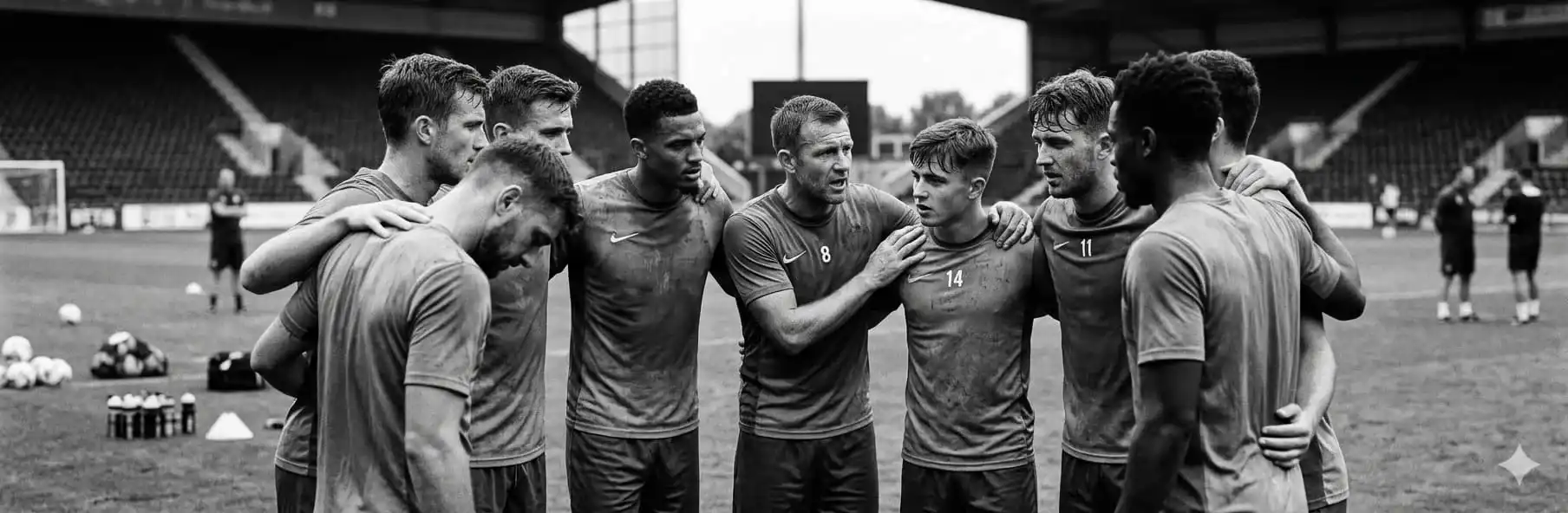
The Psychology of Pre-Season (Football): How to Build a Collective Mindset Early
How to use football pre-season to build group cohesion, competitive mindset and team identity from the very first training session, without empty motivational speeches.
Written by
João Araújo
Physical Education Teacher (FADEUP – University of Porto) · Futsal Coach – Level II · UEFA B License · Master’s in Physical Education
15 years teaching Physical Education in schools, 20 years coaching futsal at youth development level and 5 years coaching football. Federated and amateur football and futsal player.
Most teams arrive at the first match of the season with the tactical system installed but the collective mindset still not built. Then they wonder why players don’t communicate, why there are difficulties under pressure, why the group doesn’t function as a unit.
Collective mindset is not created in a speech. It is created through repeated experiences, shared challenges, decisions made together, established behavioural norms. And pre-season is the only time of year with sufficient training density to create those experiences in an accelerated way.
The Problem: Why Many Teams Fail to Build Mindset
The most common mistake: managers who treat pre-season purely as physical and tactical preparation, completely ignoring the psychological and social dimension of the group. The result is predictable: they arrive at matchdays 5 or 6 with players who still don’t trust each other, who avoid risk, who don’t communicate under pressure.
Collective mindset is not a state that appears spontaneously. It is a product of what the manager does or does not do in the first weeks.
The Solution: Football Pre-Season Psychology
Week 1. Establish the Norms
The first days of pre-season are the most powerful moment for establishing norms. The group is still in observation mode, watching what is acceptable, what is valued, how the manager reacts. This is the moment when behavioural norms become embedded.
Concrete actions:
- Initial meeting with the group: what you expect of them, what they can expect of you
- Define behaviours explicitly: punctuality, communication on the pitch, effort in training
- React immediately and consistently when a norm is violated, not punitively, but clearly
- Publicly value the behaviours you want to see repeated
Week 2. Create Shared Challenge Experiences
Group cohesion is not created in talks. It is created when the group faces something difficult together. Physically demanding team exercises, internal mini-tournaments with competitive pressure, training situations where communication is required for success, these are the experiences that create connection.
Exercises that create cohesion:
- Physical training sessions in mixed groups (seniors + younger players)
- Internal mini-tournament with cumulative points across several sessions
- Mandatory communication exercises: rondos where failure to communicate costs the team a point
- Timed transition games: ball recovery within the first 5 seconds after losing possession, creates shared urgency and anchors the collective pressing behaviour that will define your playing identity
🔧 Useful Tool
Tracking the emotional state of players, motivation, energy, wellbeing, throughout pre-season allows the manager to intervene early when a player is disconnected or struggling. The SportsLabTools Football Athlete Journal lets players log their daily state, giving the manager a view of the group that training alone does not provide.
Week 3. Build Team Identity
A team with identity knows what it is, how it plays, what it stands for, what distinguishes it. That identity cannot be imposed by the manager: it must emerge from a conversation between the manager and the group.
How to build identity:
- Facilitated meeting: “How do we want to be known this year?”, 3 words that define the team
- The manager articulates the game model in terms of values, not just tactics: “We’re a team that presses high because we believe collective effort beats individual talent”
- The words chosen by the group become a reference point in conversations throughout the season
Week 4. Test Under Pressure
In the friendlies of the final weeks, the mindset that has been built is tested. The manager observes: how does the group react when losing? Is there communication? Is there mutual support? Is there accountability without blame?
What happens in friendlies, the group’s emotional response, is a more reliable indicator of the season ahead than the results of the matches.
Checklist: Football Pre-Season Psychology
- Initial meeting with the group in the first days (mutual expectations)
- Behavioural norms defined and explicitly communicated
- Manager reacts consistently when norms are violated
- Shared challenge exercises in weeks 2 and 3
- Team identity conversation (3 words that define us)
- Player emotional state tracked throughout pre-season
- Group’s emotional response observed during friendlies
Conclusion
The pre-season that builds mindset is the one where the manager treats the group as a social system, not just as a set of bodies to prepare physically. Teams that arrive at matchday 1 with cohesion, identity and clear norms have an advantage that does not show up in physical or tactical data. It is the hardest advantage to measure and the most valuable to have.
See also: How to Evaluate Players During Pre-Season and Define Your Final Squad
Track the emotional and motivational state of your players throughout the entire pre-season. Use the SportsLabTools Football Athlete Journal to collect daily wellbeing data that complements the manager’s pitch-side observation.