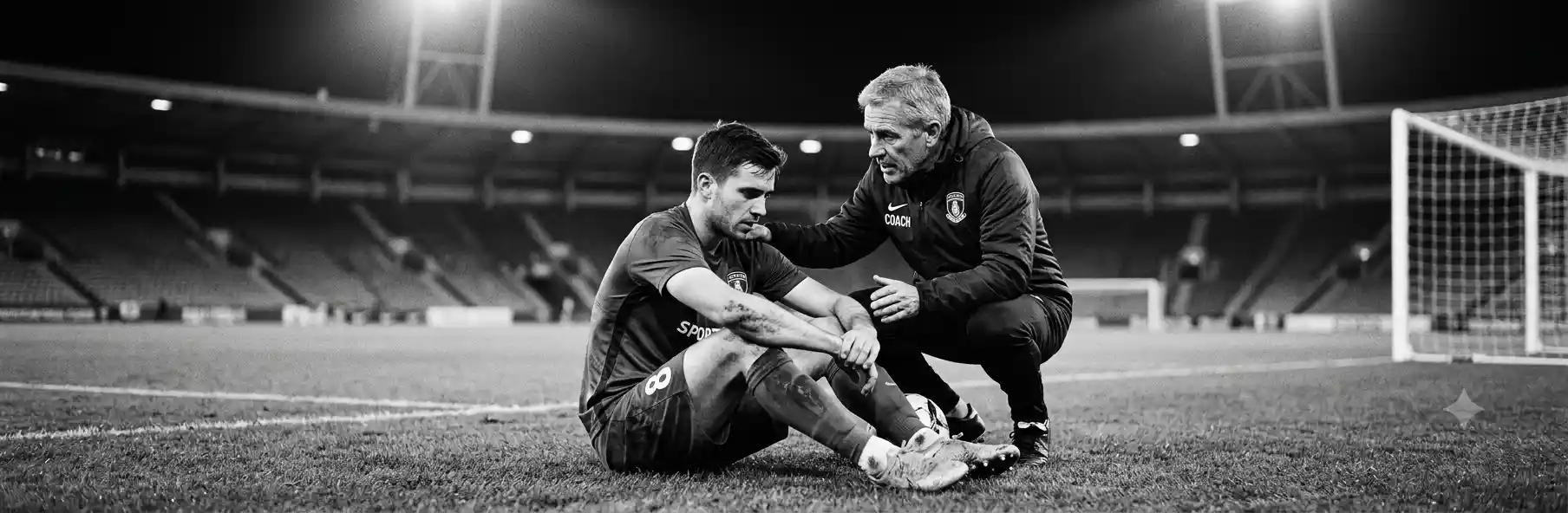
How to Rebuild a Player's Confidence After a Costly Mistake in Football
A psychological guide for managers: how to help a footballer recover confidence after an error that cost the team goals or points.
Written by
João Araújo
Physical Education Teacher (FADEUP – University of Porto) · Futsal Coach – Level II · UEFA B License · Master’s in Physical Education
15 years teaching Physical Education in schools, 20 years coaching futsal at youth development level and 5 years coaching football. Federated and amateur football and futsal player.
Your centre-back misplaces a pass on the edge of his own box in the 88th minute and the team loses all three points. On Monday he arrives at training silent, avoids the group’s eyes, and in the first possession drill plays everything backwards, safe. It’s not a lack of quality, it’s the mistake playing on loop inside his head. And how you, the manager, handle the next seven days will decide whether he returns to being the player he was or spirals for months.
The costly mistake is inevitable in football. Prolonged loss of confidence is not. The difference almost always lies in the response of the environment: manager, group and the player himself.
Why a Single Mistake Destroys Confidence
Sporting confidence rests on perceived competence: “I can do what my position demands.” A mistake with a visible cost (goal conceded, missed penalty, red card) attacks that perception with disproportionate force, through three psychological mechanisms:
- Negativity bias: the brain weighs one failure more than ten successes; the player remembers the misplaced pass in the 88th minute, not the 60 correct actions before it
- Rumination: the repeated mental replay of the moment, which steals focus from the present; the player still stuck in Sunday’s incident makes the next mistake on Tuesday
- Evaluation anxiety: fear of judgement (the stands, teammates, social media) changes behaviour: the player stops taking risks to avoid failing again, and playing “not to make mistakes” is playing worse
The Cost of Ignoring the Process
The manager who responds with “he’ll get over it” takes a real risk. A player in a confidence slump reduces his actions per game, hides in decisive moments and carries the tension into training. Within weeks, the individual problem becomes collective: the group loses a starter and gains a source of anxiety. In the worst cases, especially with young players, the player gives up the position or the club.
The Solution: Core Principles of Rebuilding
- Separate the mistake from identity: the central message: “you misplaced a pass”, never “you’re a failure”; the mistake is an event, not a trait
- Normalise without trivialising: acknowledge the cost (“yes, it cost points”) and frame it (“every player in your position goes through this; what matters is the response”)
- Return to process, not outcome: confidence rebuilds on controllable behaviours: positioning, communication, aggression in the duel, not on “you can’t make another mistake”
- Gradual, planned re-exposure: the player needs to perform the action he failed at again, first in training, then in matches, with a high probability of success at the start
Application: Concrete Strategies for the Following Week
The one-to-one conversation (24-48h later)
Not in the heat of the post-match. A three-part structure: first listen (“how are you living with this?”), then frame the facts, with video if it helps (the error often had collective origins: a passing option nobody offered), and finally agree the week’s plan together. End with a clear expectation: “I’m counting on you.”
Training as re-exposure
Design drills where the player repeats the action he failed at with frequent success: if the mistake came playing out from the back, use possession games where he’s the free man in overload. Raise the difficulty through the week. The goal is to replace the replay of the failure with fresh repetitions of success.
Managing the group and selection
The dressing room follows the leader: if the manager treats the error with competent normality, so does the group. On selection there’s no single rule, but there’s always communication: if the player drops out of the XI, explain it’s management, not punishment; if he keeps his place, tell him before Thursday’s session, don’t let the doubt fester until the squad announcement.
🔧 Useful Tool
Confidence is rebuilt with evidence, not stock phrases. The SportsLabTools Athlete Journal lets the player log his daily mental state and lets you track the trend, concrete data to show him the curve is rising.
Special Cases: Nuances That Change the Approach
The goalkeeper lives the extreme case: his mistake is almost always a goal. He needs his own protocol and, ideally, the goalkeeping coach as the first line of support. The academy youngster has no back catalogue of successes to hold on to, rebuilding demands more training re-exposure and parent contact aligned with the club. The captain or veteran may feel added shame because of his status; the conversation should acknowledge his role in the group rather than treat him like a novice.
Also read: Mental Preparation for Decisive Matches: Managing Run-In Pressure, the mental routines that prevent confidence collapse in the highest-pressure moments.
Checklist: Responding to the Costly Mistake
| Practice | In place? |
|---|---|
| One-to-one conversation within 24-48h | ☐ |
| Error framed in its collective context (video) | ☐ |
| Gradual re-exposure plan in training | ☐ |
| Focus on controllable behaviours, not outcomes | ☐ |
| Selection decision communicated in advance | ☐ |
| Group steered towards a constructive response | ☐ |
| Mental-state follow-up in the following weeks | ☐ |
Conclusion
The costly mistake is one of the rare moments where a manager can win or lose a player for the rest of the season, and the player knows it. Treat the process with the same rigour you give to match preparation: a structured conversation, planned re-exposure, clear communication. The player who comes through a big mistake well doesn’t come back the same: he comes back more resilient. That transformation is coaching, and it’s yours to deliver.
Track your players’ mental recovery with data. Use the SportsLabTools Athlete Journal to monitor confidence and wellbeing across the season.