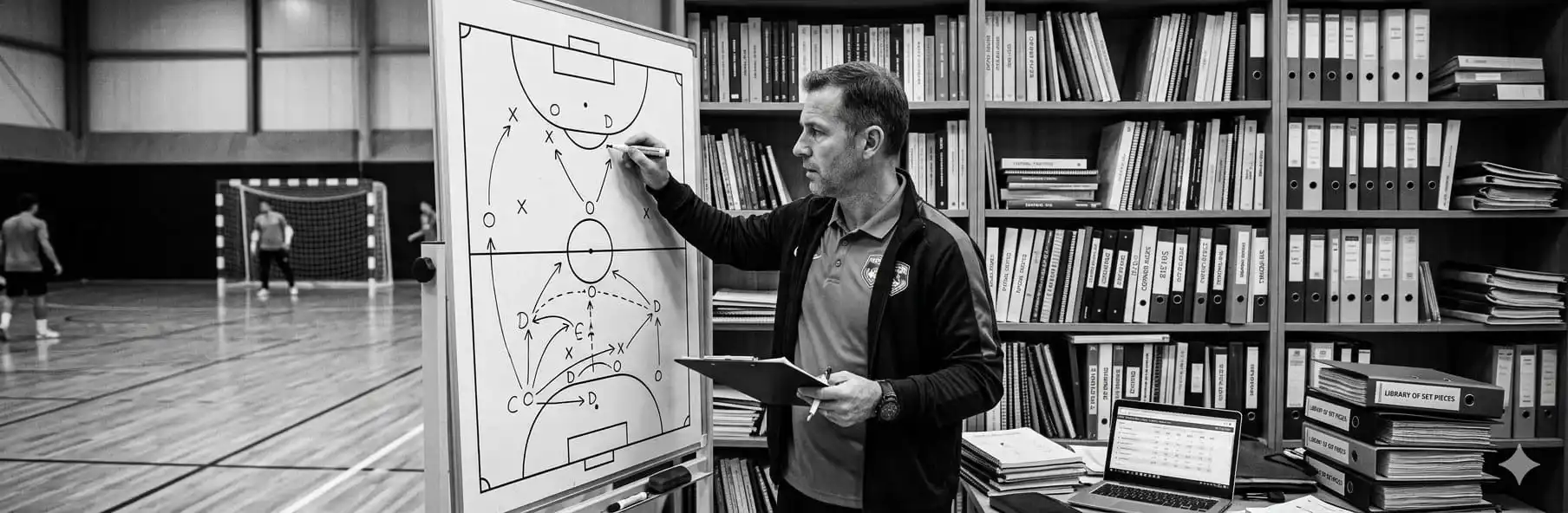
The Set Piece Scouting Guide in Futsal: Building a Corner and Kick-In Library
How to build a futsal set piece library using video analysis: cataloguing corners and kick-ins, organising by category and using your tactical idea bank to enrich your team's repertoire.
Written by
João Araújo
Physical Education Teacher (FADEUP – University of Porto) · Futsal Coach – Level II · UEFA B License · Master’s in Physical Education
15 years teaching Physical Education in schools, 20 years coaching futsal at youth development level and 5 years coaching football. Federated and amateur football and futsal player.
It’s happened before: you’re watching a match on television, the team executes a corner with a double screen that completely dismantles the defence, and you think “that routine would be perfect for my pivot.” Two days later, you can’t remember the details. Three weeks later, the video is no longer available.
A set piece library solves this problem. It’s an organised archive of corners and kick-ins collected from matches you watch, on television, on YouTube, or from your own games, that you can access at any time to enrich the tactical repertoire of your team.
Why Build a Set Piece Library
Modern futsal has an increasingly rich repertoire of rehearsed set pieces, double screens, crossed runs, short corners with combinations, progressive kick-ins. No coach can invent everything from scratch. The best coaches are, in large part, great observers who adapt what they see to the characteristics of their own team.
An organised library gives you:
- Quick access to tactical ideas tested in a real context
- Visual references to communicate to players in the dressing room
- Analysis material to understand why certain routines work
- A bank of counter-measures when scouting the opposition’s set pieces
What to Record and How to Record It
Sources of Material
- Matches on television: Portuguese Futsal League, UEFA Futsal Champions League, Brazilian Liga Nacional (Série A), Spanish Liga Nacional. Record the full match or use pause to capture relevant moments
- YouTube and social media: many federations and clubs share goal compilations and rehearsed play highlights
- Your own matches: the corners and kick-ins you train and execute in games should be the first to enter the library, they form the foundation of your game model
What to Catalogue
For each corner or kick-in you add to the library, record:
- Type of set piece: direct corner, short corner, screening corner, quick kick-in, progressive kick-in
- Attacking organisation: number of players involved, positions, blocking movements
- Opposition defensive shape: how they defended (zone, individual, mixed)?
- Outcome: goal, shot, ball recovered?
- Tactical note: what made this routine effective or ineffective?
🔧 Useful Tool
Use the SportsLabTools Video Analysis Tool to upload your set piece clips, organise by tags (direct corner, screening corner, kick-in, etc.) and build your tactical library. Tag-based categorisation lets you filter quickly by routine type when preparing for a specific match.
How to Organise the Library by Category
A disorganised library is as useless as having no library at all. The recommended structure divides entries into four main categories:
Category A. Simple Offensive Corners
Routines with two to three players, no screening, for teams who are just beginning to work on rehearsed set pieces. Easy to train and execute under pressure.
Category B. Screening Corners
More elaborate routines with one or two screens. They require more training but have a higher success rate against teams that mark individually.
Category C. Offensive Kick-Ins
Kick-ins as the starting point for organised attack, quick, combined or reset. Many teams underestimate the offensive potential of the kick-in.
Category D. Defensive Counter-Measures
Routines you’ve observed from the opposition and for which you need a specific defensive response. This category is pure scouting.
How to Use the Library in Training
The library only has value if it’s used. Suggested integration into the weekly microcycle:
| Moment | Library Use |
|---|---|
| Start of the week | Select one new set piece to introduce |
| Set piece session (Wednesday) | Show the reference clip before drilling |
| Match eve | Review the set pieces to use + scout the opposition’s |
| Post-match | Add new clips from the match just played |
How Many Set Pieces Should a Team Have in Their Repertoire
The question isn’t how many, it’s how many the team can execute with automatism. A practical guide:
- Foundation / Under-13: two corners and one kick-in, no screening
- Under-15 / Under-17: three to four corners (including one with screen) and two kick-ins
- Amateur Senior: four to five corners with variants and two to three kick-ins
- Competitive Senior: repertoire of six to eight with variants for different defensive shapes
Conclusion
A set piece library is one of the most valuable tactical assets a coach can build throughout their career. It requires no major resources, just consistency in observation, rigour in cataloguing and discipline in use.
With a video analysis tool that supports tags and category organisation, building and maintaining this library moves from a time-consuming process to something achievable in a few minutes per week.
Start building your set piece library today. Use the SportsLabTools Video Analysis Tool to upload, tag and organise your corner and kick-in clips in an always-available idea bank.
Optional accelerator · the tool is always free
Start tagging matches without spending hours building categories
An analysis model with 12 categories and more than 60 actions organised by game moment, already carrying individual/collective context and pitch and goal location. Import it and tag your first clip right away.