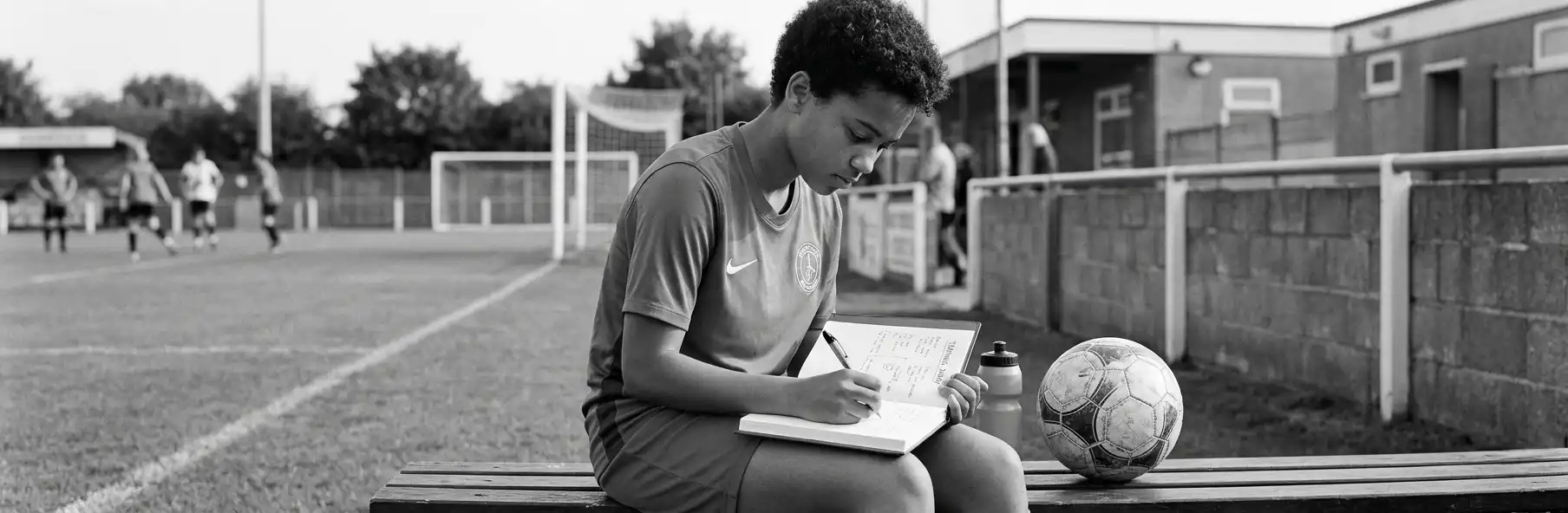
Training Journal for Young Football Players: Track Your Progress
A guide for young football players: how to keep a simple training journal to track your technical and physical progress, session by session.
Written by
João Araújo
Physical Education Teacher (FADEUP – University of Porto) · Futsal Coach – Level II · UEFA B License · Master’s in Physical Education
15 years teaching Physical Education in schools, 20 years coaching futsal at youth development level and 5 years coaching football. Federated and amateur football and futsal player.
You’ve trained three times this week, played on Saturday, and if someone asked you a month from now what you’ve improved, you probably couldn’t answer clearly. It’s not a lack of work; it’s a lack of tracking. In football, if you train without writing anything down, you’re relying only on memory, and memory forgets the details that make all the difference over a season.
A training journal isn’t just for adults or professionals. It’s for any young football player who wants to know, with facts rather than just feelings, whether they’re actually improving.
The Problem With Training Without Tracking
Without a record, every session stands alone. You can’t compare how you felt this week to a month ago, or tell whether a specific drill is genuinely improving your game. Your manager loses that information too; they only see what happens on the pitch, not how you felt getting there.
Core Principle: What’s Worth Recording
- Perceived effort (RPE): on a simple 1-10 scale, how hard the session felt.
- One strength and one area to improve per session, rather than a long description.
- Confidence before and after training or a match: on a short scale, nothing complicated.
- A goal for the next session, set at the end of the previous one.
Practical Application: How to Structure Your Journal
Log It Right After Training
Waiting until the next day loses details. Two minutes right after training or a match, still in the changing room or the car, is enough.
Always Use the Same Questions
An effective journal doesn’t change format every week. The same four or five questions, answered briefly, build a history you can compare over time.
Review the Journal Every Two Weeks
Reading what you wrote two weeks ago reveals patterns you can’t see session by session. For example, if your confidence always rises after a specific type of drill.
Common Mistakes
- Writing long entries you end up abandoning after a week.
- Logging only matches and forgetting training sessions, where most real improvement happens.
- Using the journal only for complaints, without also noting what went well.
🔧 Useful Tool
Keeping a paper journal is easy to forget or lose. The SportsLabTools Athlete Journal lets you log RPE, confidence, and notes for each session in under a minute, building an organised history you can review whenever you want.
Using the Journal to Talk to Your Manager
A well-kept journal isn’t just for you; it’s a tool for bringing concrete data to a conversation with your manager instead of just saying “I feel like I’m improving.” Showing weeks of records makes that conversation far more objective.
Also see: Individual Football Training at Home: Exercises to Improve on Your Own. Learn how to structure the extra work you’ll later log in your journal.
Checklist: My Football Training Journal
- I log RPE right after every training session or match
- I note one strength and one area to improve per session
- I log my confidence before and after competing
- I set a simple goal for the next session
- I always use the same questions, without complicating the format
- I review the journal every two weeks to spot patterns
- I use the journal as a basis for talking to my manager
Conclusion
The difference between a young player who feels they’re improving and one who knows they’re improving often comes down to a well-kept training journal. Logging isn’t paperwork; it’s the simplest way to make visible a progress that would otherwise go unnoticed, even by yourself.
Don’t leave your progress to memory alone. Use the SportsLabTools Athlete Journal to log every session and see your progress across the season.