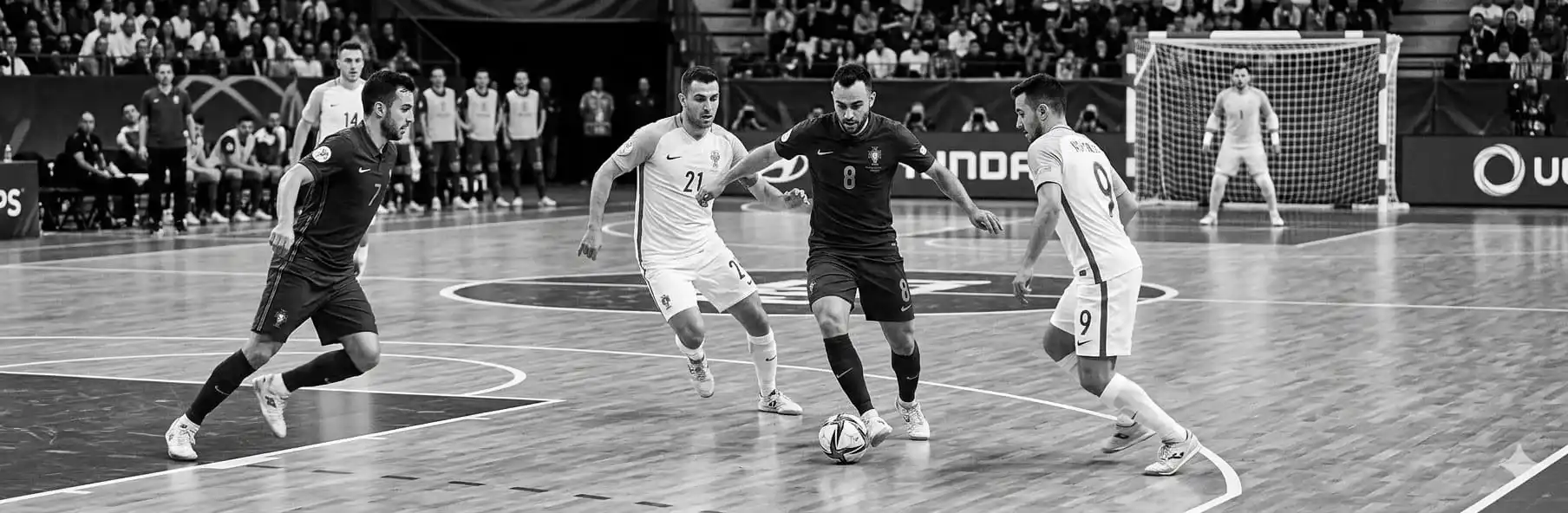
How to Break a Zone Defence in Futsal: 3 Practical Moves
Learn 3 tactical moves to disorganise a zone defence in futsal: screens, diagonal runs and corridor overloads with direct application in training.
Written by
João Araújo
Physical Education Teacher (FADEUP – University of Porto) · Futsal Coach – Level II · UEFA B License · Master’s in Physical Education
15 years teaching Physical Education in schools, 20 years coaching futsal at youth development level and 5 years coaching football. Federated and amateur football and futsal player.
You’re facing a team that completely shuts down the central corridor, denies the interior pass and waits for you to make mistakes. This is a well-organised zone defence, and without the right tools, your team may end up circulating the ball indefinitely without creating any real danger. The three moves below are designed to create structural imbalances against this type of defensive block, whether it’s set up in a diamond or square shape.
Why Zone Defence Is Hard to Break
Zone defence in futsal is effective because it removes individual references from the attack: defenders cover spaces, not players. This means moving players without moving the ball has little effect. To break the zone, you need to force simultaneous rotations in the defensive structure, opening passing lanes that are normally closed.
The two most common mistakes when attacking a zone:
- Circulating the ball laterally without creating any interior movement
- Trying to solve it individually with dribbling in tight spaces
Move 1: Diagonal Screen with Far-Post Run
How It Works
The pivot positions himself on the opposite side to where the ball is. The winger with the ball plays a short pass to the pivot/anchor, who is positioned centrally. At that exact moment, the pivot sets a screen on the nearest defender to the far post and breaks diagonally to receive.
Why It Works
The screen forces the defender to choose: go around the screen and lose time, or leave the route open for the pivot. The zone cannot react quickly enough to two simultaneous movements on opposite sides of the court.
Critical timing: the pivot’s screen must happen as the ball arrives to the anchor, not before, or the defence detects it too early.
Mistakes to Avoid
- Screen with movement (foul called)
- Anchor delaying the pass: the window is one to two seconds
🔧 Useful Tool
Draw this move with your team before training using the SportsLabTools Futsal Tactical Board. Simulate player positions, passing lanes and screen movements so you can present them clearly in the dressing room.
Move 2: Inside-Outside Combination with Pivot Pinning Defender
How It Works
The right winger passes to the anchor and makes an interior run (penetrating towards the area). The pivot, already positioned in the left corridor of the box, pins his direct marker and stays still. This pinning forces the central zone defender to cover the penetrating winger, opening the outside lane for the anchor to play back to the winger who has now drifted to the corridor.
Why It Works
Zone defence relies on collective responsibilities. When two attackers cross the same zone simultaneously, the defensive structure creates a momentary gap in the exit corridor.
Tactical key: the winger must enter with decisiveness and speed, even if he doesn’t receive the ball. His run is the mechanism that creates the space for his teammate.
Advanced Variant
The winger who ran inside can continue his movement, make a sharp stop and peel off to the far post, becoming available for a crossed shot if the outside pass isn’t on.
Move 3: Corridor Overload with Diagonal Cut
How It Works
The team intentionally overloads one corridor with three players: anchor, winger and pivot all on the same side. The zone will naturally concentrate two to three defenders in that corridor. The fourth player, the opposite winger, cuts diagonally through the centre with a defined timing to receive the long switch.
Why It Works
A compact zone only works when the ball and players are in the same sector. The overload creates the illusion of an attack on one side, opening real space on the other.
The switch pass: the anchor with the ball needs peripheral vision to spot the moment the diagonal winger’s defender is drawn across to the overloaded side. That is the moment to switch.
Adapting for Diamond vs Square Zone
- Diamond: the overload is most effective through the anchor’s corridor (the bottom vertex of the diamond is the weakest point)
- Square: the diagonal cut works best when made between the two defenders on the same side
🔧 Useful Tool
Use the SportsLabTools Futsal Tactical Board to simulate all three moves against different zone configurations. diamond or square. and adjust your player positions before presenting them in training.
Checklist: How to Attack a Zone Defence
| Element | Right | Wrong |
|---|---|---|
| Ball circulation | Quick, with changes of rhythm | Slow and predictable |
| Movement off the ball | Screens, diagonals, runs | Static or purposeless |
| Interior pass | When defensive line is open | Forced into closed zone |
| Pivot | Pins defender or sets screen | Always drops to receive |
| Screen timing | At the moment of the pass | Too early, detected by defence |
| Zone variant analysed | Diamond vs square adapted | One approach for all |
Conclusion
Breaking a zone defence requires purposeful movement, not individual pace. The three moves presented work because they create simultaneous problems in different areas of the court, and zone defence doesn’t have fast enough mechanisms to cover everything at once.
Train each move in isolation, then with passive opposition, and finally in a real situation with active defence. With the Tactical Board, visualising and communicating every detail before training becomes much more straightforward.
Simulate these moves before you arrive at the gym. Use the SportsLabTools Futsal Tactical Board to prepare your training session with tactical precision.
Optional accelerator · the tool is always free
A library of exercises instead of drawing every one
Packs of 40 exercises per theme, with an animated tactical diagram, four levels of progression, teaching points and success criteria. Import them and they stay in your library, ready to edit and present to the team.