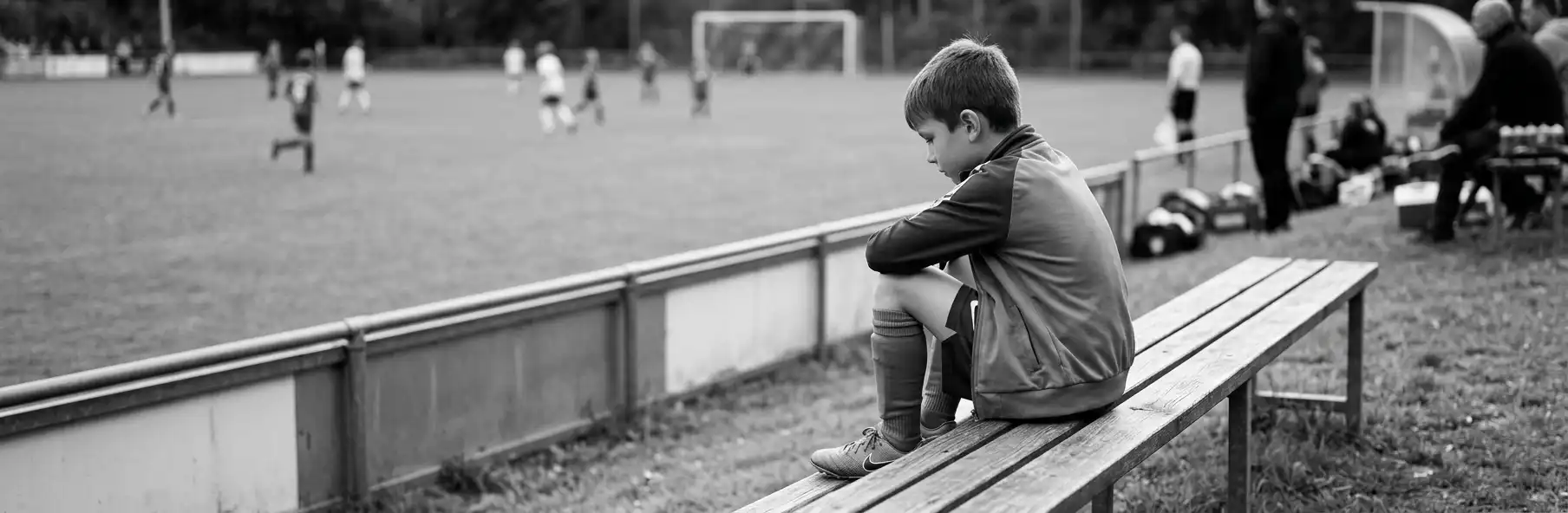
Is Your Child on the Bench in Football? Why That Might Be a Good Sign
Watching your child sit on the bench hurts. But it's not always unfair: sometimes it's the best decision for their development. A guide for grassroots football parents.
Written by
João Araújo
Physical Education Teacher (FADEUP – University of Porto) · Futsal Coach – Level II · UEFA B License · Master’s in Physical Education
15 years teaching Physical Education in schools, 20 years coaching futsal at youth development level and 5 years coaching football. Federated and amateur football and futsal player.
The kick-off whistle goes and your child isn’t on the pitch. They’re sat on the bench in their tracksuit, watching their mates play. For a lot of parents, this is one of the hardest moments to watch from the sidelines, harder, often, than a defeat.
Why This Hurts Parents So Much
Parents’ emotional reaction when their child is on the bench is rarely about football: it’s about a perceived sense of unfairness, about remembering every training session, lift and weekend sacrifice that went into getting there. It’s natural to feel your child “deserved” to play. But that perception, formed off the pitch, almost never has access to the full picture the coach uses to make the call.
What Parents Usually Don’t See
A grassroots or academy coach picks a starting eleven based on factors that are rarely visible from the sideline: who trained best that week, who’s physically freshest, what kind of opponent calls for what type of player, and, at youth level, who’s had more minutes recently and needs to make room for a teammate. Being benched for one match isn’t a verdict on a player’s ability; it’s a decision about that specific fixture.
Why It Might Be a Good Sign, Not a Bad One
At many well-run academies, minute rotation is a deliberate policy, not a punishment. A child who’s on the bench one week and starts the next is, in practice, being managed to get more game time across the season, not being cut out. Missing one match also teaches something constant starting doesn’t: handling frustration, keeping training standards up without immediate reward, and supporting the team from off the pitch. Those are skills higher-level football demands later on.
How to Help Without Making It Worse
What parents say, or don’t say, after the game matters more than they realise:
- Don’t criticise the coach in front of your child. Even if you disagree with the call, doing so undermines the authority your child needs to respect day to day at training.
- Ask “how did that feel?” before “why weren’t you picked?” The first question opens a conversation; the second transfers the parent’s frustration onto the child.
- Avoid comparisons with other players. “So-and-so always plays and he’s not better than you” teaches your child to compete against teammates rather than against themselves.
Plenty of parents feel powerless because all they see is the 90 minutes on matchday. That’s why I started suggesting that more involved parents also track their child’s call-up and minutes history across fixtures, not to question the coach but to understand the real pattern behind each decision. The SportsLabTools Call-up tool is built exactly for this: it gives visibility over rotation across the season, instead of every match feeling like an isolated case.
When It’s Worth Raising with the Coach
If the pattern repeats, with your child benched match after match and no visible rotation for other teammates, that’s when a calm, direct conversation with the coach is worthwhile, framed around development rather than complaint: “What does he need to improve to earn more minutes?” is a far more productive question than “why didn’t he play?”.
See also: Football Player Frustrated on the Bench: Managing Frustration Early in the Season, the same situation seen from the coach’s side of managing the squad.
Checklist: How to React When Your Child Is Benched
| Practice | Done? |
|---|---|
| I asked how they felt, without judging | ☐ |
| I avoided criticising the coach in front of them | ☐ |
| I didn’t compare them to other players | ☐ |
| I checked whether it’s a one-off or a repeated pattern | ☐ |
| If it’s a pattern, I arranged a calm chat with the coach | ☐ |
| I reinforced that training well counts, even without playing | ☐ |
Being on the bench isn’t the end of a football journey: it’s often just a normal part of it. A parent’s job isn’t to argue the decision, it’s to help their child get through it without losing motivation.
Track the real pattern behind every call-up. Use the SportsLabTools Call-up tool to see your child’s minutes rotation across the season.