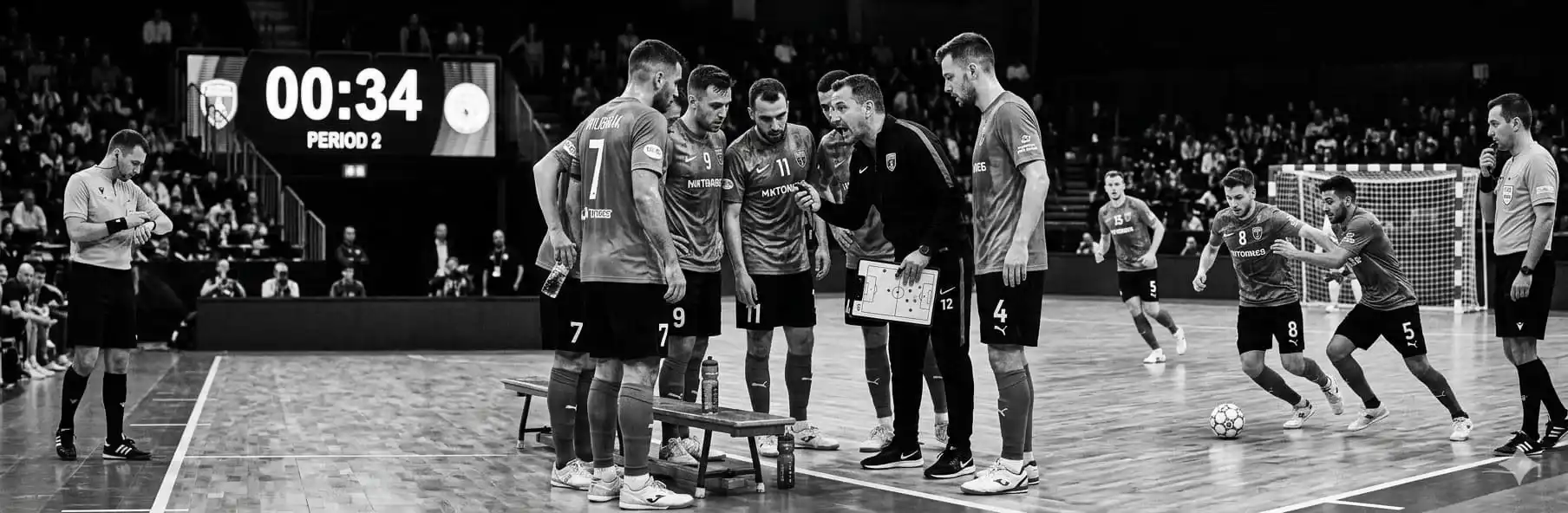
Clock Management in Futsal: Strategic Stoppages in the Decisive Minutes
The final minutes of a futsal match are decided before the final whistle. Learn to manage time with strategic timeouts, fouls and substitutions.
Written by
João Araújo
Physical Education Teacher (FADEUP – University of Porto) · Futsal Coach – Level II · UEFA B License · Master’s in Physical Education
15 years teaching Physical Education in schools, 20 years coaching futsal at youth development level and 5 years coaching football. Federated and amateur football and futsal player.
In the final three minutes of a close futsal match, clock management can be worth more than any tactical system. Teams that lose matches while leading do not lose through lack of quality. they lose through lack of time and space control in moments of highest opponent pressure.
Futsal is one of the few sports where the clock stops. That is a huge strategic advantage. and most amateur teams waste it entirely.
Why It Happens: Time Management as a Problem
The pressure of the final minutes causes two typical errors in leading teams: they speed the game up (when they should slow it down) and fail to use available stoppages at the right moment. Conversely, teams chasing the game frequently do not use tactical fouls with criteria, wasting opportunities to stop play and reorganise.
Consequences of Ignoring Clock Management
- Goals conceded in transition in the last 2 minutes due to excessive offensive speed
- Timeouts used too early (at 30 min) without a game situation to justify it
- Accumulated fouls used non-strategically, without forcing a stop when needed
- Opponent controlling the game’s rhythm in the minutes that decide it
The Solution: Core Clock Management Principles
- Identify when the clock becomes relevant: typically the last 5 minutes with a 1-goal lead; last 3 minutes with 2 goals.
- Use stoppages before you need them: a timeout called in a controlled game situation is worth more than one called in panic.
- Control rhythm with the ball: deliberately slower circulation when winning is not negative play. it is intelligent management.
- Use fouls to stop play: a tactical foul at the right moment breaks opponent momentum and buys time to reorganise.
Application: Concrete Strategies
Leading by 1 Goal in the Last 5 Minutes
- Slow the ball circulation. 3 safe passes are worth more than 1 rushed shot
- Use the timeout when the opponent substitutes or after conceding, never during your positive momentum
- Keep the defensive block low. avoid high-risk offensive transitions
Chasing the Result in the Last 5 Minutes
- Use strategic fouls to stop play and reorganise. each stoppage resets the situation
- Consider the flying goalkeeper from 2:30-3:00 min with a 1-goal deficit
- Use the timeout after conceding, not before. momentum favours the opponent; the stoppage breaks it
5v4 Management (Flying Goalkeeper)
- Define in advance when to bring the goalkeeper up. not in panic
- Have a fast ball-in-play routine after conceding to avoid losing time
- Communicate clearly who defends the counter-attack (not the starting goalkeeper)
🔧 Useful Tool
Tracking the score and time in a live match requires full focus on the bench. The SportsLabTools Scoreboard centralises the score, fouls and period on a single screen, freeing you to make decisions instead of managing information.
Special Cases: When Rules Change the Equation
- Accumulated fouls (6th foul): from the 6th foul, each opponent foul results in a direct free kick. This changes management entirely. a strategic foul from your team can function as an implicit timeout.
- Substitutions as time management: a well-timed substitution stops the clock and provides 30 seconds of organisation without using a timeout.
- Two 20-minute halves format: the clock stops on every game stoppage. every ball out of play is time gained or lost.
See also: Accumulated Fouls in Futsal: The Strategic Impact That Can Define a Match. fouls and clock management are inseparable in the decisive minutes.
Checklist: In-Match Clock Management
- Timeout reserved for moments of opponent pressure, not positive momentum
- Ball circulation speed deliberately reduced from the last 5 min (when leading)
- Moment to bring up the goalkeeper defined before the match, not in panic
- Strategic fouls used to interrupt opponent momentum
- Substitutions timed to stop the clock when needed
- Fast restart routine after conceding in 5v4 situations defined
- Clear communication of who defends the counter-attack with flying goalkeeper
Conclusion
Clock management is not improvised. it is prepared. Teams that win close matches do so because they trained the last 5 minutes as much as they trained the first 35. The clock stops in futsal: use that advantage.
Centralise score, fouls and period on a single screen during the match. Use the SportsLabTools Scoreboard to make time management decisions without splitting your attention.