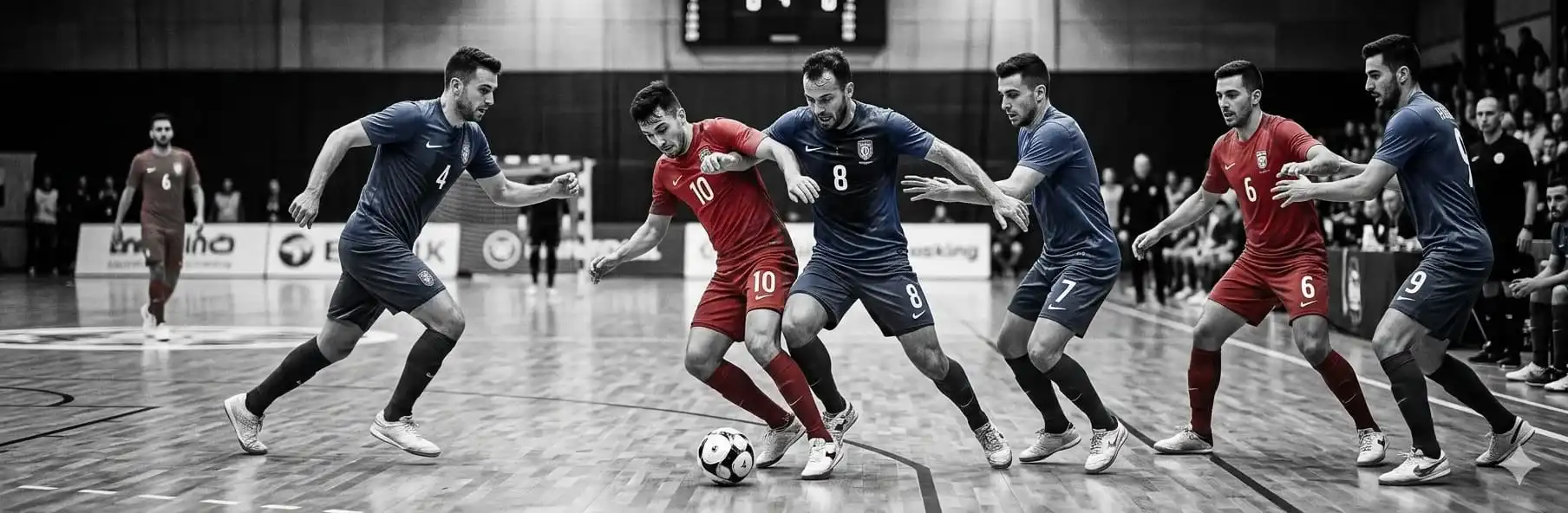
Counter-Pressing in Futsal: Win the Ball Back in the First 5 Seconds
How to implement counter-pressing in futsal to recover possession immediately after losing it and create goalscoring situations. Full tactical guide.
Written by
João Araújo
Physical Education Teacher (FADEUP – University of Porto) · Futsal Coach – Level II · UEFA B License · Master’s in Physical Education
15 years teaching Physical Education in schools, 20 years coaching futsal at youth development level and 5 years coaching football. Federated and amateur football and futsal player.
There is a moment in every futsal match that most coaches waste without realising: the 5 seconds immediately after losing the ball. In that window, the opposition is still disoriented, the build-up structure has not yet formed, and the ball is more vulnerable than at any other point in the game. Counter-pressing exists precisely to exploit that window.
Teams like Barcelona under Jesús Velasco or Inter Movistar at their best did not merely press high. They pressed in a coordinated, immediate fashion after every loss. The result was elegant: the defensive transition became simultaneously an offensive one.
Why the First 5 Seconds Are Decisive
When a team loses possession, the opposition needs time to read the available space, organise the build-up, and move the ball into dangerous areas. That time is measured in seconds, often fewer than five. After that interval, the team in possession reorganises and space closes.
Counter-pressing rests on this practical principle: a team disoriented immediately after winning the ball makes more carrying errors, hurried passes, and turnovers than at any other phase of the game. Generating that chaos systematically is a huge tactical advantage.
Ignoring counter-pressing means gifting the opposition free time to build out. In high-intensity futsal, that time equals goals conceded.
The Core Principle: Press the Ball Carrier, Cover the Pass
The most common mistake coaches make when implementing counter-pressing is focusing only on pressure against the ball carrier. One player pressing individually is easily beaten with a simple pass. The correct structure demands three simultaneous roles:
Immediate Pressure (0–2 seconds)
The player nearest the turnover presses the ball carrier without waiting for instruction. The objective is not to recover the ball, it is to force an error or a slow pass. Individual reaction speed is the critical factor here.
Pass Coverage (2–4 seconds)
The remaining players cut off priority passing lanes. In futsal, this means occupying the wide channels and the passing line to the opposition pivot or fixo. Space closes more quickly than in eleven-a-side, making counter-pressing particularly effective.
Block Compactness (4–5 seconds)
If the ball has not been recovered within 4 seconds, the team must organise into an immediate defensive block to prevent the counter-attack. Counter-pressing is not reckless, it has a defined cancellation trigger.
Practical Application: The 3 Activation Triggers
Not every turnover should trigger the counter-press. One of the most costly mistakes is pressing indiscriminately, creating fatigue without tactical return. Define three clear triggers with your players:
Trigger 1: Loss in the Attacking Third Always activate. The team is compact, the ball is far from the own goal, and the opposition is in a positionally weak situation.
Trigger 2: Loss in the Middle Third with Local Numerical Superiority Activate if at least 2 players are within 5 metres of the ball. Otherwise, structured transition.
Trigger 3: Loss from a Dead Ball (after opposition corner or kick-in) Rarely activate. The opposition is already set and the risk of a counter-attack is high.
The Most Common Implementation Mistakes
1. Pressing without cover: One player presses; the rest watch. The opposition exits with a simple lateral pass.
2. Maintaining counter-pressing beyond 5 seconds: Creates cumulative fatigue and exposes the team to runs in behind.
3. No defined triggers: Players press inconsistently, with no collective pattern. The opposition adapts quickly.
4. Ignoring the goalkeeper: The goalkeeper must participate in the counter-press, stepping forward to support the pressure and ensure local numerical superiority.
🔧 Useful Tool
Planning and visualising counter-pressing shapes and movements before training saves precious court time. The SportsLabTools Tactical Board lets you draw and share your pressing blocks and coverage positions with your squad in seconds.
How to Train Counter-Pressing: A 3-Step Progression
Step 1: Individual Recognition (Week 1)
Reaction drills: simulated turnover → immediate individual pressure. Focus on speed of body orientation after losing the ball.
Step 2: Pair Coordination (Week 2)
2v1 → on losing the ball, both react with pressure + pass cut. Introduce the trigger language to both players.
Step 3: Small-Sided Games with a Criterion (Weeks 3–4)
3v3 or 4v4 in reduced space, with a bonus point for recovery within 5 seconds. The criterion makes counter-pressing an automated habit.
See also: High Press in Futsal: How to Implement It, When to Use It, and How to Defend Against It. counter-pressing and high pressing are complementary systems that together create total pressure on the opposition.
Checklist: Counter-Pressing in Futsal
- Three activation triggers defined and communicated to the squad
- Nearest player activates pressure within 0–2 seconds
- Two players cut priority passing lanes
- Goalkeeper included in the pressing dynamic
- Cancellation trigger defined at second 5 (organised block)
- Trained in sessions with a scoring criterion
- Reviewed on video to identify correct and incorrect activations
Conclusion
Counter-pressing is not merely a tactic, it is a collective mindset that transforms turnovers into opportunities. The difference between teams that execute it well and those who do not train it lies, above all, in the clarity of triggers and the automation of individual reactions. Start small: define a single trigger, train it for 10 minutes per session over two weeks. The impact will be visible in matches.
Ready to implement counter-pressing with your squad? Use the SportsLabTools Tactical Board to draw your pressing blocks and share them with your players before every training session.
Optional accelerator · the tool is always free
A library of exercises instead of drawing every one
Packs of 40 exercises per theme, with an animated tactical diagram, four levels of progression, teaching points and success criteria. Import them and they stay in your library, ready to edit and present to the team.