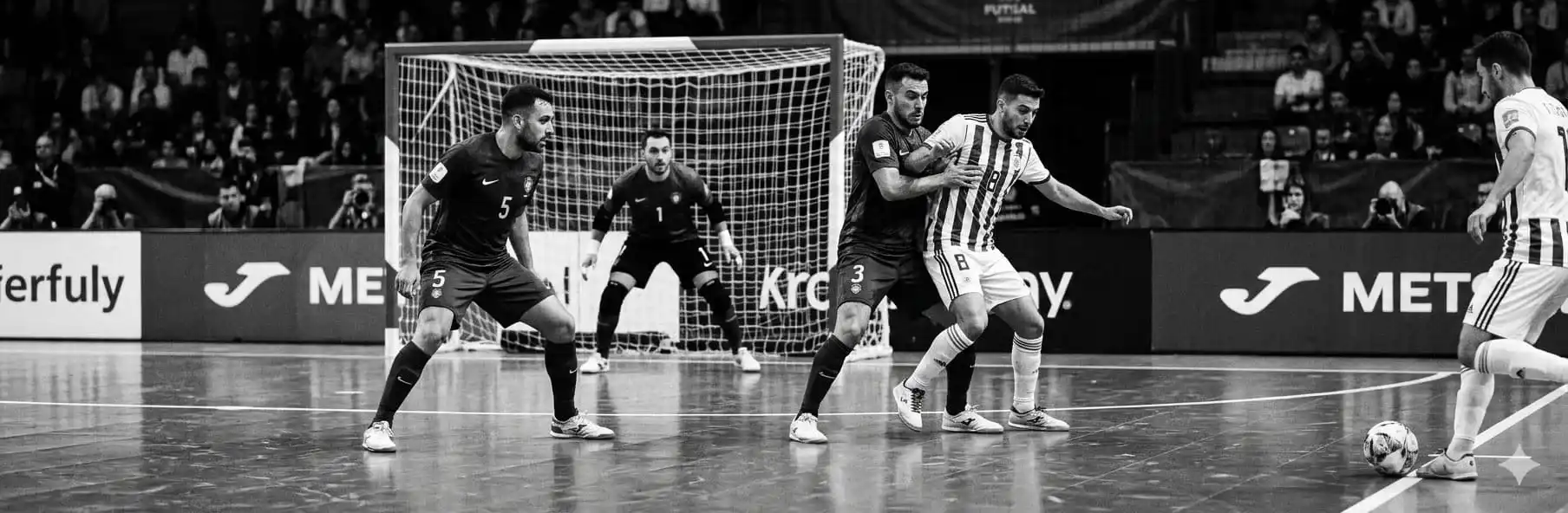
Defending Set Pieces in Futsal: How to Neutralise Corners and Kick-Ins
Complete defensive protocol for corners and kick-ins in futsal: organisation, marking, and transition to prevent goals from opposition set pieces.
Written by
João Araújo
Physical Education Teacher (FADEUP – University of Porto) · Futsal Coach – Level II · UEFA B License · Master’s in Physical Education
15 years teaching Physical Education in schools, 20 years coaching futsal at youth development level and 5 years coaching football. Federated and amateur football and futsal player.
Performance analysis in top-level futsal consistently shows that between 25% and 35% of goals in competition originate directly or indirectly from set pieces. Yet most teams dedicate over 80% of their tactical training time to the attacking phase of dead balls and almost none to defending them. That imbalance has a concrete cost on the scoreboard.
Defending a futsal corner or kick-in well is not a question of size or pace. it is a protocol. And protocols are trained.
Why Defensive Set Pieces Are a Different Challenge
Unlike eleven-a-side football, where the goalkeeper can set a wall and the defensive line has space to drop, in futsal the playing area is compressed, the opposition can play the ball immediately after the referee’s signal, and one second of disorganisation is enough to create a high-probability shot.
Most set-piece goals exploit at least one of the following: the defending team losing concentration, uncalled blocking screens, or confusion over marking responsibility. Without a clear protocol, players hesitate. In futsal, hesitation equals a goal conceded.
The Plan: Set Piece Defensive Protocol
| Phase | Duration | Responsible |
|---|---|---|
| Organisation | 0-3 sec. after foul called | Goalkeeper / Captain |
| Positioning | 3-8 sec. | Defensive quartet |
| Defensive execution | Duration of play | All |
| Attacking transition | After recovery | Player + GK |
Phase 1: Immediate Organisation (0–3 seconds)
The goalkeeper takes vocal command as soon as the referee awards the set piece. Two words define the system: “Zone!” or “Man!” The team must move immediately. not wait. while the opposition is still placing the ball.
Golden rule: Players do not choose the system on the pitch. it is pre-defined for each type of set piece (corner vs. kick-in, area of the pitch, minute of the game).
Phase 2: Zonal Positioning (preferred in futsal)
Zonal defence in futsal divides space into four sectors, with each player responsible for an area rather than a specific opponent.
Standard positioning for a corner:
- Player 1: Near post (cuts short crosses)
- Player 2: Second line in the area (contests second balls)
- Player 3: Penalty spot (controls central space)
- Player 4: Outside the area (first pass after recovery)
Standard positioning for a kick-in:
- Immediate pressure on the taker (3–4 metres)
- Remaining players close interior passing channels
Phase 3: Defensive Execution. The 3 Moments
Moment A. Before contact: Confirm positions, call out opposition screens, maintain focus on the ball AND the most dangerous opponent simultaneously.
Moment B. During flight: Anticipatory movement for interception. A defence that does not anticipate is beaten before the ball arrives.
Moment C. Second ball: Goals that do not come from the first action come from the second. The player at the penalty spot owns the second ball. no one else.
Phase 4: Transition to Attack
Recovering the ball from an opposition set piece immediately creates a favourable counter-attacking situation, because the opposition has players in advanced attacking positions. The recovering player passes immediately to Player 4 (outside the area), who launches the counter.
The Most Common Mistakes in Defensive Set Pieces
1. Arguing with the referee instead of organising. wastes the critical 3 seconds before the opposition plays the ball.
2. Two players marking the same opponent. creates a vacant zone with no one responsible.
3. No one attacking the second ball after the first deflection. most corner goals come from second-phase shots.
4. Goalkeeper advancing without communicating. creates confusion with the nearest defender and leaves the goal exposed.
🔧 Useful Tool
Before the match, analyse the opposition’s set pieces and identify their preferred patterns. The SportsLabTools Video Analysis lets you clip and tag opposition set-piece sequences and share them with your squad before the specific training session.
Adaptations by Game Context
Corner in the final 2 minutes when trailing by one goal: Consider keeping the goalkeeper in a more advanced position as an extra reference. Assign the player responsible for covering the opposition counter-attack after a potential recovery.
Kick-in in your own defensive half: Maximum pressure on the taker. give no time to pick a pass. The risk of a direct goal from a kick-in close to goal is consistently underestimated.
Corner after the opposition receives a yellow card: The opposition may prefer a controlled build-up rather than playing the corner directly. adjust positioning with a deeper block and two players covering the quick outlet pass.
See also: Set Pieces in Futsal: Corners and Kick-In Strategies to Decide Matches: understanding how the opposition attacks set pieces is the first step to defending them better.
Checklist: Defending Set Pieces
- System defined (zone / man) for each type of set piece
- Goalkeeper has vocal authority to organise within 3 seconds
- Standard positions trained for both corners and kick-ins
- Second-ball responsibility explicitly assigned
- Player 4 positioned for transition after recovery
- Opposition video analysed before important matches
- Simulated in training with live opposition (not just static)
Conclusion
Defending set pieces is not a detail. it is a repeatable protocol that directly reduces goals conceded. Most set-piece goals do not happen because the opposition was technically superior: they happen because the defending team had no clear plan. Define the plan, train it once a week, review it on video. The difference at the end of the season will be measured in points, not just situations.
Analyse the opposition’s set pieces before every match. Use the SportsLabTools Video Analysis to build a library of opposition patterns and prepare your squad for every situation.
Optional accelerator · the tool is always free
Start tagging matches without spending hours building categories
An analysis model with 12 categories and more than 60 actions organised by game moment, already carrying individual/collective context and pitch and goal location. Import it and tag your first clip right away.