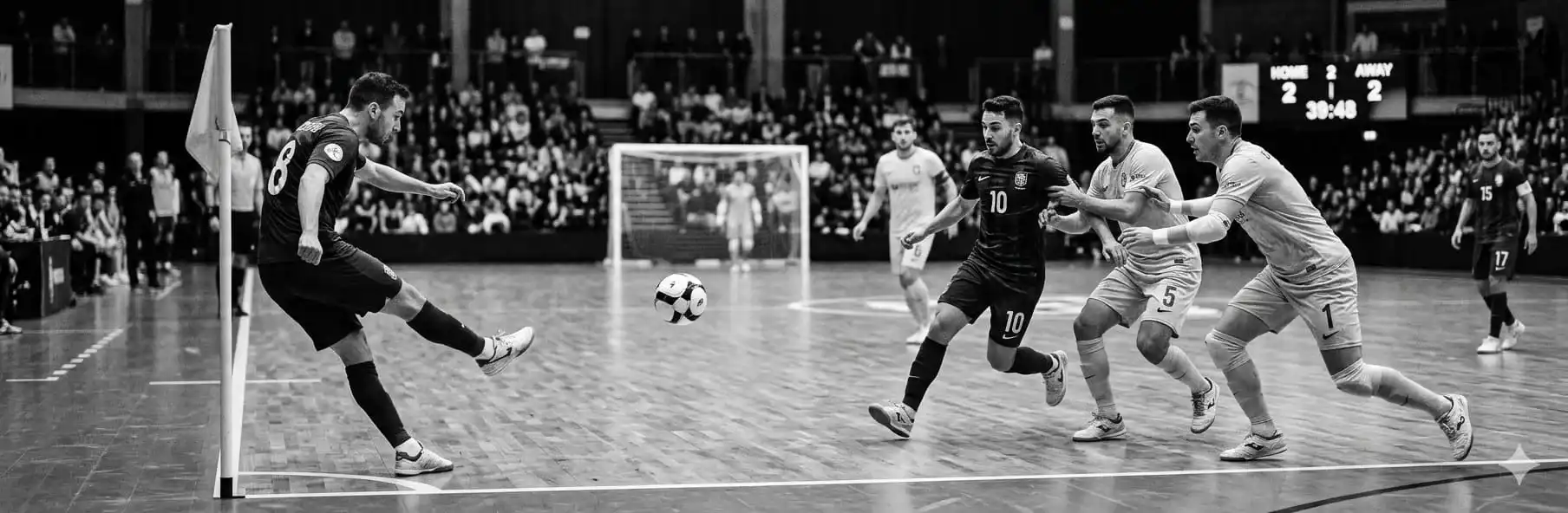
Set Pieces in Futsal: Corner Kick and Kick-In Strategies to Win Games
Learn how to design and execute effective corner kick and kick-in routines in futsal to create real goal-scoring opportunities and improve defensive organisation at set pieces.
Written by
João Araújo
Physical Education Teacher (FADEUP – University of Porto) · Futsal Coach – Level II · UEFA B License · Master’s in Physical Education
15 years teaching Physical Education in schools, 20 years coaching futsal at youth development level and 5 years coaching football. Federated and amateur football and futsal player.
In a sport played on a compact court where every metre counts, set pieces carry enormous tactical weight. A well-rehearsed corner kick or kick-in routine can unlock an organised defence instantly, and in tight games between evenly matched teams, they are often the difference between winning and losing.
Why Set Pieces Matter in Futsal
Unlike in field football, where a corner may travel 40 metres before reaching anyone, in futsal the proximity to goal transforms every set piece into an immediate threat. The goal line is close, passing lanes are short, and the goalkeeper has fractions of a second to react.
Analysis of professional futsal leagues suggests that between 20% and 30% of goals have a direct or indirect connection to set-piece situations. In youth futsal, the figure can be even more significant, teams at this level struggle most with defensive organisation precisely in these moments.
Corner Kick Strategies: Beyond the Simple Cross
Direct Corner. Strike at First Contact
The most straightforward option when the taker has strong delivery or shooting ability. The aim is to create a trajectory the goalkeeper cannot read, using runners to the near and far posts.
Tactical key: the near-post movement must be sharp and explosive, forcing an immediate decision from the goalkeeper.
Short Corner. Creating an Overload
Playing the corner short to a nearby teammate before delivering allows the taker to create a different angle, disorienting a zonal defensive block. Particularly effective against teams that hold their zone rigidly.
Variant: after the short pass, the original taker continues their run into the box, available for a back-cross or a direct shot on the second post.
Screen Play Corner. The Rehearsed Routine
One of the most effective patterns in modern futsal. A player sets a screen on a defender, freeing a teammate to receive in a shooting position or to make a near-post run uncontested.
Important note: the screen must be set with a static body position, moving screens can be penalised as a foul by the referee.
Kick-Ins: The Most Underused Set Piece in Futsal
Unlike field football, the futsal kick-in is taken with the foot, not the hands, which opens tactical possibilities many coaches fail to exploit.
The Quick Kick-In
Playing before the defence organises creates immediate numerical advantages. This requires pre-agreed communication between players and a receiver always available near the touchline.
The Combined Kick-In
Using the kick-in to start a passing combination along the flank, building progression and creating imbalance. Ideal for technically capable teams that build from the back.
The Tactical Reset Kick-In
When under pressure, the kick-in offers a pause: play it back to the goalkeeper, reorder positionally, and restart the attack with structure. In professional futsal, using the kick-in as a rhythm-control tool is increasingly common and deliberate.
Defensive Organisation at Set Pieces
How you defend is as important as how you attack at set pieces. Two main models:
- Zonal marking: each player covers an area rather than a man. More compact and less vulnerable to screens.
- Man-marking: each defender tracks a specific attacker. Effective against reference players, but vulnerable to switches and crossing screens.
Elite teams frequently use a hybrid approach: zonal on the near side and man-marking on the far-post attacker most likely to score.
Post set-piece transition: define roles before every set piece, who presses, who drops into cover, to avoid disorganisation in the first seconds after defending.
Training Set Pieces Effectively
Set pieces need dedicated time in the weekly training cycle. A practical structure:
- Isolated repetition (no defenders): build movement memory and timing.
- Conditioned repetition (passive defenders): develop spatial reading.
- Live situation (active defenders): validate the routine under match conditions.
As a benchmark, every team should have at least 3–4 corner variants and 2 kick-in variants trained and automatised.
🔧 Useful Tool
To track and log set-piece data during matches, including corners and kick-ins per team, the SportsLabTools Futsal Stats gives you real-time access to this information from the bench. An essential resource for coaches who make decisions based on current data.
Checklist: Set Piece Best Practices in Futsal
| Situation | Recommended Action | Priority |
|---|---|---|
| Taker with strong delivery | Direct corner to near and far post runners | High |
| Opposition in rigid zone | Short corner to break the line | High |
| Key opposition player man-marked | Corner screen to free him | Medium |
| Opposition disorganised (after substitution) | Quick kick-in before they reset | High |
| Team under pressure | Tactical reset kick-in | Medium |
| Opposition man-marking | Position switches and crossing screens | High |
Conclusion
Set pieces in futsal are far more than interruptions in play, they are goal-scoring opportunities built in training. Well-organised corners and kick-ins, with rehearsed variants automatised over weeks of work, create a tactical capital that pays dividends in close, high-stakes matches.
Invest training time in set pieces, record your routines, analyse what works, and use the right tools to stay on top of the game in real time.
Take your tactical control to the next level. Use the SportsLabTools Futsal Stats to track corners, kick-ins and more during your matches.
Optional accelerator · the tool is always free
Reliable stats as soon as the next match
An action taxonomy ready for live logging from the bench, with pitch and goal location already active — heat maps and shot maps without configuring anything.