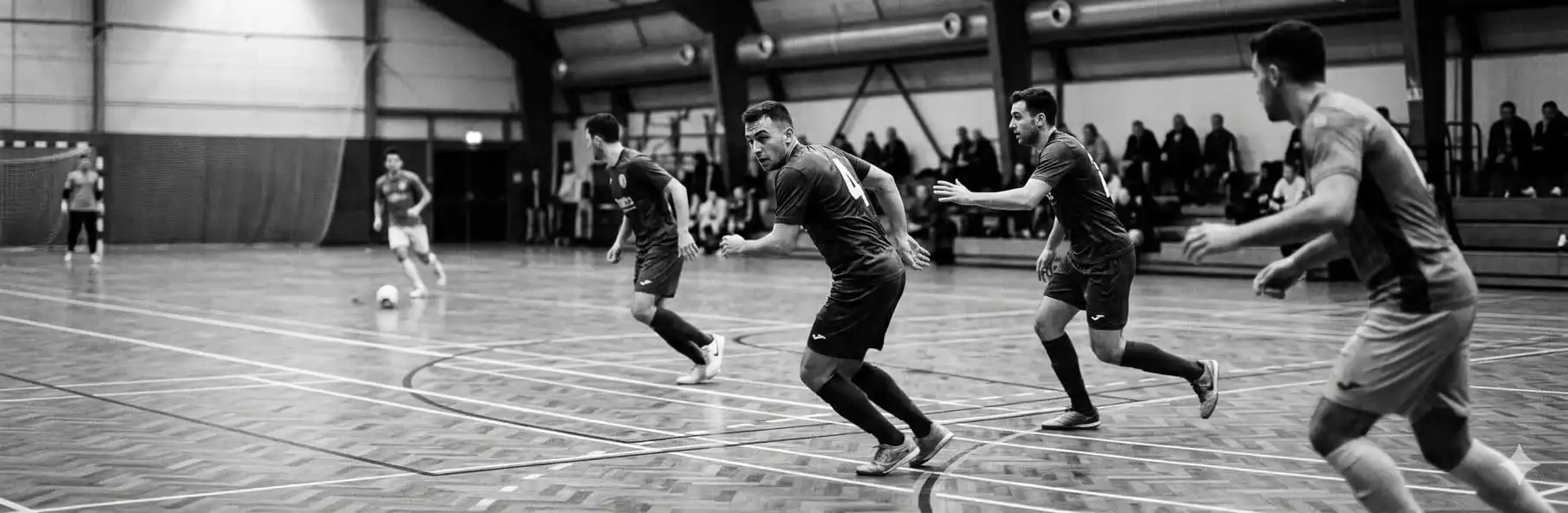
Defensive Transition in Futsal: The Complete Guide to Preventing Counter-Attack Goals
Master the principles of defensive transition in futsal to eliminate goals conceded on the counter. The three pillars of positional recovery are explained with direct practical application.
Written by
João Araújo
Physical Education Teacher (FADEUP – University of Porto) · Futsal Coach – Level II · UEFA B License · Master’s in Physical Education
15 years teaching Physical Education in schools, 20 years coaching futsal at youth development level and 5 years coaching football. Federated and amateur football and futsal player.
You lose the ball in an attacking move. Two seconds later, the opposition have three players ahead of you with only one defender between them and your goal. Sound familiar? You’re not alone. Goals conceded on the counter-attack are the number one complaint from youth coaches and one of the biggest tactical headaches in amateur futsal.
The good news: defensive transition is trainable, repeatable and fully systematisable.
Why the Counter-Attack Is So Lethal in Futsal
Futsal is played on a compact court with only four outfield players. When possession is lost in advanced zones, the distance between your out-of-position attackers and your own goal is small, and the opposition only need two or three touches to get a shot off. Unlike in outdoor football where a counter-attack covers 60 metres, in futsal it covers 20 metres in three seconds.
The difference between an organised team and a vulnerable one isn’t the individual pace of the players. It’s the collective reading of the moment possession is lost.
The 3 Principles of Defensive Transition
Principle 1: Instant Reaction to Loss of Possession
The first second after losing the ball is the most critical. Elite teams have one clear rule: every player who was in an attacking position starts recovering immediately, without waiting to see whether the ball is won back.
This behaviour is called recovery press and must be trained as an automatic reflex, not a conscious decision.
Practical drill: during organised attacking sequences in training, the coach removes the ball from the team’s possession at any moment. The success criterion is every player already moving back in under one second.
Principle 2: Closing the Central Corridor
The priority goal during transition is not to win the ball back. It is to block the central pass to a player in an immediate shooting position. The central corridor is the most direct route to goal, and that’s where most counter-attack goals come from.
The first player to recover must position himself in the central corridor, even if he can’t reach the ball-carrier. His presence alone limits the opposition’s passing options.
Principle 3: Delay, Don’t Dive In
One of the most common mistakes in youth futsal is when a recovering player finds himself outnumbered and tries to win the ball back immediately with individual pressing. Result: a foul, or getting beaten and being out of the game.
The delay rule: when outnumbered (1v2, 1v3), the defender must retreat in a defensive shape, buy time for teammates to recover, and only press the ball-carrier when the opposition’s numerical advantage disappears.
🔧 Useful Tool
Draw your team’s defensive recovery routine on the SportsLabTools Futsal Tactical Board. Define the recovery paths for each position and simulate different scenarios of possession loss to present to the group before training.
The Positional Recovery Routine
Beyond the three principles, you need to define who does what when possession is lost, based on each player’s position on the court:
- Player who loses the ball: presses immediately to slow the transition
- Nearest players to the ball: block lateral passing lanes
- Most advanced recovering player: positions in the central corridor between the ball and the goal
- Goalkeeper: steps off the goal line slightly to narrow angles
This scheme must be rehearsed until it becomes automatic. The brain doesn’t have time to think during transition, only to react.
Common Mistakes That Lead to Counter-Attack Goals
- All outfield players in attacking positions with no defensive cover: the attacking block always needs one player with defensive responsibility
- The anchor/pivot joining the attack without communication: opens the central space exactly where the counter will run through
- Individual pressing while outnumbered: leads to a foul or being beaten, making the situation worse
- Goalkeeper too far off the line during attack: not enough time to recover position
How to Train Defensive Transition
| Drill | Description | Focus |
|---|---|---|
| Game with mandatory transition | After every shot, attacking team transitions immediately | Reaction to loss |
| 3v2 with quick exit | Two defenders organise transition against three | Delay principles |
| Recovery by position | Coach signals possession loss in different zones | Recovery paths |
| Game with penalty | Counter-attack goals count double for the opposition | Collective awareness |
Conclusion
Defensive transition is not luck or athleticism. It is organisation, reading and trained automatism. Teams that consistently concede on the counter almost always have a problem of poorly defined collective principles, not a lack of individual pace.
Define your recovery routine, train it with consistency and use the right tools to communicate the system clearly to your team.
Draw your defensive transition routine before training. Use the SportsLabTools Futsal Tactical Board to visualise recovery paths and show your team exactly what to do.
Optional accelerator · the tool is always free
A library of exercises instead of drawing every one
Packs of 40 exercises per theme, with an animated tactical diagram, four levels of progression, teaching points and success criteria. Import them and they stay in your library, ready to edit and present to the team.