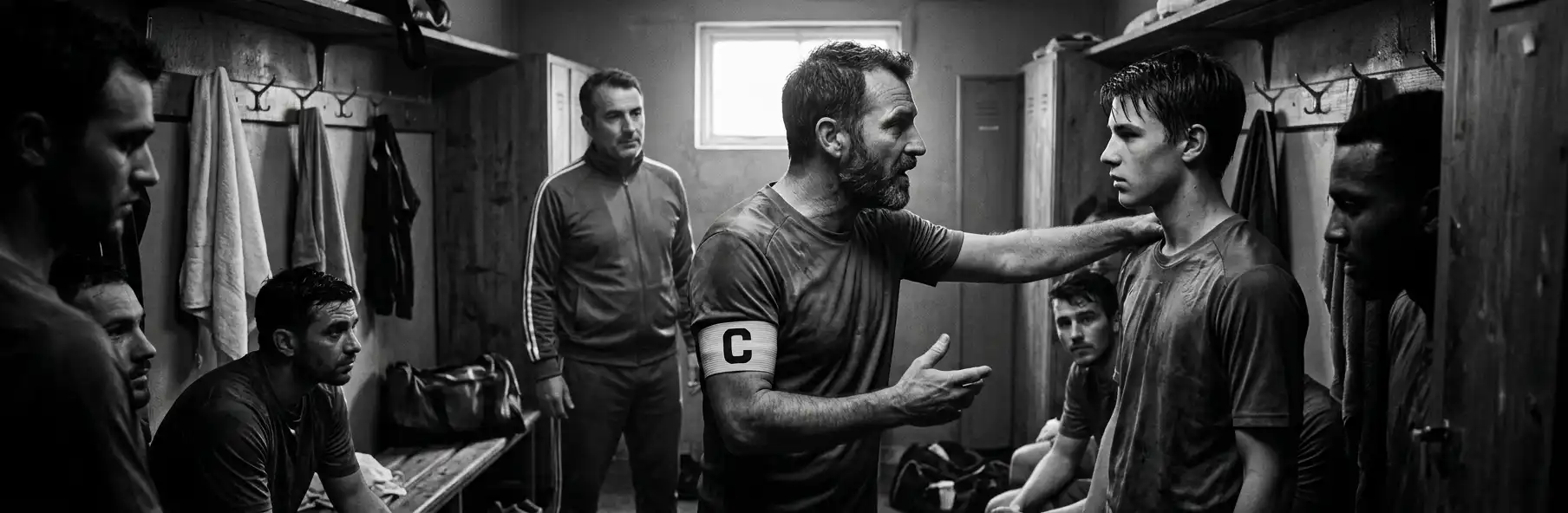
Dressing Room Leadership in Football: The Captain's Role in Managing the Squad
How a team captain can strengthen cohesion and communication in the dressing room, and what the manager should do to prepare that leadership.
Written by
João Araújo
Physical Education Teacher (FADEUP – University of Porto) · Futsal Coach – Level II · UEFA B License · Master’s in Physical Education
15 years teaching Physical Education in schools, 20 years coaching futsal at youth development level and 5 years coaching football. Federated and amateur football and futsal player.
The manager isn’t in the dressing room for every moment that matters. the tense half-time break, the coach journey home after a defeat, the pre-warm-up team talk. That’s where the captain’s leadership makes the difference between a squad that holds together and one that falls apart.
Plenty of clubs pick a captain based on the armband and seniority, without ever discussing with him what’s actually expected of the role. The result is a decorative captain who shouts “come on” in the tunnel but has neither the tools nor the standing to manage real conflict within the group.
Why Captain Leadership Happens by Default
Without a defined role, a captain tends to stick to the symbolic gesture: arguing with the referee, shaking hands with the opposition. Real dressing-room leadership (resolving a conflict between two players, managing a substitute’s frustration, holding the training standard) doesn’t happen, because it was never asked for or prepared.
The Consequences of a Captain With No Defined Role
When informal dressing-room leadership falls to whoever “shouts loudest” instead of the appointed captain, an authority vacuum opens up that breeds cliques, perceived favouritism, and unresolved conflict. problems that only reach the manager once they’re already well advanced.
The Solution: Core Principles for Preparing the Captain
- Agree with the captain, in a one-to-one conversation, what’s expected of him in critical situations (a defeat, a conflict, an unhappy player)
- Give him information the rest of the squad doesn’t have. the week’s plan, the reasoning behind decisions. so his communication with the squad stays consistent with the manager’s
- Review with him periodically how that leadership is going, not just at the start of the season
Application: Concrete Strategies for Preparing the Captain
Monthly One-to-One Meeting
15 minutes just for the captain, focused on how the group’s mood is. information that rarely reaches the manager any other way.
Delegate Micro-Decisions
Letting the captain manage small day-to-day decisions (the order of warm-up drills, sorting out a late arrival) strengthens the authority the squad perceives him to have.
Prepare the Difficult Conversation
Before a losing streak, discuss with the captain what he’s going to say in the dressing room. so his message reinforces, rather than contradicts, the manager’s.
🔧 Useful Tool
Understanding how each player is doing emotionally before asking the captain to manage a specific situation makes preparing that conversation easier. The SportsLabTools Athlete Journal gives visibility into each player’s state, match by match.
Special Cases: When the Captain Isn’t the Natural Leader
Sometimes the player wearing the armband isn’t the group’s informal leader. In that case, the manager should identify the real informal leaders and work with everyone. formal captain and informal leaders alike. instead of insisting on a hierarchy the group doesn’t recognise.
See also: Managing Losing Streaks: Reacting Tactically and Psychologically to a Results Crisis. the moment when the captain’s leadership matters most.
Checklist: Preparing the Captain’s Leadership
| Practice | In place? |
|---|---|
| One-to-one conversation about the expected role | ☐ |
| Information shared ahead of the squad | ☐ |
| Day-to-day micro-decisions delegated | ☐ |
| Periodic review of how the leadership is going | ☐ |
| Conversations prepared before critical moments | ☐ |
| Informal leaders identified beyond the captain | ☐ |
Conclusion
The armband doesn’t create leadership. it only formalises it. Preparing the captain with information, trust, and practice making small decisions is what turns a symbol into real leadership inside the dressing room.
Give your captain the information he needs to lead consistently. Use the SportsLabTools Athlete Journal to track the group’s state match by match.