Fitness Myths That Data Can Debunk
Science has disproved some of the most popular fitness advice out there. Discover the most common myths and what the data actually says about how the body works.
Written by
João Araújo
Physical Education Teacher (FADEUP – University of Porto) · Futsal Coach – Level II · UEFA B License · Master’s in Physical Education
15 years teaching Physical Education in schools, 20 years coaching futsal at youth development level and 5 years coaching football. Federated and amateur football and futsal player.
Did you know that sweating a lot does not mean burning more fat? Or that muscle soreness the next day is not required for growth? Fitness is one of the fields with the most circulating myths; where data most easily dismantles them.
Here are six of the most common myths, and what science actually says about each one.
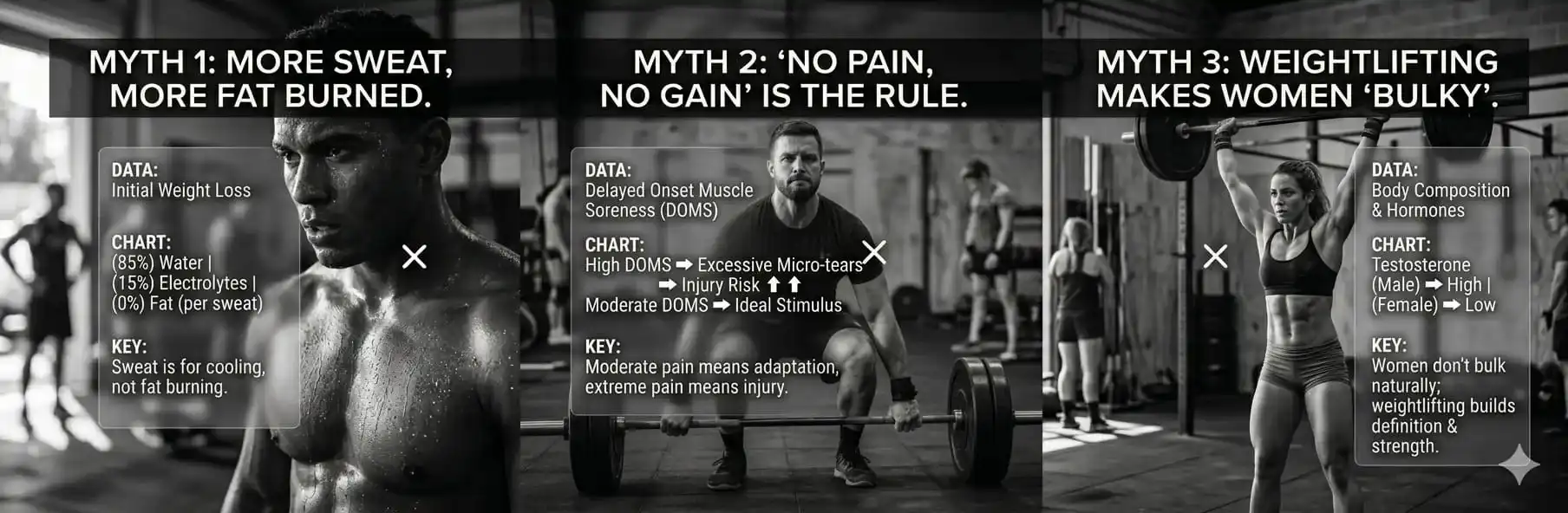
Myth 1: “The More You Sweat, the More Fat You Burn”
This is arguably the most widespread confusion in fitness. Sweating is a thermoregulation mechanism. The body cools itself through sweat evaporation. It is not a measure of caloric effort.
What the data says: the immediate weight loss after an intense workout is mostly water loss. Replace fluids and the weight comes back. What determines fat burning is total caloric deficit and metabolic effort intensity. not the amount of sweat produced.
Curiosity: in extreme heat, you can sweat profusely doing almost nothing. In cold conditions, you can burn thousands of calories without a single visible drop of sweat.
Myth 2: “If You’re Not Sore, You Didn’t Train Hard Enough”
Delayed Onset Muscle Soreness (DOMS) is real and results from micro-tears in muscle fibres during training. But its presence or absence is not an indicator of training quality.
What the data says: well-trained athletes experience significantly less DOMS than beginners. not because they train less, but because their muscular system has already adapted. An experienced athlete can have an excellent session and wake up with no soreness at all. A beginner may feel severe soreness after a moderate session.
Chasing pain as a training goal can lead to unnecessary overload and increase injury risk.
Myth 3: “Cardio Before Weights Is Better for Burning Fat”
This idea assumes that the body depletes glycogen during cardio and is then “forced” to burn fat during strength training. The reality is more nuanced.
What the data says: the order of training affects performance in both components. Doing intense cardio before strength training compromises your ability to lift; it is the intensity of strength training that contributes most to elevated post-workout metabolism (EPOC).
The general recommendation from exercise physiology: if your goal is strength and body composition, do weights first. Cardio afterwards, or in a separate session.
Myth 4: “You Need Supplements to Build Muscle”
The supplement industry generates billions annually. but scientific evidence on the necessity of supplements is far more modest than marketing suggests.
What the data says: additional protein through supplements only provides benefit when the regular diet does not cover daily protein needs. For most people consuming a varied diet, supplements like creatine have reasonable scientific backing. but they do not replace food, sleep, and training consistency.
The uncomfortable truth: many people who fail to gain muscle are not lacking supplements. They are lacking sufficient calories, quality sleep, and progressive overload in their training.
Myth 5: “Heavy Weights Make Women Bulky”
This myth persists despite decades of contrary scientific evidence. The argument is that heavy strength training causes excessive hypertrophy in women.
What the data says: women have, on average, 10 to 30 times less testosterone than men. The most important anabolic hormone for muscle growth. This fundamental hormonal difference makes it extremely difficult for most women to gain muscle mass in the way the myth suggests.
What heavy strength training actually provides for women: greater bone density, higher resting metabolism, improved posture, and reduced risk of osteoporosis.
Myth 6: “You Can Burn Fat from a Specific Body Zone”
The concept of “spot reduction” (burning fat in specific areas by exercising that area) is one of the most persistent myths in fitness.
What the data says: the body uses stored fat as a global energy source, not a localised one. Doing 500 sit-ups a day will not make abdominal fat disappear faster than any other exercise of equivalent intensity.
Where the body loses fat first is determined primarily by genetics and hormones. not by the specific exercise. What you control is the total caloric deficit and overall body composition.
What Data Teaches Us About Fitness
These six myths have something in common: they all sell a simple narrative for something that is complex. And the complexity of the human body resists simple narratives remarkably well.
What exercise science consistently demonstrates:
- Progressive overload is the primary stimulus for muscle gain
- Consistency outperforms any “optimal” method applied irregularly
- Recovery (sleep, nutrition, stress management) is as important as training
- Individual data. your own records over time. is more relevant than any general rule
The best way to debunk a myth is with your own data. SportsLabTools Futsal Stats logs every match’s events in real time, giving you the concrete information you need to make decisions based on your reality. not on general rules.
The greatest enemy of fitness progress is not lack of effort. It is misinformation about where that effort should go.
Optional accelerator · the tool is always free
Reliable stats as soon as the next match
An action taxonomy ready for live logging from the bench, with pitch and goal location already active — heat maps and shot maps without configuring anything.