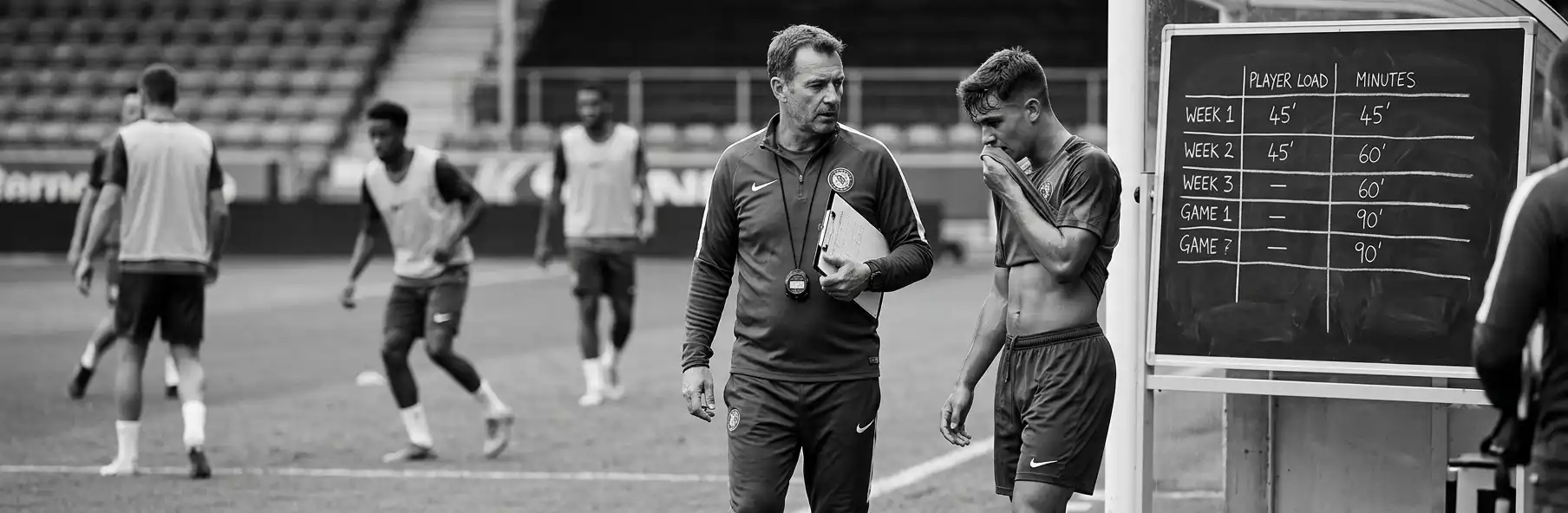
Managing Pre-Season Friendly Load in Football: Minutes Without Injury Risk
How to plan a squad's minutes progression across pre-season friendlies so players arrive at matchday one match-fit and free of muscle injuries.
Written by
João Araújo
Physical Education Teacher (FADEUP – University of Porto) · Futsal Coach – Level II · UEFA B License · Master’s in Physical Education
15 years teaching Physical Education in schools, 20 years coaching futsal at youth development level and 5 years coaching football. Federated and amateur football and futsal player.
It happens every summer: a player comes back buzzing for the first friendly, plays 70 minutes because he “feels fine physically,” and two weeks later he’s in the treatment room with a muscle strain. A pre-season friendly isn’t a normal fixture. It’s a load tool that needs dosing like any other stimulus in the microcycle.
The problem is that competitive pressure. The opposition, the scoreline, playing in front of supporters. Makes managers and players forget the squad is still building its physical base. Managing friendly minutes off a written plan, rather than in the moment, is what separates a pre-season that ends with a fully available squad from one that ends with a packed treatment room.
Why Managing Friendly Minutes Is a Different Challenge
A friendly produces intensity spikes. Sprints, changes of direction, duels. That pitch-based training rarely replicates in full. In the early weeks of pre-season, muscles aren’t yet adapted to these spikes, especially coming off the summer break. Playing too many minutes too soon is one of the most common causes of muscle injury (hamstrings, groin) in the opening weeks of the season.
Managing minutes isn’t about playing less. It’s about playing the right amount at each stage, with a planned progression and no exceptions for external pressure.
The Plan: Minutes Progression Across Pre-Season
| Week | Friendly | Target minutes (base) | Target minutes (returning from injury / late signing) |
|---|---|---|---|
| 1-2 | Match 1 | 30-45 min | 15-20 min |
| 3-4 | Matches 2 and 3 | 45-60 min | 30-45 min |
| 5-6 | Matches 4 and 5 | 60-90 min | 45-60 min |
Phase 1: Weeks 1-2. Aerobic Base
Short minutes, focus on training volume on the pitch. The friendly is there to assess collective coordination, not to test physical limits.
Phase 2: Weeks 3-4. Specific Intensity
Exposure to high-intensity efforts. Sprints, duels, transitions. Increases, always within the defined minutes cap.
Phase 3: Weeks 5-6. Competitive Simulation
Closer to matchday format, with players completing 60-90 minute blocks and rotations already mapped out for matchday one.
The Most Common Mistakes in Managing Friendly Minutes
- Letting the scoreline dictate minutes management (“we’re winning, keep him on 15 more”)
- Not logging internal load (RPE) for the friendly, treating it as “active rest” (a 60-minute friendly typically generates RPE 6-7, well above a recovery session)
- Ignoring players returning from injury or late signings in the progression table
- Applying the same minutes cap across the whole squad, without accounting for position or injury history
🔧 Useful Tool
Logging minutes and perceived exertion after every friendly is what lets you adjust the progression in time. The SportsLabTools Athlete Journal centralises that log per player, match by match.
Communicating Minutes Management to the Squad
Explaining to a player why he won’t get 90 minutes in the first friendly heads off frustration and pushback. Being transparent about the progression plan. Shown, not just told. Builds trust in the process, even when the player’s immediate instinct is to ask for more minutes.
See also: Pre-Season Fitness Testing in Football: Assessing Player Condition on Return. The baseline assessment that sets the starting points for the minutes progression.
Checklist: Managing Minutes in Pre-Season Friendlies
- Weekly minutes progression table set before the first friendly
- Special cases (injury return, late signings) have their own plan
- RPE logged after every friendly
- Target minutes communicated to the player before kick-off
- Substitutions planned before the starting XI is set, not decided on the fly
- Weekly progression review with the coaching staff
Conclusion
A pre-season friendly earns its value when it’s treated for what it is: a load tool with a defined physical purpose. A written minutes plan, communicated and adjusted to each player’s particulars, is what gets a squad to matchday one fully available. Not through luck, but through deliberate technical decision-making.
Don’t leave load progression to the moment. Use the SportsLabTools Athlete Journal to track every player’s minutes and RPE throughout pre-season.