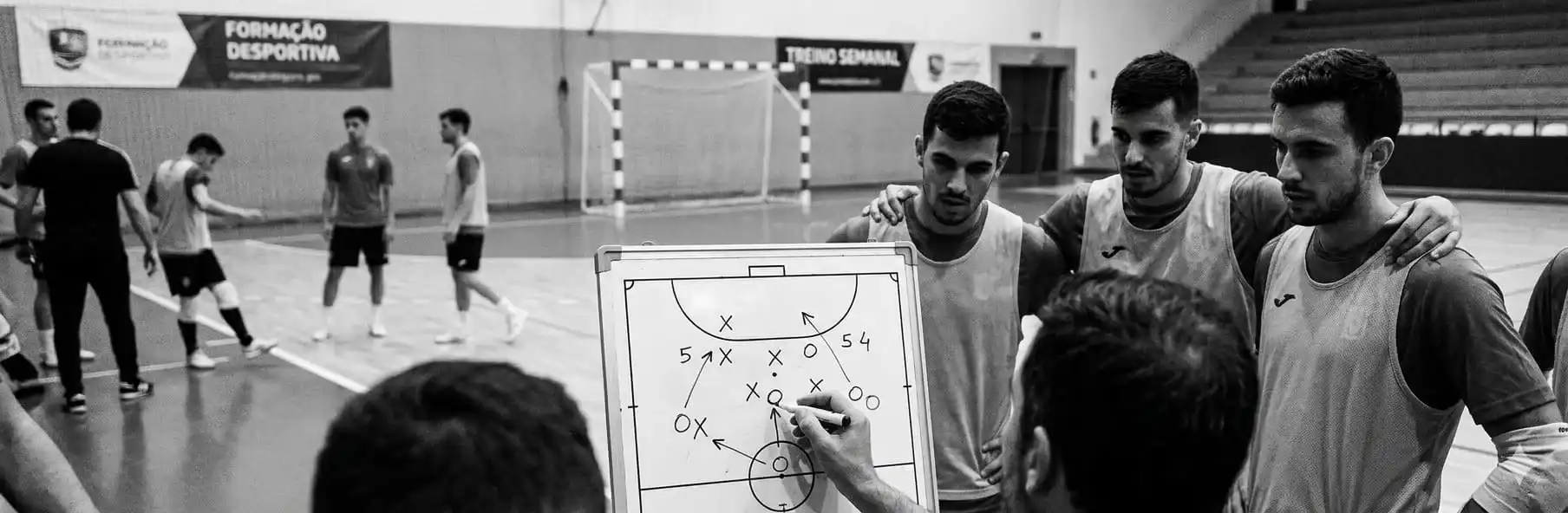
Tactical Planning for the 5v4 Defence in Futsal: How to Prepare Your Team During the Week
How to plan specific training sessions for defending the 5v4 with an outfield goalkeeper: defensive principles, specific drills and a weekly training structure to build automatisms in numerical inferiority.
Written by
João Araújo
Physical Education Teacher (FADEUP – University of Porto) · Futsal Coach – Level II · UEFA B License · Master’s in Physical Education
15 years teaching Physical Education in schools, 20 years coaching futsal at youth development level and 5 years coaching football. Federated and amateur football and futsal player.
The last two minutes of a match with a one-goal deficit are the highest-pressure moment in futsal. The opposition pull their goalkeeper, create 5v4 numerical superiority, and your team needs to defend a reduced space against five attacking players with surgical coordination and calm. If this moment hasn’t been trained frequently and specifically, the team will improvise. And teams that improvise in 5v4 defensive situations concede.
The solution isn’t individual talent. It’s collective automatisms, and collective automatisms are only built through deliberate, repeated training throughout the week.
Why 5v4 Defence Is the Most Demanding Situation in Futsal
Defending the 5v4 with an outfield goalkeeper differs from any other futsal defensive situation because:
- Numerical inferiority is permanent: unlike a momentary 3v2 transition, it persists throughout the opposition’s possession
- Decision space is minimal: four defenders must cover a full pitch against five attacking players with rapid circulation
- Psychological pressure is maximal: deficit + inferiority + running clock create perfect conditions for anxiety-induced errors
- Errors are immediately fatal: in 5v4 defence, a coverage error or mis-timed press almost always results in a goal
Defensive Principles in 5v4
Principle 1. Compact Block in the Central Corridor
Four defenders close the central corridor and force ball circulation towards wide areas. The objective is not to win the ball. It is to delay the attack, force opposition decision errors and buy time in the critical seconds.
Principle 2. Controlled Press Exits
The biggest defensive error in 5v4 is a defender stepping out to press without immediate cover. The rule: only press when the nearest teammate’s cover is guaranteed.
Principle 3. Constant Verbal Communication
In 5v4, communication between defenders is more critical than in normal play because the reaction space is smaller. “Shut off to the left”, “come now”, “cover the pivot”. These calls must be automatic, not thought.
Principle 4. Pressure Line Decision
Each team must decide its collective pressing line: high (more aggressive, more risk), medium (balanced) or low (more compact, less risk of transition). This depends on the score and remaining time, and must be trained for all scenarios.
🔧 Useful Tool
Plan your weekly 5v4 defensive training sessions with the SportsLabTools Futsal Planning Tool. Structure the monthly microcycle with dedicated numerical inferiority sessions, define each drill’s objectives and track the progression of defensive automatisms throughout the season.
How to Structure Training Throughout the Month
Weeks 1-2: Building Automatisms (Without Time Pressure)
| Drill | Description | Focus |
|---|---|---|
| Static defensive block | Four defenders in block position, coach signals different zones for adjustment | Communication + compaction |
| 5v4 with slow circulation | Five attackers circulate without shooting and without time pressure | Corridor coverage |
Weeks 3-4: Progressive Pressure (Introducing Shooting and a Clock)
| Drill | Description | Focus |
|---|---|---|
| 5v4 with real shooting | Full circulation, real shots. Defenders close angles and cover finish situations | Reaction to finish |
| 5v4 with a stopwatch | Two minutes of real-match 5v4 defence. Evaluation: goals conceded, balls won | Competitive pressure |
Specific 5v4 Session: 20-Minute Structure
| Block | Drill | Duration | Focus |
|---|---|---|---|
| 1 | Defensive block with verbal adjustments | 5 min | Compaction + communication |
| 2 | 5v4 with controlled circulation | 5 min | Corridor coverage |
| 3 | 5v4 with shooting and entry variants | 7 min | Real decision situations |
| 4 | 5v4 with score and stopwatch (real match) | 3 min | Competitive pressure |
See also: How to Build an Efficient 5v4 + Outfield Goalkeeper Attack (And How to Defend It)
Checklist: 5v4 Defensive Planning
- 5v4 defensive principles defined and communicated to the group
- Collective pressing line agreed for different score scenarios
- Static defensive block drills included in first sessions
- Progression to situations with ball and shooting planned
- Specific 5v4 session included in microcycle at least once per month
- Different score and time scenarios trained in isolation
- Goals conceded per 5v4 training session recorded
- Real in-match 5v4 performance reviewed after each occurrence
Conclusion
Teams that lose in the last two minutes through poor 5v4 defensive organisation don’t have a talent problem. They have a preparation problem. Defensive automatisms in numerical inferiority don’t appear spontaneously under pressure: they are built week by week, drill by drill, throughout the entire season.
Structure your weekly 5v4 defensive training plan with the SportsLabTools Futsal Planning Tool. Define sessions, drills and automatism objectives. And arrive at the end of the season with a team prepared for the most critical moments.
Optional accelerator · the tool is always free
Start the season with the whole year already planned
Macrocycle, monthly mesocycles and weekly microcycles with the real season dates, sessions categorised by focus and technical-tactical blocks, and exercises with animated diagrams. From U11 to Seniors, 1 to 5 sessions per week.