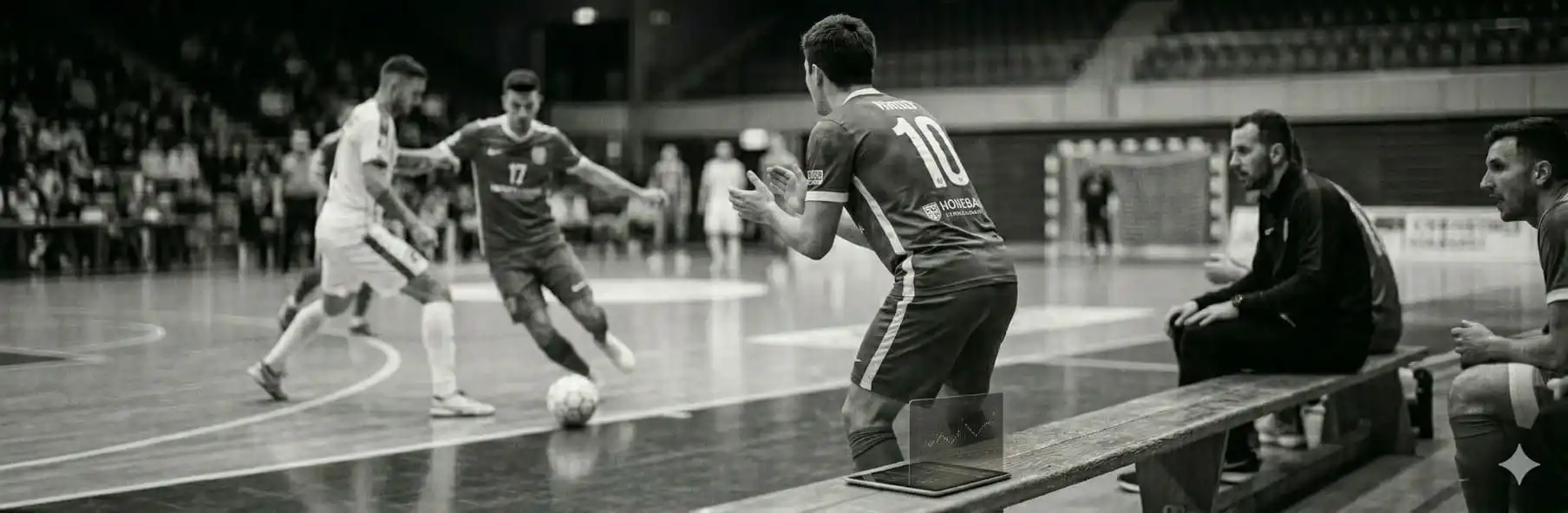
The Psychology of the Bench Player in Futsal: How to Use Data to Keep Your Squad Motivated
How data-driven leadership eliminates the sense of injustice in futsal bench players: strategies for keeping the squad motivated using training metrics and objective feedback.
Written by
João Araújo
Physical Education Teacher (FADEUP – University of Porto) · Futsal Coach – Level II · UEFA B License · Master’s in Physical Education
15 years teaching Physical Education in schools, 20 years coaching futsal at youth development level and 5 years coaching football. Federated and amateur football and futsal player.
There’s a moment every futsal coach knows well: the player who has spent three consecutive weeks on the bench corners you in the corridor after training. The conversation is uncomfortable because your justification, however honest, will always sound subjective. “Tactically you weren’t the right fit”, “the other player was sharper”. Arguments the player accepts rationally but emotionally rejects as excuses.
The alternative: when decisions are grounded in objective data, the conversation changes completely.
The Problem of Perceived Injustice on the Bench
Managing the bench is one of the most demanding components of sports leadership. The bench player is not a problem to be solved. They are a valuable resource that, poorly managed, becomes a source of internal tension that erodes group cohesion.
Sports psychology is clear on the mechanism: when the athlete doesn’t understand the decision criterion, the brain fills the void with the most common interpretation. “I’m not good enough” or “there are personal preferences at play”. Neither interpretation is useful for the player or the team.
What eliminates this mechanism is not more conversation. It is more clarity. And the most powerful clarity comes from data.
How Data Transforms Bench Dynamics
When the coach has objective performance records for each athlete in training, the feedback conversation shifts from opinion to analysis:
- “Over the last three weeks, your defensive pressing rate was the lowest in the group. You were at 6 in a week when the average was 7.8”
- “Your 1v1 defensive decision-making has improved from 4 to 6 since October. That’s the area to keep developing to become a regular starter”
- “The player who came on ahead of you has a 12% pass error rate under pressure vs. 22% for you. That was the criterion for today’s match”
These arguments are not infallible. The player may disagree with the criteria. But they are verifiable, repeatable and impersonal. The discussion shifts from “you prefer him” to “how can I improve this metric?”.
🔧 Useful Tool
Use the SportsLabTools Athlete Journal to record individual training assessments for each player throughout the season. With each athlete’s history accessible, individual feedback conversations are supported by evidence. And the player left on the bench receives not just an explanation, but a concrete roadmap for changing the situation.
The Three Rules of Motivational Bench Management
Rule 1. The Bench Knows When They’re Coming On
Uncertainty is the greatest destroyer of motivation. The solution: in the pre-match briefing, every player knows their role. “Michael comes on at 8 minutes in place of James. If we’re two goals ahead, the plan changes.” This information should ideally be communicated at training the day before.
Rule 2. Bench Feedback Is Positive and Prospective
The feedback to a bench player should not be a defensive justification. It should be an answer to the implicit question they’re asking: “What do I need to do to not be on the bench next week?”
Answering this question is one of the most cost-effective leadership investments a coach can make. The player who understands the path, even if frustrated, focuses on working harder. The player who doesn’t understand the path focuses on resentment.
Rule 3. Data Is Shared Regularly, Not Only in Crisis Moments
Waiting for the difficult corridor conversation to share performance data is a missed opportunity. The most effective approach is integrating data-based feedback into the normal weekly rhythm:
- A brief end-of-session group feedback moment (5 minutes)
- Monthly individual meetings with each athlete
- A system where players can see their own evolution in real time
Structuring Feedback to Bench Players
| Situation | What Not to Say | What to Say (data-based) |
|---|---|---|
| 3rd week on bench | “You weren’t right for the moment” | “Your training RPE has been 5.2. Below the group average. I need you at 6.5+” |
| Not selected | “Others are in better form” | “Your defensive indicators dropped in the last two weeks” |
| Only last-minute appearances | “The game didn’t call for more” | “Your pattern is last 5 minutes because we need more high-pressure data. We’re building that in training” |
See also: The Psychology of Selection: How to Manage Player Expectations
Checklist: Motivational Bench Management
- Selection and squad criteria defined and documented
- Every bench player knows their role before the match
- Individual feedback given based on training data, not just subjective impression
- Systematic record of individual indicators throughout the season
- Monthly individual meetings (especially with least-used players)
- Clear answer to “what do I need to do to play more?” given to each player
- Data shared regularly with the group, not only in moments of tension
Conclusion
The bench is not the problem. It is the mirror of the coach’s leadership quality. When the coach leads with data, transparency and proactive communication, the players who spend most time on the bench often become the hardest workers and the most committed to the process. Because they understand the effort is visible, the criterion is fair, and the path is clear.
Record and share individual development indicators with the SportsLabTools Athlete Journal. Transform individual feedback into a systematic process and keep the entire squad. Starters and bench. Focused on improvement.