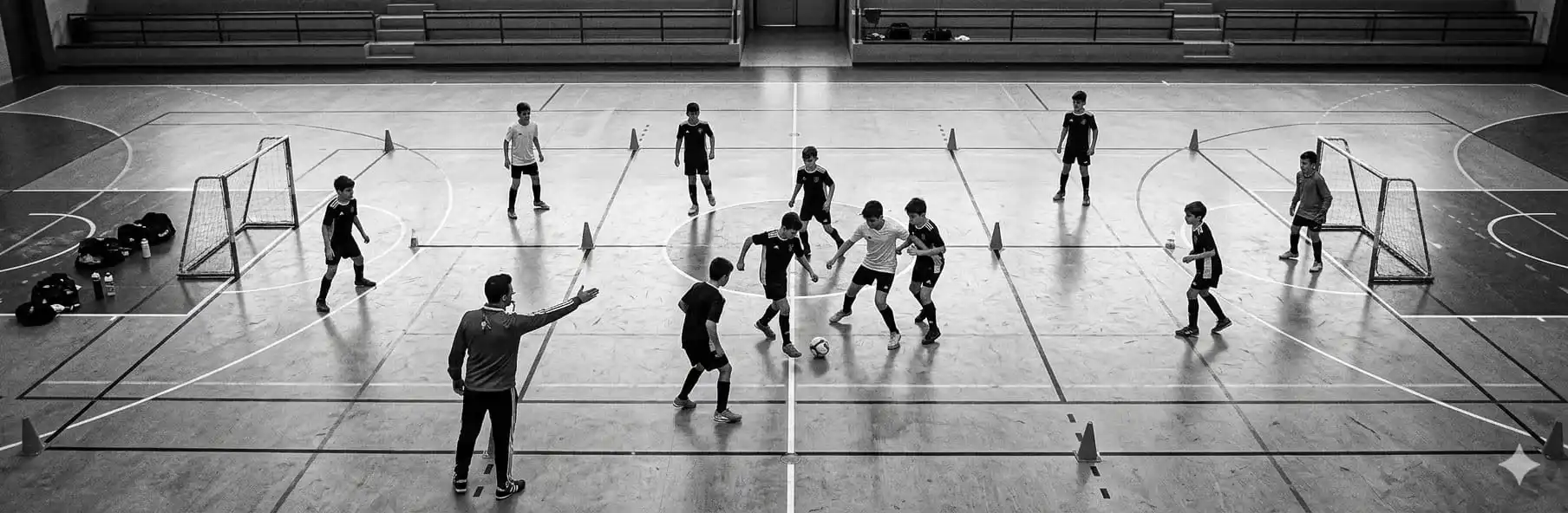
Futsal Drills for Under-13 and Under-15: How to Organise Playing Space
Practical guide for academy coaches: how to divide the sports hall, set up training stations and create futsal drills adapted to Under-13 and Under-15 age groups with clear pedagogical progression.
Written by
João Araújo
Physical Education Teacher (FADEUP – University of Porto) · Futsal Coach – Level II · UEFA B License · Master’s in Physical Education
15 years teaching Physical Education in schools, 20 years coaching futsal at youth development level and 5 years coaching football. Federated and amateur football and futsal player.
A futsal hall with twenty Under-13 players, a ball each and no spatial structure is a recipe for chaos. But the same hall divided into three clearly defined stations, with smooth transitions and age-appropriate drills, transforms a forty-minute session into genuine learning time.
Organising playing space is one of the most neglected skills in youth coaching. And one of the highest-impact ones.
Why Space Organisation Is Critical at Academy Ages
At Under-13 and Under-15 level, players are still developing their ability to read space. A skill that can only be trained when the space is clearly defined and appropriately sized. A full court is too large: young players tend to drift, lose the thread of the exercise and have very few touches on the ball.
Pedagogical principle: the smaller the space, the more ball contacts, the more decision-making opportunities and the more technical-tactical development per unit of time.
How to Divide the Hall: 3 Practical Configurations
Configuration 1. Three Parallel Stations
Divide the hall into three longitudinal lanes (for example, in a 40x20 metre hall, each lane ends up around 40x6-7 metres). Each station works a different theme simultaneously:
- Station A (left channel): individual technical work. Dribbling, receiving, shooting
- Station B (central channel): small-sided collective drill with opposition (2v1, 3v2)
- Station C (right channel): conditioned game with a specific objective
Rotation: every 10 to 12 minutes, groups rotate between stations.
Configuration 2. Double Half-Court
Use each half of the court for a different small-sided game. Allows the whole squad to play simultaneously and gives the coach an easy view of both groups.
Ideal for: developing collective tactical skills (defensive shape, pressure exits, transition) in a real game context but with reduced space.
Configuration 3. Full Court with Marked Zones
Mark the court with cones defining action zones (left channel, right channel, central corridor, box). The drills require the game to pass through the different zones before a shot can be taken.
Ideal for: Under-15 players who already have basic automatisms and need to develop positional awareness and space utilisation in a game.
🔧 Useful Tool
Before the session, use the SportsLabTools Futsal Tactical Board to draw the hall’s division into zones, the station layout and the drill schemes. Present the layout to your players at the start of the session so they understand exactly what they’re going to do and where.
Specific Drills by Age Group
Under-13: Focus on Technique and Play
At this age, space must be small with plenty of ball contacts. Collective drills should have simple rules and clear objectives.
Drill 1. Rondo with Finish (central channel, 4v1 + GK)
- Four attackers in a reduced half-court space against one defender
- Objective: combination pass and shot in fewer than six team touches
- Progression: reduce to 3v1 once the drill is well understood
Drill 2. 2v2 on a Mini-Court
- Court of five by seven metres
- Works pressure exits, short passing and quick decision-making
- Time: three-minute bursts with pair rotations
Under-15: Focus on Collective Principles
At this age, spatial organisation begins to have tactical reading. Drills should include constraints that force correct use of space.
Drill 3. Mandatory Corridor Game
- 4v4 with the rule that each attack must include at least one pass through the wide channel
- No central play without first going through the outside
- Develops awareness of width and depth
Drill 4. 4v3 with Transition
- Four attackers against three defenders plus GK
- When defenders recover the ball, two of them immediately transition into attack (2v2)
- Trains both offensive and defensive transitions in the same drill
Pedagogical Progression: From Under-13 to Under-15
| Skill | Under-13 | Under-15 |
|---|---|---|
| Space size | Small (3v3, 4v4) | Medium (4v4, full court) |
| Opposition | Passive or reduced (1 defender) | Active and balanced |
| Primary focus | Individual technique + simple combinations | Collective tactical organisation |
| Drill rules | Simple with few constraints | With specific tactical conditions |
| Transition | Basic introduction | Automatism in transition |
| Set duration | 3–5 minutes | 6–10 minutes |
Conclusion
Organising playing space is not a logistical decision. It’s a pedagogical one. By structuring the hall with intent, the coach controls the number of ball contacts, the type of decisions players make and the learning rate throughout the session.
For Under-13 and Under-15, the quality of training begins the moment you define the space. Not when you blow the whistle to start.
Plan your training session with spatial clarity. Use the SportsLabTools Futsal Tactical Board to draw your stations, playing zones and drill schemes before arriving at the hall.
Optional accelerator · the tool is always free
A library of exercises instead of drawing every one
Packs of 40 exercises per theme, with an animated tactical diagram, four levels of progression, teaching points and success criteria. Import them and they stay in your library, ready to edit and present to the team.