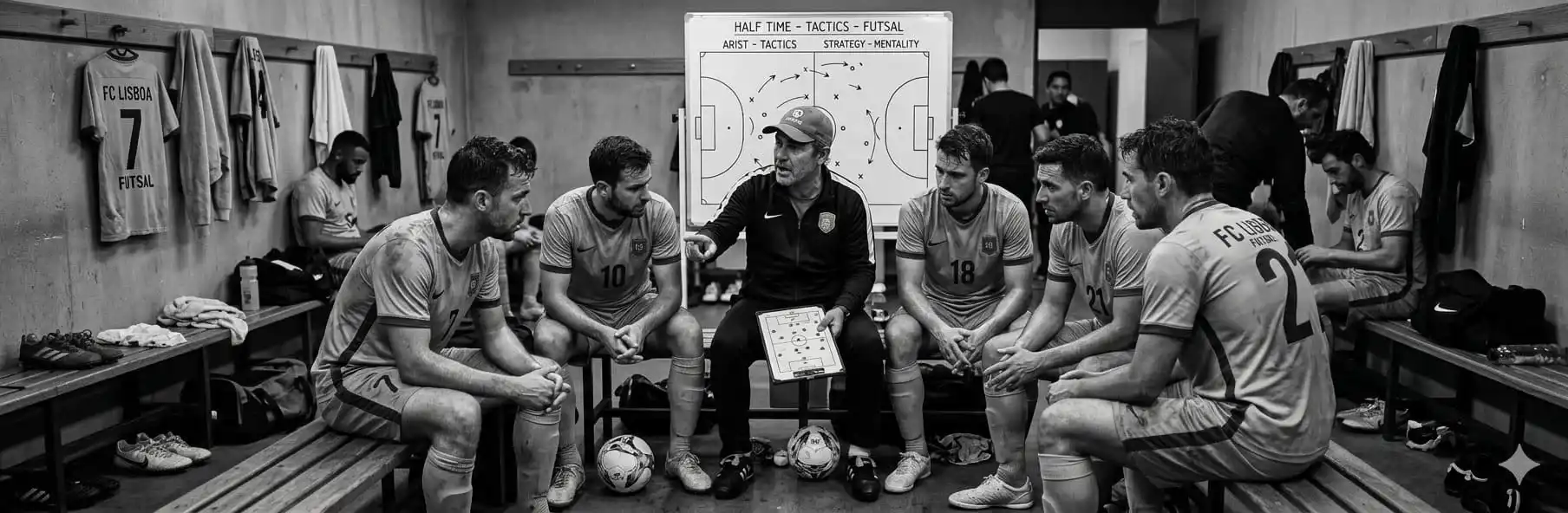
How the 10-Minute Halftime Can Change the Result of a Futsal Match
Learn how to structure the halftime interval in futsal across 4 practical phases to improve second-half performance and influence the final result.
Written by
João Araújo
Physical Education Teacher (FADEUP – University of Porto) · Futsal Coach – Level II · UEFA B License · Master’s in Physical Education
15 years teaching Physical Education in schools, 20 years coaching futsal at youth development level and 5 years coaching football. Federated and amateur football and futsal player.
Research in team sports shows that teams who structure their halftime interval are 23% more likely to improve their second-half performance. Ten minutes is not long. But it is enough to change a game if used well.
The problem is that most coaches arrive at halftime with too much adrenaline and too little plan. The result is a six-minute monologue, disengaged players, and a second half that repeats the same mistakes as the first. The difference between a good and a poor halftime is not what you say. It is when you say it, how you say it, and what you choose not to say.
Why Halftime Is a Different Kind of Challenge
Halftime is not a compressed training session or a performance review. It is a physiological and psychological transition window: players need to recover physically, process what has just happened, and reorient towards what is coming. All in ten minutes.
The coach’s challenge is to manage these three needs simultaneously. The natural temptation is to talk. But a five-minute monologue in a context of high fatigue has an extremely low retention rate. Players absorb the first few sentences and lose the thread after that. Structuring the interval into distinct phases is how to work around this limitation.
The Plan: 10 Minutes in 4 Phases
| Phase | Time | Objective | Action |
|---|---|---|---|
| Decompression | 0-2 min | Physiological recovery | Silence, hydration, breathing |
| Diagnosis | 2-4 min | Identify 1-2 key issues | Coach observes, does not speak yet |
| Communication | 4-7 min | Deliver adjustments | Max. 2 tactical messages + 1 emotional |
| Activation | 7-10 min | Prepare for second half | Short sequence + rallying message |
Phase 1: Decompression (0-2 min)
When players enter the changing room, heart rate is still elevated and the nervous system is in response mode. Speaking at this point has minimal effect. What works is creating a recovery environment: water, deliberate silence, controlled breathing.
The coach does not speak. This time is used to observe. Who is visibly exhausted, who is frustrated, who is composed. This reading will directly inform the next phase.
Phase 2: Diagnosis (2-4 min)
Between minutes two and four, the coach identifies the problems. But does not communicate yet. The objective is not to react to the emotional noise of the game, but to isolate the one or two issues that genuinely explain what happened in the first half.
A useful question: “If we change just one thing, what has the greatest impact?” This forces prioritisation and avoids the most common error. Trying to fix everything at once.
Phase 3: Communication (4-7 min)
Three minutes. Maximum. Two tactical messages and one emotional message.
Tactical messages must be accompanied by the board: a visual diagram is retained far better than words alone. “In the second half, when the fixo receives the ball, the left winger closes the central corridor here”. And show it on the board while speaking.
The emotional message is not empty motivation. It is a specific acknowledgement: “The pressing we put in during the first five minutes was excellent. I want that back from the very first minute of the second half.” Specific, concrete, forward-facing.
Phase 4: Activation (7-10 min)
The final three minutes are for re-engagement. Physically and mentally. A short passing sequence or a two-minute rondo re-engages the muscular system and brings players into the present. The captain says their word. The coach closes with one short, direct sentence.
The Most Common Halftime Mistakes
- Talking too much: The extended monologue is the most frequent error. Beyond three minutes of continuous speech, retention drops sharply.
- Criticising individuals in front of the group: Making one player feel responsible for the result in front of their teammates creates division and reduces that player’s focus in the second half.
- Not using the board: Verbal instructions without visual support are harder to process under fatigue.
- No plan for the second-half opening: The first two minutes of the second half are critical. Entering without a defined opening move wastes the work done at halftime.
- Reacting emotionally: A coach in reactive mode transfers their anxiety directly to the squad.
🔧 SportsLabTools Tactical Board
Communicating tactical adjustments is far more effective with visuals than with words alone. The SportsLabTools Tactical Board lets you draw and share your second-half plan in seconds, even in the changing room.
Communication and Tone of Voice
The tone at halftime should be calm and directive. Not reactive, not emotional, not a Hollywood-style motivational speech. The squad does not need a performance; they need clarity.
A calm tone communicates confidence: “I know what happened, I have the diagnosis, I have the plan.” An anxious or irritable tone communicates the opposite. Players partly regulate their emotional state through their coach’s. Particularly under pressure.
In British football culture, the analytical, composed halftime talk is generally more respected than an emotional outburst. Coaches like Pep Guardiola and Gareth Southgate have popularised a structured, evidence-based approach that works equally well in futsal: specific observations, targeted adjustments, and a clear message for the opening phase of the second half.
See also: Squad Selection Psychology: Managing Player Expectations. How to build trust with your squad before the game even starts.
Checklist: The Perfect Halftime
- Silence and hydration in the first two minutes
- Observe players before speaking. Read the group’s energy
- Identify a maximum of two issues to address
- Use the tactical board for the main instruction
- Keep verbal communication to a maximum of three minutes
- Include one specific, positive emotional message
- Close with a short physical activation (passing sequence or rondo)
- Define the opening move for the first two minutes of the second half
Conclusion
The perfect halftime is not improvised. It is structured. Not in the week before the match, but as a habitual framework: knowing what to do in the first two minutes, knowing how to select adjustments, knowing when to stop talking. These habits are trained like any other coaching skill.
Ten minutes is enough to change the game. The question is whether you use them with intent.
Prepare your halftime tactical adjustments in advance. Use the SportsLabTools Tactical Board to draw your second-half plan and communicate it clearly at the decisive moment.
Optional accelerator · the tool is always free
A library of exercises instead of drawing every one
Packs of 40 exercises per theme, with an animated tactical diagram, four levels of progression, teaching points and success criteria. Import them and they stay in your library, ready to edit and present to the team.