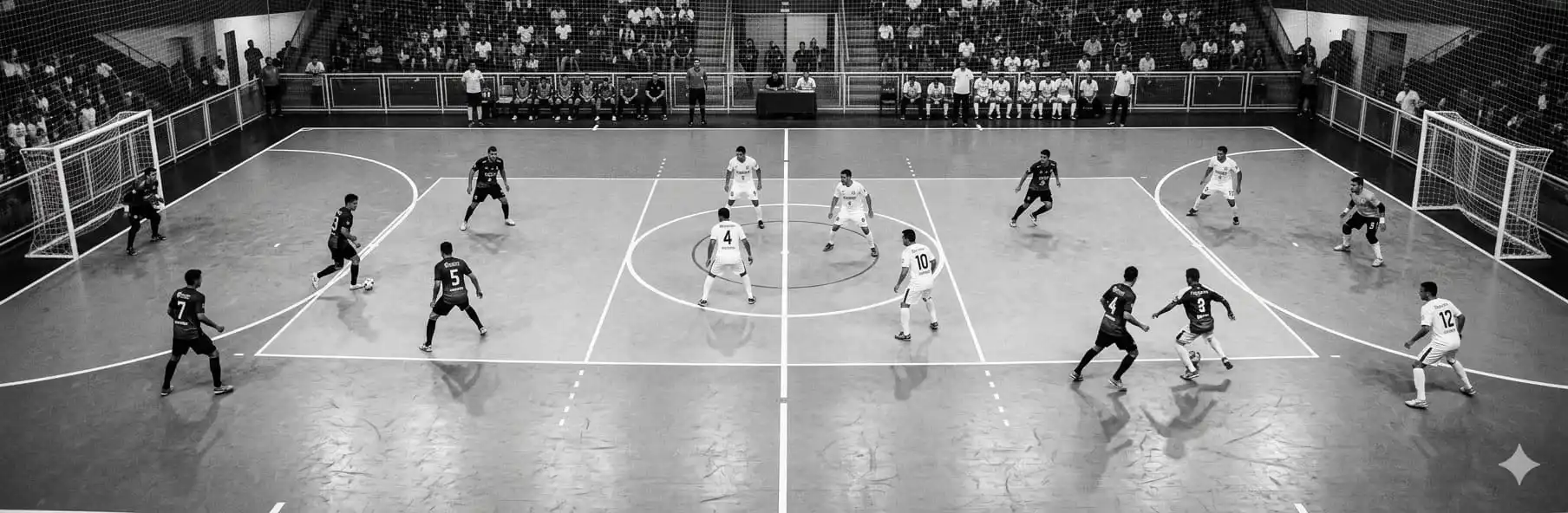
Futsal Tactical Systems: The Complete Guide to 3-1, 2-2 and 4-0
Understand the differences between the 3-1, 2-2 and 4-0 systems in futsal, when to use each one and how to match your tactical model to your squad's strengths.
Written by
João Araújo
Physical Education Teacher (FADEUP – University of Porto) · Futsal Coach – Level II · UEFA B License · Master’s in Physical Education
15 years teaching Physical Education in schools, 20 years coaching futsal at youth development level and 5 years coaching football. Federated and amateur football and futsal player.
Choosing a tactical system is one of the most consequential decisions in building a futsal team. There is no universally superior system. Only the system that best fits your players’ profiles, the competition level and the game model you want to implement. The three most widely used systems in futsal are the 3-1, the 2-2 and the 4-0, each demanding a different player profile and a different reading of the game.
The 3-1 System: Defensive Solidity with an Offensive Reference
The 3-1 organises the team with three players in deeper roles. Two wingers and a fixed player (the equivalent of a defensive midfielder). And one pivot as a permanent offensive reference near the opposition goal.
Strengths
- Excellent for teams with a dominant, technically capable pivot
- Creates superiority in the high-press zone when the fixed player and wingers push forward
- Offers clear build-up options through the fixed player under pressure
- Strong defensive reference: the fixed player covers the central channel
Limitations
- High dependency on the pivot. If nullified, the team loses its main offensive outlet
- Can become predictable against defences that read pivot movements early
- Demands a fixed player with above-average defensive and offensive awareness
When to use: teams with a dominant pivot, matches against compact low-block defences where fixing defenders opens space.
The 2-2 System: Balance and Flexibility
The 2-2 distributes the team as two players in more defensive roles (fixed player and a deeper winger) and two with more attacking responsibility (advanced winger and pivot). It is the most balanced system in terms of defensive-to-offensive transition.
Strengths
- Better balance between attack and defence
- Smoother defensive cover in transitions
- Allows tactical variations. A winger can push forward or drop back contextually
- Suits squads with versatile, adaptable players
Limitations
- Less direct attacking penetration than the 3-1
- Requires precise co-ordination between the two pairs to avoid structural gaps
- Can be neutralised by teams with strong midfield pressure
When to use: balanced matches where transition is critical, developing youth squads, or when the opposition is competitive and defensive stability is a priority.
The 4-0 System: Rotation and Continuous Movement
The 4-0. Sometimes called the diamond or square. Assigns no fixed positions to the four outfield players. All four rotate continuously, disorientating the defence and exploiting spaces created by constant movement.
Strengths
- Very difficult to defend. The defence loses its positional references
- Maximises individual technical quality
- Creates threats from all areas of the court
- Highly effective against zonal defences that rely on positional marking
Limitations
- Demands very high levels of communication and automatism. Players need extensive time training together
- Vulnerable in defensive transitions if players lack positional discipline
- Less effective with highly specialised players (a pure pivot rarely adapts well to the 4-0)
When to use: technically accomplished, experienced squads with established training routines, against opponents with predictable zonal defending.
Choosing the Right System
Three questions should drive the decision:
- What player profiles do I have? A dominant pivot suits the 3-1. Versatile players suit the 4-0 or 2-2.
- What is our collective understanding? The 4-0 demands more automatism. The 3-1 is more intuitive for younger groups.
- Who is the opponent? Compact defensive blocks call for a fixed pivot (3-1). Active, pressing defences call for mobility (4-0).
Practical example: an U15 team with a dominant pivot and little collective rehearsal time gains more from a 3-1 — a clear attacking reference, less automatism required — than from risking a 4-0 that only pays off after weeks of repetition in training. A senior team with versatile players and two years working together, on the other hand, can exploit 4-0 rotations against a predictable zonal defence.
🔧 Useful Tool
Track your tactical structure in real time. Including fouls, goals by system and rotations. With the SportsLabTools Futsal Scoreboard. Log match events live to analyse afterwards which system generated the most goalscoring situations.
Comparison Table: 3-1 vs 2-2 vs 4-0
| Criterion | 3-1 | 2-2 | 4-0 |
|---|---|---|---|
| Defensive organisation | High | High | Medium |
| Offensive dynamism | Medium | Medium | High |
| Execution difficulty | Low | Medium | High |
| Dependence on fixed positions | High | Medium | Low |
| Suitable for youth development | Yes | Yes | No |
| Suitable for top-level competition | Yes | Yes | Yes |
Conclusion
All three systems have genuine tactical value. The issue is never the system itself, but whether it fits the context. A well-drilled 3-1 will beat an improvised 4-0 every time. The key is choosing the model your players can execute with confidence and automatism.
Know your athletes, train the system’s principles consistently. And use real match data to validate what actually works.
Track your team’s tactical performance in real time. Use the SportsLabTools Futsal Scoreboard to log match data and make informed decisions.