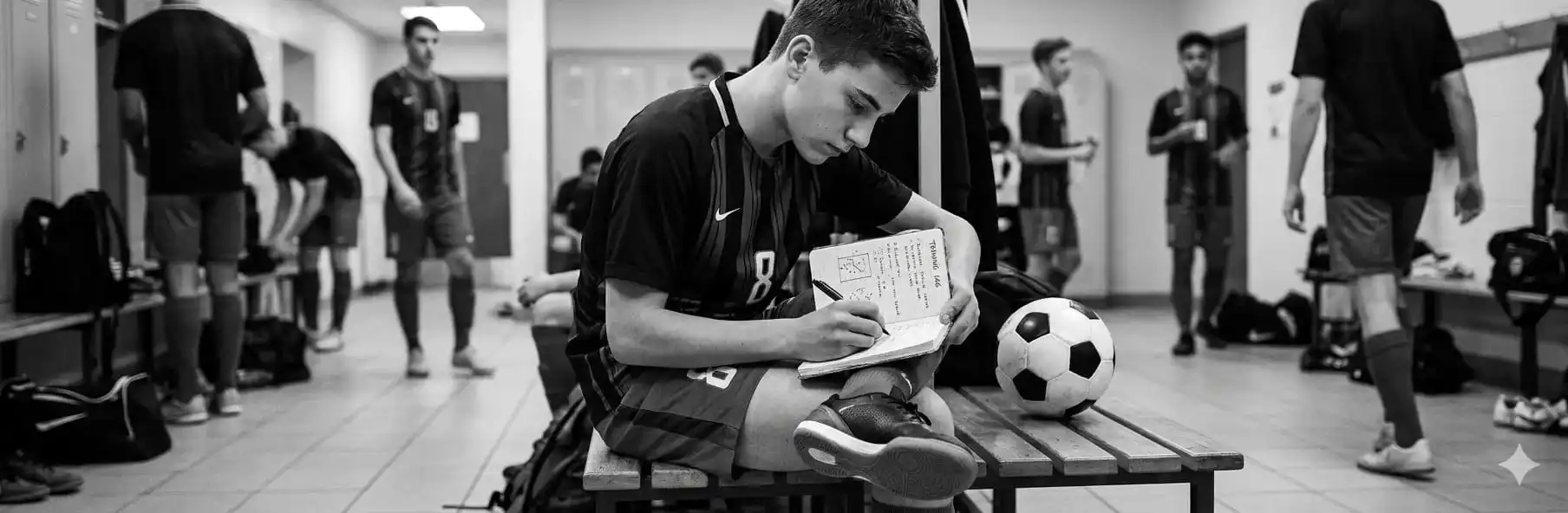
The Training Diary as a Self-Analysis Tool for Young Futsal Talents
How the habit of writing a training diary accelerates tactical learning, focus and mental resilience in young futsal players. And how to implement this elite performance routine in youth development.
Written by
João Araújo
Physical Education Teacher (FADEUP – University of Porto) · Futsal Coach – Level II · UEFA B License · Master’s in Physical Education
15 years teaching Physical Education in schools, 20 years coaching futsal at youth development level and 5 years coaching football. Federated and amateur football and futsal player.
Elite athletes share a secret that is rarely taught in youth academies: they write about what they do. Rafael Nadal, Cristiano Ronaldo, top tennis players, the best athletes across disciplines. Almost all share a common practice that goes far beyond physical training. They reflect, record and systematically analyse their own performance.
In youth futsal, this practice is almost completely absent. And it is a huge opportunity being wasted.
What the Science Says About Reflective Writing in Sport
Sports psychology research is unequivocal about the benefits of reflective writing:
Accelerated learning: writing about a game situation forces the athlete to encode the experience more deeply than simply living it. The process of putting into words “what happened, what I did, what I should have done” activates memory consolidation mechanisms that physical repetition doesn’t activate as effectively.
Enhanced metacognition: metacognition. The ability to think about one’s own thinking. Is one of the most predictive skills for high-level performance. The athlete who can identify their own error patterns, situations where they tend to hesitate, moments where pressure affects them. Has a significant developmental advantage.
Improved emotional regulation: writing about emotionally intense experiences (an error at a critical moment, a conflict with the coach, an unexpected defeat) helps to process and integrate the experience healthily.
What to Write After Each Session
Five guiding questions any young player can answer in five to ten minutes:
Question 1. What did I learn today?
Not “what we did” (that’s a report) but “what I learned that I didn’t know yesterday”. It may be tactical, technical or mental. The specificity is what turns reflection into learning.
Question 2. What was my best moment?
Identifying the most positive moment. Not to be complacent, but to anchor progress in memory. The brain has a natural tendency to focus on the negative. This question is a deliberate counterweight.
Question 3. What did I do poorly and why?
Not “I lost the ball” but “I lost the ball because I attempted the through pass when my teammate hadn’t completed the run yet. I should have waited half a second more.” Specificity is what converts error into learning.
Question 4. What will I work on in the next session?
A concrete intention for the next training session. Written and re-read before training, this intention significantly increases the probability of execution.
Question 5. How am I feeling physically and mentally? (1-10)
A simple record of overall state. Over weeks, this data reveals patterns: energy drops before important matches (anxiety), low mood after consecutive defeats (demotivation risk).
🔧 Useful Tool
Use the SportsLabTools Athlete Journal to record post-training and post-match reflections. The digital structure supports consistency, the history is preserved across the entire season, and the coach can follow the athletes’ reflections. Creating a two-way communication channel that goes far beyond what happens on the court.
How to Implement This Habit in Youth Development
Step 1. The Coach Leads by Example If the coach shares their own reflections (“today I noticed our two-man press works better when the far-side wide player closes the corridor before the near-side presses”), it creates a model and a culture of reflection.
Step 2. Five Minutes at the End of Each Session Reserve the final five minutes of the session for every player to answer the five questions. This time is non-negotiable: not optional, not replaced by conversation. It is silence and writing.
Step 3. Regular Coach-Player Diary Review Once a month, the coach reviews each player’s diary and uses the records as the starting point for individual conversation. “I saw you’ve written three times that you find it hard to call for the ball under pressure. Let’s work on that.”
Step 4. Public Validation of Reflection When a player correctly self-identifies a pattern. Even an error. Acknowledge it publicly. “Ryan identified on his own that his positioning at corners needs adjustment. That’s game intelligence, well done.”
The Training Diary as Pre-Match Mental Preparation
The night before a match, the player can re-read the last three or four entries and identify:
- What progress they’ve made that gives them confidence
- What tactical situations they’ve trained that will appear against the next opponent
- Their current mental state. And how to prepare for the match optimally
See also: The Psychology Behind the Daily Training Record. To deepen the scientific basis for reflective writing in sport and understand how this habit transforms an athlete’s mindset in the long run.
Checklist: Implementing the Training Diary for Young Players
- Five guiding questions defined and communicated to the group
- Five minutes at the end of each session reserved for reflective writing
- Recording format chosen (app, notebook, digital form)
- Coach shares their own reflections to build group culture
- Monthly coach review of each player’s diary
- Intention for the next session written at the end of each entry
- Physical and mental state score (1-10) included in each entry
- Pre-match diary reading integrated into the mental preparation routine
Conclusion
The training diary is the most affordable and most underused development tool in youth futsal. It requires no technology, no court time, no budget. It requires only that the athlete sits down, picks up a pen and asks the most important question any sportsperson can ask: “What did I learn today?”
Start the habit today. Use the SportsLabTools Athlete Journal to give your young players a structured digital self-analysis tool. And watch the mindset transformation unfold over the course of the season.