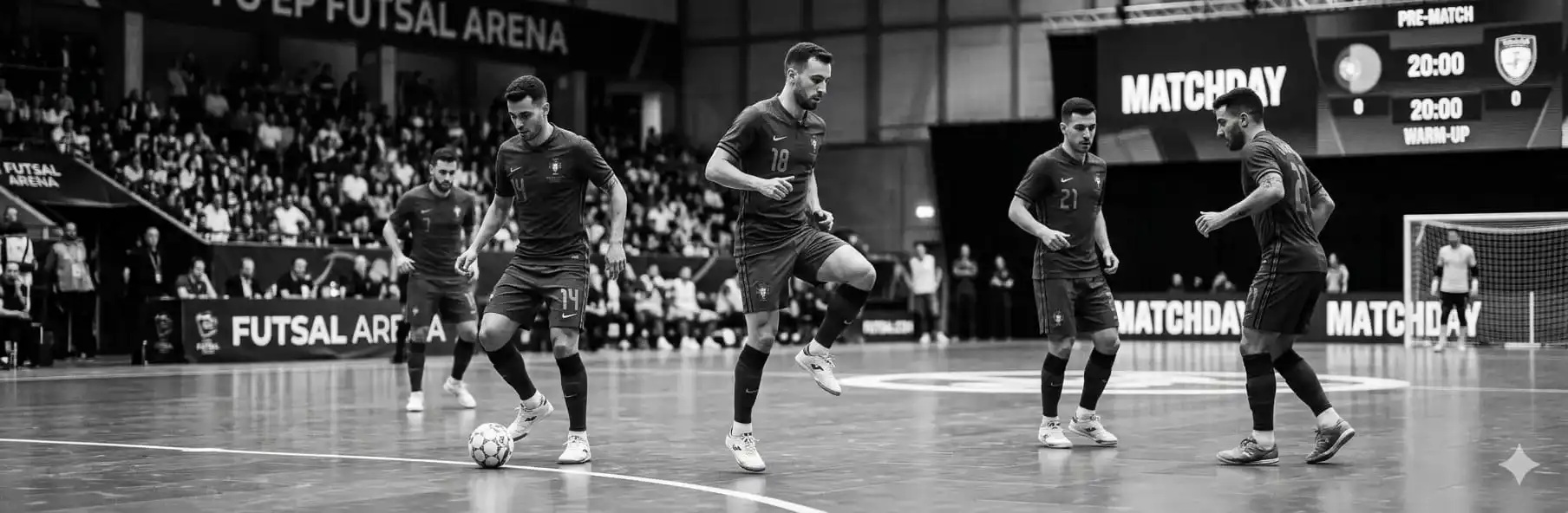
Futsal Warm-Up Protocol: The 20 Minutes Before the Whistle
A proper futsal warm-up transforms how your team starts a match. Step-by-step guide with phases, timing and evidence-based exercises.
Written by
João Araújo
Physical Education Teacher (FADEUP – University of Porto) · Futsal Coach – Level II · UEFA B License · Master’s in Physical Education
15 years teaching Physical Education in schools, 20 years coaching futsal at youth development level and 5 years coaching football. Federated and amateur football and futsal player.
Skeletal muscle requires a minimum of 15 to 20 minutes of specific warm-up to reach optimal contraction temperature. And for the central nervous system to begin processing the game before the opening whistle. In futsal, where explosive actions and direction changes occur from the first seconds, arriving cold at the first challenge is simply not an option.
The problem is not the absence of warm-up. It is the generic approach. Many teams do a lap of the hall and two stretches. This protocol is different: specific, phased, and tactically intentional.
Why the Futsal Warm-Up Is a Different Challenge
Futsal combines high-intensity sprints with very short active recovery periods. Muscle activation requires work in the frontal and transverse planes (direction changes, lateral starts, pivots) that generic running exercises do not prepare.
Beyond physiology, the warm-up in futsal serves a tactical function: it is the moment to lock in pressing principles, initial positioning and inter-line communication. Before any game adversity interferes.
The Plan: 20-Minute Protocol
| Phase | Duration | Goal |
|---|---|---|
| General activation | 4 min | Raise body temperature, joint mobility |
| Neuromuscular activation | 5 min | Acceleration, braking, direction-change patterns |
| Ball activation | 6 min | Touch, reaction, decision in reduced space |
| Tactical work | 4 min | Pressing principles, positioning, first ball |
| Final activation | 1 min | 2-3 maximum sprints + rest |
Phase 1: General Activation (4 min)
Progressive light running + hip, ankle and shoulder mobility. Avoid static stretching. It reduces muscular power output for the first 20 minutes.
Phase 2: Neuromuscular Activation (5 min)
- Lateral starts on an agility ladder
- Single- and double-leg jumps and landings
- Direction changes with braking (3-5 metres)
- Skipping coordination into acceleration
Phase 3: Ball Activation (6 min)
- 3v1 or 4v1 rondos in tight space (3x3 metres)
- Moving passes with 1 touch
- Receiving and shielding under light pressure
Phase 4: Tactical Work (4 min)
- Communicate the initial press (who triggers, which channel, on which signal)
- Reinforce positioning on the opponent’s kick-off
- 2-3 repetitions of the team’s corner or throw-in routine
Phase 5: Final Activation (1 min)
2-3 ten-metre sprints at 100% followed by 30 seconds of light jogging. The nervous system arrives at the whistle already switched on.
The Most Common Warm-Up Mistakes in Futsal
- Static stretching at the start: reduces strength and power for the first 20 minutes of play
- No ball in early phases: players arrive at kick-off without calibrated touch
- Tactical phase skipped: the match’s first ball is frequently lost because positioning was not rehearsed
- Excessive duration: more than 25 minutes increases pre-match fatigue without additional benefit
🔧 Useful Tool
Integrate the warm-up protocol into your team’s weekly plan. SportsLabTools Planning lets you structure each session. Including match days. With defined phases and timings.
Adjustments by Context
- Cold hall: add 2-3 extra minutes to Phase 1; keep layers on until Phase 3
- Second match in 48h: reduce Phase 2 (impact volume); keep Phase 4 complete
- Youth team (U15): extend Phase 3 to 8 min. More touch volume, less formal tactics
See also: Nutrition and Hydration for Match Day: What to Eat Before and After. Fuelling your body and warming up are the two pillars of match-day readiness.
Checklist: Futsal Pre-Match Warm-Up
- Phase 1 without static stretching (active mobility only)
- Neuromuscular activation includes direction changes
- Ball introduced in Phase 3 with touch and decision exercise
- Tactical game principles communicated in Phase 4
- 2-3 maximum sprints in the last 60 seconds
- Total duration between 18 and 22 minutes
- Adjusted if second match in under 72 hours
Conclusion
The warm-up is not pre-match. It is the beginning of the match. Teams that arrive at the whistle with warm muscles, an active nervous system and locked-in tactical principles win the first 5 minutes before the ball rolls. That is not luck. It is a deliberate technical decision.
Plan the warm-up as an integral part of the match-day session. Use SportsLabTools Planning to structure each phase with precise timings and share it with your coaching staff.
Optional accelerator · the tool is always free
Start the season with the whole year already planned
Macrocycle, monthly mesocycles and weekly microcycles with the real season dates, sessions categorised by focus and technical-tactical blocks, and exercises with animated diagrams. From U11 to Seniors, 1 to 5 sessions per week.