My Goal Drought in Football: A Young Striker's Diary
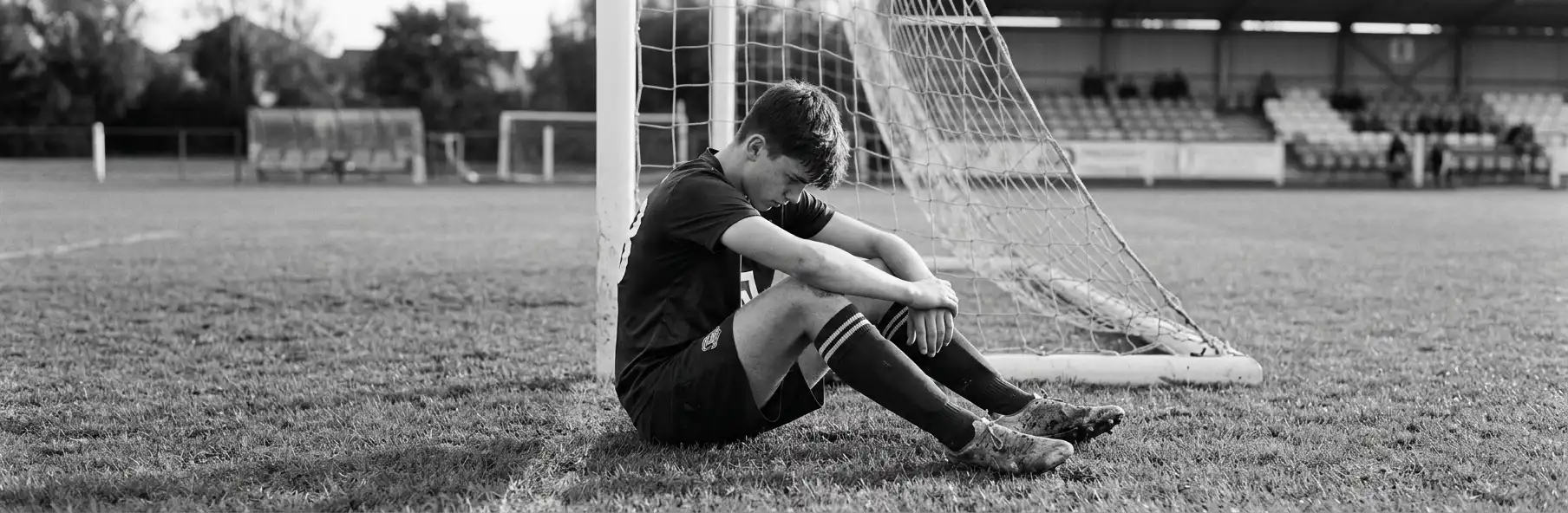
Seven games without scoring, my place on the line and my head heavier than my legs. A first-person diary of a goal drought in youth football.
Written by
João Araújo
Physical Education Teacher (FADEUP – University of Porto) · Futsal Coach – Level II · UEFA B License · Master’s in Physical Education
15 years teaching Physical Education in schools, 20 years coaching futsal at youth development level and 5 years coaching football. Federated and amateur football and futsal player.
Saturday, 5:10pm. Fourth game running where I came on around the 60th minute and did nothing with it. The manager said nothing in the dressing room, and there are days when his silence costs more than a rollicking would. On the coach home I counted on my fingers, head against the window: seven games without scoring. For an u18 striker, seven games feels like a whole season.
Before this drought I scored almost without thinking. I got into the box, the ball turned up, I hit it. Now I get into the box and think about everything at once: my standing foot, the keeper coming out, what the manager is writing on his teamsheet, the two lads on the bench who want my shirt. I think so much that the move has already passed me before I’ve decided what to do with the ball.
I’m writing this because, in the middle of the drought, nobody explained what was actually happening. Everyone around me repeated the same lines, “you’ll get your chance”, “next one comes off”, “keep believing”, and none of them helped me score the eighth goal. What helped was something else, and it took me nearly a month to see it.
The Shot I Put Into the Second Row of the Stand
Against the second-placed side in our league, I played the last twenty minutes. On 74 the exact chance I’d been asking for all week in my head turned up: low cross from the right, their centre-back slipping as he planted his foot, me alone eight yards out with the keeper covering the near post. A month earlier I put that ball in the far corner without even looking up.
That Saturday, I stopped it with the sole of my boot. Set my body. Waited half a second too long. And smashed it over the bar, into the second row of the stand, where my dad was sitting.
The problem wasn’t technical, it was that half a second. When you’re confident, you shoot before the defence recovers. When you’re in a drought, you want to guarantee the perfect goal, and the perfect goal doesn’t exist. There’s only the goal that goes in before the defender arrives. I stood there with my hands on my head, heard a “not again” from somewhere on the bench, and knew I was coming off before the manager lifted the board. I came off on 78.
The Dressing Room Doesn’t Help, and It’s Not Out of Malice
During a drought, the dressing room becomes a strange place. Nobody treats you badly. It’s almost worse: they treat you carefully. Your teammates stop taking the mick after a miss, and that’s when you know it’s bad, because the usual stick is a sign that nobody’s worried. The manager starts talking to you in a lower voice, in the tone of someone who doesn’t want to break anything.
An older lad, who’d been through this the year before, said something to me in the dressing room after that game: “Stop trying to score the goal that ends the drought. Score the next scruffy one that comes along.” I’m not sure that line changed anything, but it was the first one that didn’t leave me worse than I already was.
That Was the Week I Started Writing Everything Down
The Monday after, instead of pretending the game hadn’t happened, I sat at the kitchen table and wrote. Date, minutes played, chances I had, what I felt in the seconds before each shot. It wasn’t to show anyone. It was to stop lying to myself, because in my head the drought was “I haven’t scored in months” and on paper it was seven games, four of them off the bench, and only three genuine clear chances actually missed. Three. The rest of the time I hadn’t even shot.
I started logging this properly in the SportsLabTools Athlete Journal tool after every game: minutes, chances, and the state of my head before going on. After three weeks the pattern jumped out on its own. I scored in the games where I came on properly warmed up and I missed in the games where I came on staring at the substitution board, thinking about who was going off. The problem wasn’t my right foot. It was my head arriving at the game ten minutes after my body.
What the Numbers Showed That My Eyes Didn’t
I asked our team’s kit man for the data from the last few games. Nothing complicated: number of shots, area of the pitch I shot from, passes I received inside the box. I ran it all through the SportsLabTools Stats tool and saw something that left me relieved and embarrassed at the same time.
Across the seven drought games, I received less than half as many balls inside the box as in the games before. I wasn’t missing more goals. I was shooting far less, because I’d started dropping deep looking for a touch, away from where strikers score. In my head, the story was “I’ve lost my scoring instinct”. In the numbers, the story was “I’ve stopped being in the box”.
Those are two different things and they get fixed in different ways. The first one puts you in an office talking about your feelings. The second one puts you on the Wednesday training ground repeating runs in behind the centre-back. Mine was the second one, and just as well, because that one I knew how to train.
What I Changed After That
Three changes, all small.
First, I agreed with the manager that I’d always come on properly warm: ten minutes of running and finishing behind the goal before going to the touchline, not the usual two little jumps while I wait for the sub. Second, I gave myself a simple rule inside the box: the first touch is to shoot, not to tidy up. If it goes wrong, let it go wrong with my foot going through the ball. Third, I stopped dropping into midfield looking for the game. My job is to occupy the five yards in front of goal and be a nuisance to centre-backs, even if I go twenty minutes without a single touch.
The eighth goal came three games later. Cross from the left, near post, glancing header, nothing special. It wasn’t the best goal I’ve ever scored. It was the scruffy one the older lad had talked about, and it was the one that ended the count. The count was the only thing that had actually been weighing on me.
See also: How to Rebuild a Player’s Confidence After a Costly Mistake in Football, the same problem seen from the side of the coach who has to manage a low player’s head.
If you’re in a drought right now, I’ll leave you with just this. It might be that half of what worked for me was luck turning the other way, I don’t know. But before you accept that you’ve “lost your instinct”, count how many times per game you’re actually shooting. A lot of droughts aren’t finishing droughts. They’re presence-in-the-box droughts, and presence is something you count on paper, not something you feel in your stomach.
*This account is based on a real case, but the person's identity has been kept private and some contextual details have been recreated for illustrative purposes.*
Optional accelerator · the tool is always free
Reliable stats as soon as the next match
An action taxonomy ready for live logging from the bench, with pitch and goal location already active — heat maps and shot maps without configuring anything.