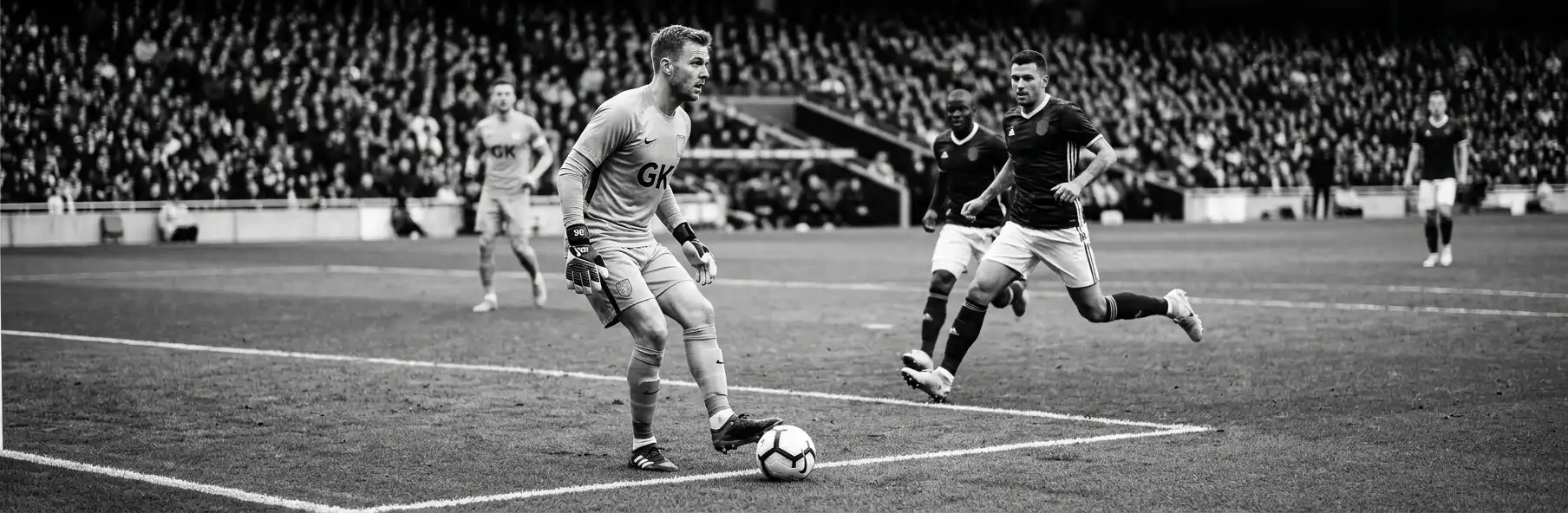
Goalkeeper Distribution Under Pressure in Football: Short or Long?
Short along the ground or a long clearance: how to decide the goalkeeper's distribution under opposition pressure, and the criteria behind each option.
Written by
João Araújo
Physical Education Teacher (FADEUP – University of Porto) · Futsal Coach – Level II · UEFA B License · Master’s in Physical Education
15 years teaching Physical Education in schools, 20 years coaching futsal at youth development level and 5 years coaching football. Federated and amateur football and futsal player.
There’s no universally correct answer between playing out short along the ground or clearing long. There’s the correct answer for that specific moment of the match. The most common mistake isn’t picking the “wrong” option in the abstract, it’s applying the same option every time regardless of the pressure, the scoreline, and the risk the team can afford to take at that minute.
A goalkeeper who only ever plays out short becomes predictable and dangerous when the opposition presses well; a goalkeeper who only ever clears long wastes valuable possession whenever there’s space to build. The decision needs criteria, not a default habit.
Option 1: Short Build-Up Along the Ground
Characteristics and Advantages
Keeps possession, draws the opposition’s press, and creates space behind their first line if the build-up succeeds. Technically develops both the defenders and the goalkeeper himself.
Limitations
High risk if the opposition’s press is well organised and the team lacks the necessary support patterns; a mistake in the build-up can result in an immediate goal.
When to use it: opposition press is disorganised or thin on numbers in the first line, the scoreline allows the team to take on risk, and the defenders have the technical confidence to resolve situations under pressure.
Option 2: Long Ball (Direct Play)
Characteristics and Advantages
Removes the immediate risk of a dangerous turnover near your own goal and quickly exploits the space behind the opposition’s back line, especially with strong aerial forwards.
Limitations
Possession is lost more often statistically, and control of the match is reduced; overusing it makes the team predictable and dependent on winning second balls.
When to use it: very intense and well-organised opposition pressing, a lead to protect, or forwards with the physical profile to win aerial duels.
How to Choose: Decision Criteria
- How many players does the opposition commit to pressing the first line of build-up?
- What’s the scoreline, and how much risk can the team afford to take right now?
- Do the defenders and goalkeeper have the technical confidence and the practised patterns to resolve the short build-up under pressure?
Practical example: with a 1-goal lead in the last 10 minutes, against an opponent pushing two forwards onto the first pressing line, the safest option is direct play to the forward strongest in the air — risking the short build-up in that context is only justified if the team already clearly masters its patterns for building out under pressure.
🔧 Useful Tool
Reviewing on video the moments the team played out short successfully, and the ones where a build-up mistake led to a goal, helps the goalkeeper calibrate his real-time decision-making better. SportsLabTools Tactical Board lets you prepare and communicate build-up patterns to the squad for each pressing scenario.
Comparison Table: Short Build-Up vs. Long Ball
| Criterion | Short Build-Up | Long Ball |
|---|---|---|
| Risk of a dangerous turnover | High | Low |
| Possession control | High | Low |
| Requires team-wide patterns | Yes | No |
| Better against intense pressing | No | Yes |
See also: Build-Up Play from the Back: How to Play Out Against a High Press. The collective build-up principles underlying the goalkeeper’s decision.
Conclusion
A goalkeeper’s distribution isn’t a fixed style. It’s a situational decision that depends on opposition pressure, the scoreline, and the team’s technical confidence. Training both options, and the criteria for choosing between them, is what makes a modern goalkeeper unpredictable and effective.
Prepare build-up patterns with your goalkeeper for every pressing scenario. Use SportsLabTools Tactical Board to communicate those decisions to the squad.
Optional accelerator · the tool is always free
A library of exercises instead of drawing every one
Packs of 40 exercises per theme, with an animated tactical diagram, four levels of progression, teaching points and success criteria. Import them and they stay in your library, ready to edit and present to the team.