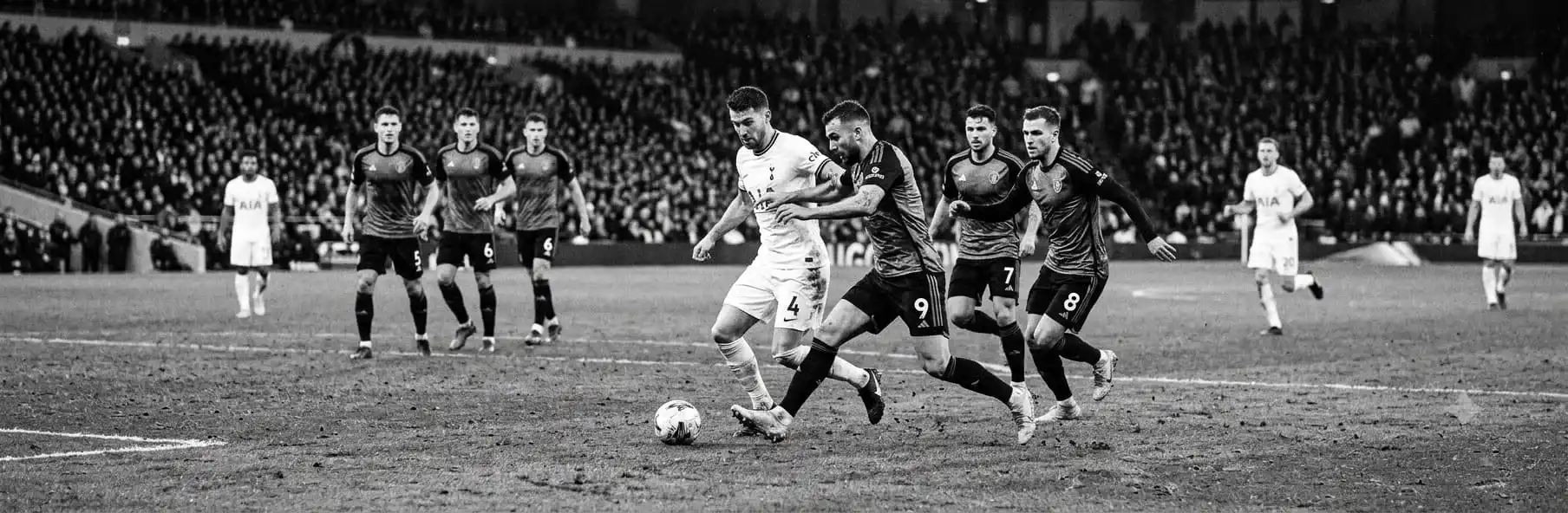
High Press in Football: Pressing Lines and Triggers to Win the Ball Back
A practical guide to high pressing in football: how to organise your three pressing lines, set clear triggers, and avoid the errors that leave space in behind.
Written by
João Araújo
Physical Education Teacher (FADEUP – University of Porto) · Futsal Coach – Level II · UEFA B License · Master’s in Physical Education
15 years teaching Physical Education in schools, 20 years coaching futsal at youth development level and 5 years coaching football. Federated and amateur football and futsal player.
A high press without structure is worse than not pressing at all. A team that pushes its defensive line up without coordination between its three blocks opens motorways for the opposition to play through; the outcome is usually worse than staying organised in a mid-block.
Effective high pressing isn’t about outrunning the opposition. It’s about clear triggers, cover between the lines, and the discipline to execute it as a unit rather than as individuals.
The Problem: Individual Pressing Isn’t Collective Pressing
The most common mistake at grassroots and academy level is confusing “pressing” with “chasing the ball.” A striker who presses alone, without the nearest midfielder closing the next passing lane, simply pushes the ball into the space he’s just vacated. The opposition plays out easily and the team is left disorganised behind the player who pressed.
High pressing without synchronisation between the lines costs more goals than it prevents.
Core Principle: The Three Pressing Lines
High pressing works as a system of three blocks moving together:
- Pressing line (forwards). trigger the press and force the opposition’s build-up towards a predictable side
- Cover line (midfielders). close the immediate passing lanes and anticipate the next pass
- Defensive line (defenders). steps up as a compact block, reducing the gap between the lines and removing depth
If any one of the three lines fails to move together, the press collapses.
Practical Application: Setting Clear Triggers
“Press” is not an instruction. it’s vague, and every player interprets it differently. Triggers need to be specific and drilled:
- Back pass to the centre-back. signal for the forward to accelerate the press and cut the passing lane to the goalkeeper
- Sideways pass with no close support. The receiving player is isolated; this is the moment to double up
- Receiving with their back to goal. The opponent loses sight of the game; immediate pressure from the nearest midfielder
- A loose ball or heavy touch: instant pressure from every nearby player, no exceptions
Drilling these triggers in shadow-play exercises before applying them in matches cuts down on collective reading errors.
Common High Pressing Mistakes
- Individual pressing without cover; one player steps up and nobody closes the space he leaves behind
- The back line doesn’t step up together. creates too much distance between forwards and defenders, easy to exploit between the lines
- No drilled triggers. random pressure driven by individual initiative rather than a collective pattern
- Not dropping off once the press is beaten, persisting with the press after the opposition has played through creates numerical disadvantage against your own team
🔧 Useful Tool
Identifying where the press breaks down means reviewing the exact moments the lines lose sync. SportsLabTools Video Analysis lets you clip and tag every pressing action to show the squad, clearly, where the trigger worked and where it failed.
When Not to Press High
High pressing isn’t the right answer at every moment of the match. Situations where dropping into a mid- or low-block makes more sense:
- Numerical disadvantage after a red card or an injury with no substitutions left
- The final 15 minutes with a favourable scoreline and high physical fatigue
- An opponent with fast attackers in behind and a back line that’s slow to recover
See also: Video Analysis in Pre-Season Friendlies: What to Assess Before the Competition. how to use friendlies to test your high press before the season starts.
Checklist: Coordinated High Press
- Three pressing lines defined and drilled through shadow-play exercises
- Specific pressing triggers communicated to the whole squad
- A clear cover rule: who closes the space left by the pressing player
- A defined drop-off signal for when the press is beaten
- Back line steps up in sync with the pressing line
- Situations to avoid high pressing identified in advance
- Post-match video review focused on moments of lost synchronisation
Conclusion
Successful high pressing isn’t about individual intensity. it’s about collective organisation. Teams that drill specific triggers and cover between the lines win the ball back in dangerous areas without leaving space in their own.
Review every pressing action clearly and correct the triggers that fail. Use SportsLabTools Video Analysis to prepare next week’s collective correction session.
Optional accelerator · the tool is always free
Start tagging matches without spending hours building categories
An analysis model with 12 categories and more than 60 actions organised by game moment, already carrying individual/collective context and pitch and goal location. Import it and tag your first clip right away.