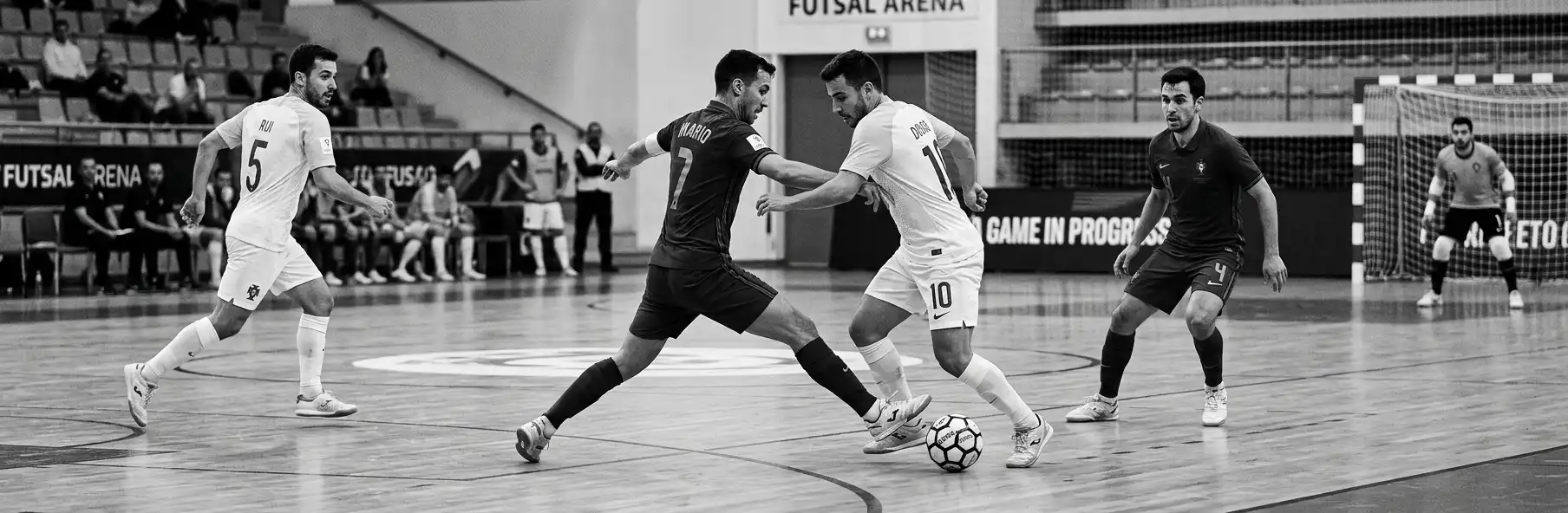
High Press in Futsal Doesn't Always Pay Off: When the Risk Outweighs the Reward
High press in futsal is the most shared coaching tactic on social media. It's also the most badly applied by amateur teams. When the risk of using it clearly outweighs the reward.
Written by
João Araújo
Physical Education Teacher (FADEUP – University of Porto) · Futsal Coach – Level II · UEFA B License · Master’s in Physical Education
15 years teaching Physical Education in schools, 20 years coaching futsal at youth development level and 5 years coaching football. Federated and amateur football and futsal player.
High press in futsal is, by far, the most shared coaching tactic on social media. It makes sense: few images are as satisfying as a team closing down all the space and stealing the ball right next to the opponent’s goal. What those clips rarely mention is that the same tactic, applied by the wrong team, at the wrong moment in the match, is probably the most costly tactical decision an amateur coach can make.
What Everyone Says (And Why It’s Wrong)
The common line is: “high press is always the more aggressive, winning option, if the team has the courage to do it.” It isn’t. That idea treats courage as the only necessary condition, ignoring that high press in futsal, on a 40x20 metre court with no offside, exposes the team to lightning-fast transitions the moment one pressing line breaks down. There isn’t enough midfield to recover from the error the way there is in eleven-a-side football.
What the Data and Experience Show
I worked with an amateur senior team that decided to install full-time high press after watching clips of Barcelona or ElPozo Murcia in total press. In the first two matches, the team conceded more goals on fast transitions than in the entire first half of the previous league season. It wasn’t a lack of intensity; it was a lack of synchronisation between the four pressing lines and, above all, a lack of conditioning to repeat sprint efforts every 10-15 seconds across entire 20-minute periods. Without that base, the second presser always arrives half a second late, and that half second is more than enough time for the opposing pivot to break free in behind.
That’s why I use the SportsLabTools Tactical Board tool to map out, player by player, the cover for each pressing line before testing it in a real match, not for a nice-looking animation but to confirm whether the squad actually has enough reaction speed to cover the spaces high press opens up behind it.
When the General Rule Still Applies
I’m not saying high press has no place at amateur level; I’m saying it rarely works as a permanent system across all 40 minutes. Where it does work, even at amateur level, is as a targeted weapon: the first few minutes of each period, when the team is physically fresh, or after the opposition loses a set piece, when the team is already naturally compact. I’m also not entirely sure this applies the same way to younger age groups, such as u13s and u15s, where the ability to repeat maximal efforts is even more limited, though teaching the principles of compactness early is still worth it.
See also: High Press in Futsal: How to Implement It, When to Use It, and How to Beat It, the full guide to setting up the lines and triggers, if you do decide to go ahead with the system.
High press isn’t a philosophy you install in one session after watching a motivational video. It’s the consequence of a team that’s already conditioned to repeat maximal efforts and already synchronised on its cover, choosing to use that base to press early too. If your amateur squad doesn’t have both of those things first, what you’re training isn’t high press: it’s handing the opposition easy transitions every time you lose the ball.
Test the cover before taking it onto the court. Use the SportsLabTools Tactical Board tool to map your high press lines.
*This account is based on a real case, but the person's identity has been kept private and some contextual details have been recreated for illustrative purposes.*
Optional accelerator · the tool is always free
A library of exercises instead of drawing every one
Packs of 40 exercises per theme, with an animated tactical diagram, four levels of progression, teaching points and success criteria. Import them and they stay in your library, ready to edit and present to the team.