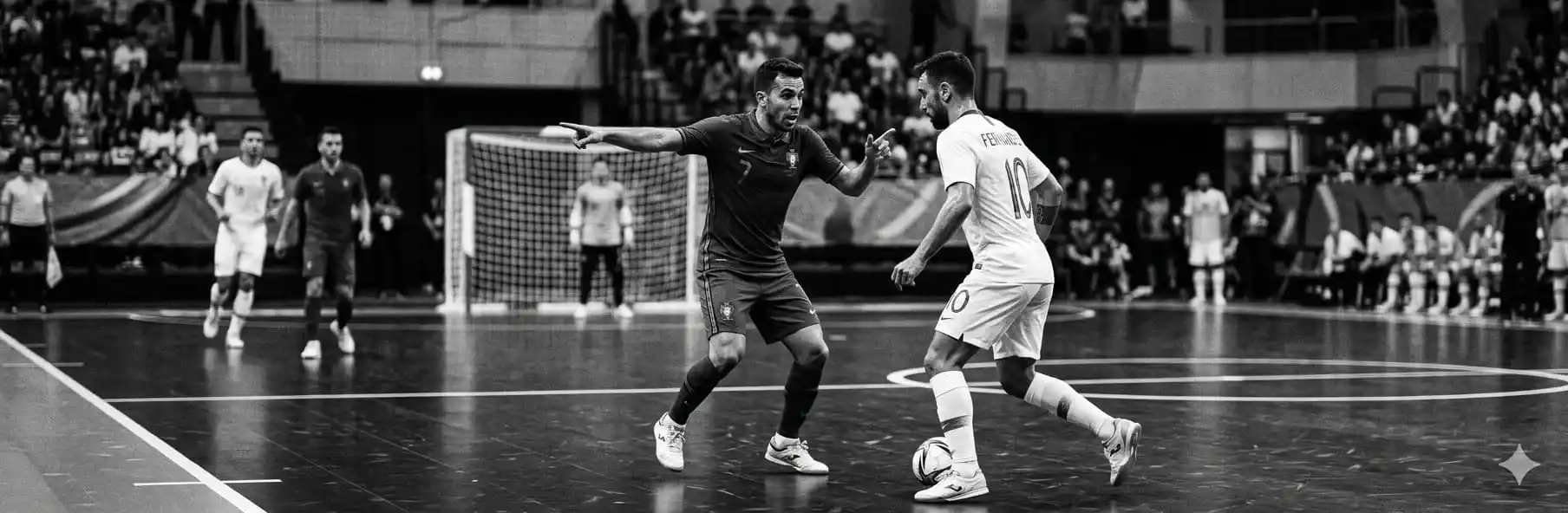
In-Match Communication in Futsal: Building an Effective Signal System
In-match communication in futsal is a trainable skill. Learn to create a verbal and gestural signal system your team can actually execute under match pressure.
Written by
João Araújo
Physical Education Teacher (FADEUP – University of Porto) · Futsal Coach – Level II · UEFA B License · Master’s in Physical Education
15 years teaching Physical Education in schools, 20 years coaching futsal at youth development level and 5 years coaching football. Federated and amateur football and futsal player.
On-court communication is one of the most underestimated skills in futsal. It is not the ability to shout louder. It is the ability to deliver relevant information at the right moment, with the lowest possible cognitive load for the receiver. A player processing an instruction during a transition is not defending.
The goal of an effective signal system is not to communicate more. It is to communicate better, with fewer words and zero ambiguity.
The Real Problem with Futsal Communication
The pace of play in futsal is higher than in 11-a-side football. This means the time window in which a verbal instruction can be received, processed and executed is very short. Research in team sports indicates that instructions of more than 3 words significantly reduce the probability of correct execution under pressure.
Additionally, many teams have “bench communication” but not “court communication”. players know what the coach wants, but do not communicate with each other during the game.
Core Principles of a Signal System
1. Maximum Brevity
Every signal must be communicable in 1-2 syllables or 1 gesture. “Press!” works. “Close the right side and apply pressure!” does not work in transition.
2. Communication Hierarchy
Define who communicates what. The goalkeeper has full pitch vision. communicates positioning and defensive lines. The universal player communicates press and transition. The winger communicates individual marking references. Without hierarchy, everyone speaks and no one listens.
3. Consistency Throughout the Season
Changing signals mid-season increases error. Introduce one new signal per week, in training, with context.
Practical Application: Essential Signals by Situation
Defensive Transition
- “Block!”. whole team retreats to organised defensive position
- “Mark!”. each player references the nearest opponent
- “GK out!” / “GK stay!”. goalkeeper positioning instruction in transition
High Press
- “Go!”. signal to trigger pressing (define who initiates it)
- “Cut [side]!”. winger closes interior or exterior channel
Offensive Organisation
- “Ball!”. I am available, play it now
- “Hold!”. keep possession, no passing line available
- “Pivot, drop!”. instruction for positional readjustment
Set Pieces
Each corner or throw-in routine has a single code word defined in training (“Alpha”, “Bravo”, etc.). The captain communicates the code before execution.
🔧 Useful Tool
Prepare tactical setups with associated signals before training. The SportsLabTools Tactical Board lets you visualise and share each situation with the squad, anchoring the visual code before execution on court.
Common Mistakes to Avoid
- Communicating the obvious: “there’s a player behind you!” when the player already knows. Communicate only what the receiver cannot see for themselves.
- Aggressive tone: hostile communication closes down information reception. Give instructions in a neutral, non-emotional tone.
- Untrained signals: a signal that has never been repeated in training does not exist in a real match.
- Single captain: delegating communication to one player creates single points of failure. Each position must have defined responsibilities.
See also: Zone vs. Man-to-Man Defence in Futsal: Complete Tactical Guide. The signal system is what allows your defensive structure to switch in real time.
Checklist: On-Court Communication System
- Each signal has a maximum of 2 syllables or 1 defined gesture
- Communication hierarchy defined by position
- Defensive transition signals trained in context
- High-press signals integrated into warm-up routines
- Set-piece codes defined and repeated weekly
- Goalkeeper has specific positioning signals
- Quarterly review of system with removal of unused signals
Conclusion
An effective signal system is not built in a day. It is built repetition by repetition, in training, with feedback. The ultimate goal is for communication to disappear: players execute because the code is automated, not because someone shouted.
Create and organise tactical setups with associated signals. Use the SportsLabTools Tactical Board to anchor each situation visually and share it with all members of your coaching staff.
Optional accelerator · the tool is always free
A library of exercises instead of drawing every one
Packs of 40 exercises per theme, with an animated tactical diagram, four levels of progression, teaching points and success criteria. Import them and they stay in your library, ready to edit and present to the team.