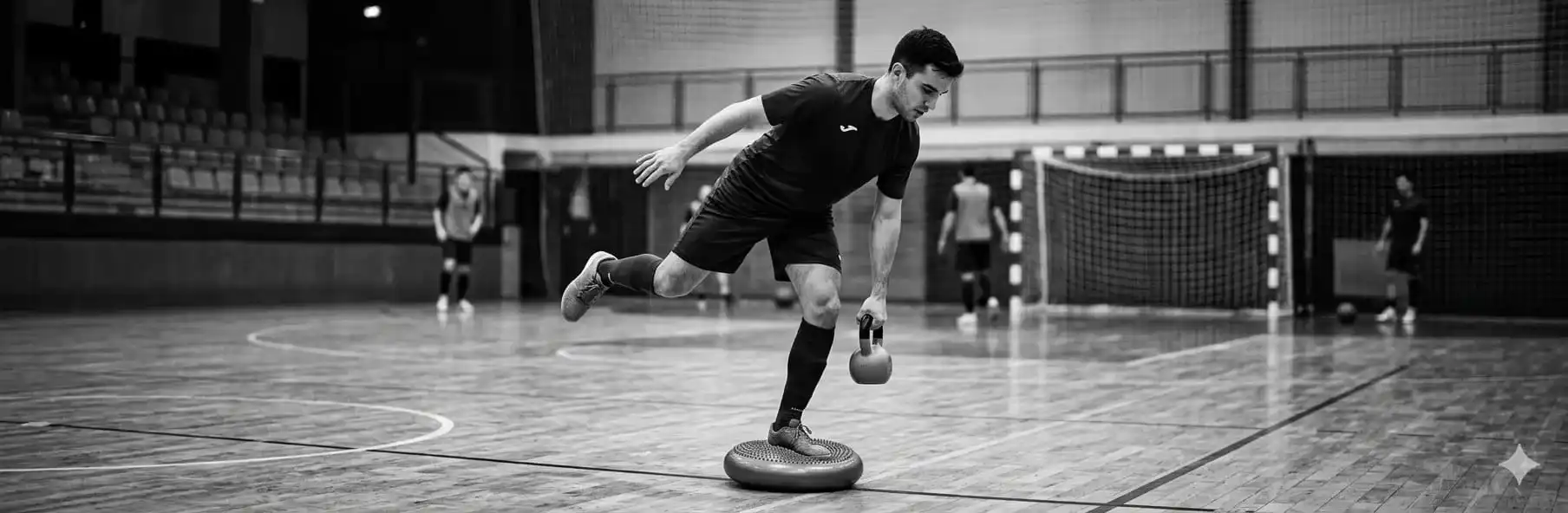
Injury Prevention in Futsal: Proprioception and Strengthening Exercises
Learn how to prevent the most common futsal injuries with proprioception exercises, muscle strengthening routines and activation protocols. A practical guide for coaches and athletes.
Written by
João Araújo
Physical Education Teacher (FADEUP – University of Porto) · Futsal Coach – Level II · UEFA B License · Master’s in Physical Education
15 years teaching Physical Education in schools, 20 years coaching futsal at youth development level and 5 years coaching football. Federated and amateur football and futsal player.
Futsal is one of the sports with the highest incidence of lower limb injuries. The ankle, knee and thigh are the most vulnerable areas. The good news: most of these injuries are preventable with a structured programme of proprioception training and muscle strengthening. This guide presents the most effective exercises and how to integrate them into the training routine.
The Most Common Injuries in Futsal
Ankle
Lateral ankle sprains are the most frequent injury in futsal, accounting for approximately 25–30% of all occurrences. The hard court surface and explosive multi-directional starts increase the risk significantly.
Knee
- Patellar tendinopathy (jumper’s knee): chronic overload from repeated jumps and changes of direction
- Cruciate ligament injuries: less frequent but with serious impact and long recovery periods
- Iliotibial band syndrome: lateral knee pain from repetitive use
Thigh and Hip
- Hamstring strains: common during maximal sprints and sudden deceleration
- Adductor contracture: frequent in wide lateral movements
Proprioception: What It Is and Why It Matters
Proprioception is the nervous system’s ability to sense the position and movement of the body in space. An athlete with good proprioception reacts more quickly to imbalances and adjusts posture instinctively, reducing the risk of sprains and falls.
Ankle Proprioception Exercises
Level 1. Foundation:
- Single-leg balance on a stable surface: 3 × 30 seconds per foot
- Single-leg balance with eyes closed: 3 × 20 seconds per foot
Level 2. Progression:
- Balance on proprioceptive disc: 3 × 45 seconds per foot
- Receiving a pass on single-leg stance: 3 × 10 reps per foot
Level 3. Functional:
- Single-leg squat with external perturbation (coach touch): 3 × 8 per foot
- Mini-trampoline with ball reception: 2 × 12 reps per foot
Knee Proprioception Exercises
- Y-balance squat: 3 × 10 reps (reach with the free leg in 3 directions)
- Single-leg hop with landing absorption: 3 × 8 per leg, focus on knee alignment
- Side planks with trunk rotation: 3 × 12 reps
Strength Training for Injury Prevention
Hamstrings and Posterior Thigh
- Nordic hamstring curls: 3 × 6–8 reps. strong evidence for reducing hamstring injuries
- Glute bridge with resistance band: 3 × 15 reps
- Eccentric leg curl on bench: 3 × 10 reps
Ankle and Calf
- Single-leg calf raises (eccentric phase): 3 × 15 reps, slow descent
- Dorsiflexion with resistance band: 3 × 20 per foot
- Box jump with controlled landing: 3 × 8 reps
Core and Hip Stability
- Front and side plank: 3 × 30–45 seconds
- Hip abduction with resistance band: 3 × 15 per side
- Dead bug: 3 × 10 reps per side
How to Integrate into the Training Routine
| Training Phase | Recommended Exercises | Duration |
|---|---|---|
| Activation (pre-training) | Level 1 proprioception + joint mobility | 8–10 min |
| Specific work | Eccentric strengthening + level 2 proprioception | 15–20 min |
| Post-training / recovery | Stretching + stability exercises | 10 min |
| Dedicated session (1×/week) | Full prevention programme | 30–40 min |
Key principle: consistency beats intensity. A simple programme done three times per week produces better results than an intensive programme done sporadically.
Return-to-Training Protocol After Injury
After a sprain or muscle injury, the return must be gradual:
- Phase 1 (0–72h): RICE (rest, ice, compression, elevation) + passive mobility
- Phase 2 (3–10 days): level 1 proprioception, no impact
- Phase 3 (10–21 days): light strengthening, level 2 proprioception, aerobic work without contact
- Phase 4 (21+ days): progressive return to team training with monitoring
🔧 Useful Tool
The SportsLabTools Futsal Scoreboard lets you log match events in real time, including injury substitutions. valuable data for identifying injury patterns across the season and informing prevention decisions.
Conclusion
Injury prevention in futsal is not complicated. It requires consistency and method. A 15 to 20-minute programme, integrated into the training routine, can significantly reduce the number of injuries across the season and keep the squad available at the most decisive moments.
The best teams do not win on talent alone. They win because they finish the season with everyone fit.
Track your squad’s injury absences and substitution patterns. Use the SportsLabTools Futsal Scoreboard to build your match history.