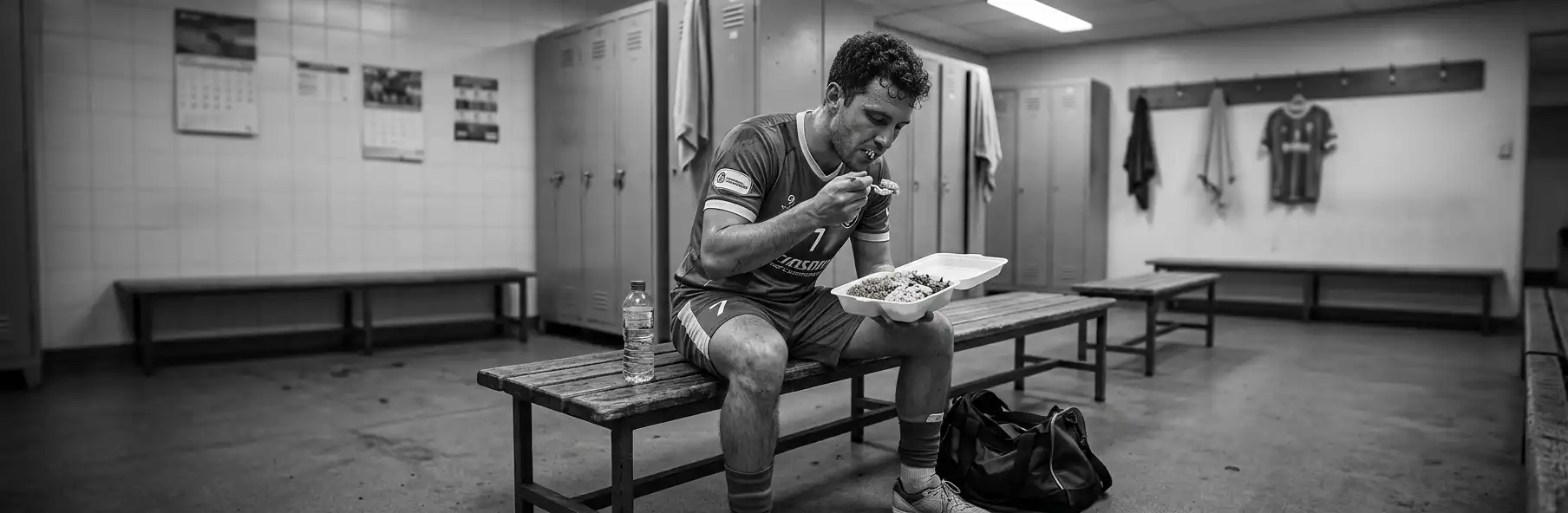
Dinner After a 10pm Futsal Match: What to Eat to Recover and Still Sleep
Futsal matches that finish at 10pm push dinner late. What to eat in the changing room and at home to recover without wrecking sleep, and the post-match pint.
Written by
João Araújo
Physical Education Teacher (FADEUP – University of Porto) · Futsal Coach – Level II · UEFA B License · Master’s in Physical Education
15 years teaching Physical Education in schools, 20 years coaching futsal at youth development level and 5 years coaching football. Federated and amateur football and futsal player.
In grassroots futsal, matches rarely kick off before 8.30 or 9pm. Shared sports halls, players who work until 6, junior teams taking the early slots. The final whistle goes around 10pm, the shower and the chat in the changing room push the exit to 10.30, and the player gets home close to 11.30.
At that point there are three typical scenarios. He eats nothing because “it’s too late”. He eats whatever’s in the fridge, standing up, in five minutes. Or he stops at the petrol station and sorts it with a burger and a pint on the way. None of them help him recover for Monday’s session.
This isn’t a meal plan. It’s a practical guide to the specific problem of playing futsal at night and having to eat afterwards.
The Problem Isn’t What You Eat. It’s When.
Classic recovery nutrition was written with afternoon matches in mind. Finish at 5pm, dinner at 8, bed at 11. Everything fits.
In evening futsal, the body is in a different situation. It has just done 40 minutes of effective playing time with intermittent, very high-intensity efforts, muscle glycogen stores well depleted, and an hour or two later it’s supposed to be falling asleep. Adrenaline is still high. So is body temperature. And the stomach isn’t exactly ready for a full plate.
The result is that many futsal players sleep badly on matchnight for two opposite reasons: either they ate too much and too heavy, or they barely ate and wake at 4am hungry, with the body on alert.
What the Body Needs in the Next Two Hours
Three priorities, in this order.
Fluids. In an indoor match, especially in a poorly ventilated hall in September or May, losing 1 to 2 kg in sweat is normal. The practical rule is to replace around 1.5 litres for every kilo lost over the following hours, spread out, not all at once. Water is enough for most. If a player sweats heavily and cramps often, a drink with sodium helps.
Carbohydrate. This is what restocks muscle glycogen. If the next match or hard session is 48 hours or more away, there’s no need to overdo it: a normal meal with a good portion of rice, pasta, potatoes or bread is enough. If there’s another match within 24 hours (tournaments, finals days), then quantity matters, in the region of 1 g per kilo of body weight per hour for the first few hours.
Protein. Between 20 and 40 grams in a meal, which is roughly a chicken breast, a tin of tuna with two eggs or a large Greek yoghurt with milk. It helps muscle repair, especially after a match full of braking and duels.
Fat and fibre aren’t the enemy, but too much slows digestion. At 11.30pm, a very greasy meal is a recipe for a restless night.
A Two-Step Strategy: Changing Room and Home
The approach that works best with the teams I work with is to split recovery into two moments. A small snack straight after the match, still in the changing room, and a light but complete meal at home.
| Moment | When | Examples | Goal |
|---|---|---|---|
| Changing room | 0-30 min after the match | Chocolate milk (500 ml); ham or cheese sandwich; banana + drinking yoghurt | Start restoring carbs and protein without waiting to get home |
| Home | 60-90 min after the match | 2-3 egg omelette with rice or potatoes; pasta with tuna and tomato; cheese toastie with soup | Complete the refuel with an easy-to-digest meal |
| Before bed (optional) | If still hungry | Natural yoghurt or cottage cheese | Slow-digesting protein without feeling heavy |
Chocolate milk is a classic for good reasons: carbs, protein and fluid, cheap, and nobody has to cook. A player who drinks it in the changing room gets home less hungry and eats a more sensible meal.
The critical point is preparation. If the sandwich and the milk aren’t in the bag before leaving for the match, they won’t magically appear at 10.15pm. I suggest players keep a “recovery kit” in their futsal bag the same way they keep shin pads.
To see whether it’s working, I ask each player to log, the morning after the match, what they ate afterwards, what time they fell asleep and how they feel from 1 to 5. The SportsLabTools Athlete Journal makes this quick, and after half a dozen matches the link between dinner and sleep stops being an opinion and becomes a visible pattern.
What About the Pint With the Lads?
It’s the topic nobody wants to raise. In amateur futsal, the social after the match is part of the culture, and it’s often what keeps the group together through a long league season. I’m not going to pretend that doesn’t matter.
But it’s worth knowing the cost. Alcohol slows rehydration because it increases urine output. It reduces muscle protein synthesis in the following hours, especially above two or three drinks. And it worsens sleep quality in the second half of the night, even when it seems to help you nod off.
My position is pragmatic. One pint after the recovery snack, with water alongside, isn’t a disaster. Three or four on an empty stomach is a different conversation, especially in weeks with two matches. I’m not convinced banning it works better than educating: in the teams where I’ve seen bans, the social just moved elsewhere and the player drank anyway, only further from the coach.
One particular case deserves a note: the player trying to lose weight who uses matchnight to “save” dinner. The logic sounds good, he’s already burned calories in the sports hall. In practice it’s the worst time to cut. The body needs to repair tissue and restore energy, and a calorie deficit concentrated in those hours adds to fatigue over the following days. If the goal is weight loss, the cut happens across the week, on non-training days, not on matchnight.
The same goes for the younger players in a senior squad, the 18 and 19-year-olds still living at home. They often rely on whatever’s been left out for them, and at 11.30pm that’s usually nothing. A two-minute conversation with the player (and sometimes with the parents) about having something ready makes more difference than any nutrition talk in the changing room.
Does Eating Late Ruin Sleep?
Depends on how much and what. A large, greasy, heavily spiced meal just before bed disrupts sleep for almost everyone. A moderate meal, rich in carbohydrate with lean protein, an hour before bed, generally doesn’t, and in some cases even helps you drop off.
What gets in the way of a futsal player’s sleep after an evening match more than food is the combination of adrenaline, screens and caffeine. A player who had a coffee at 7pm to “wake up” before the match, played until 10 and then spent an hour in bed watching clips of the game on his phone will struggle to sleep, whatever he ate.
A simple routine helps: warm shower at home, light meal, dim lights, phone away from the bed. Nothing new. But almost nobody sticks to it on matchnight.
See also: Sleep and Recovery in Futsal: Optimising Rest in Double Game Weeks: what to do when the evening match is only the first of the week.
When There’s Another Match Within 48 Hours
In weeks with a Friday 9pm match and another on Sunday afternoon, the post-match meal stops being optional and becomes part of the plan for the next game. Here, carbohydrate genuinely has to be there, in quantity, that night and at breakfast the next day.
In those weeks, some players need help understanding what “quantity” means. A 70 kg winger who needs to refuel properly should be around 5 to 7 g of carbohydrate per kilo the day after the match, which is 350 to 500 grams. That’s far more than most eat on a normal day. A big plate of pasta at lunch, bread at breakfast and as a snack, rice at dinner and fruit in between gets there.
In those weeks I lean again on each player’s daily log in SportsLabTools to cross-check food intake against perceived fatigue at the next day’s activation session. The players who eat little on Friday night are almost always the ones who turn up on Sunday with heavy legs.
Dinner after a 10pm futsal match doesn’t have to be perfect. It has to exist, be planned before you leave the house and not turn the night into a battle with your stomach. If you change only one thing this week, make it the chocolate milk in the bag.