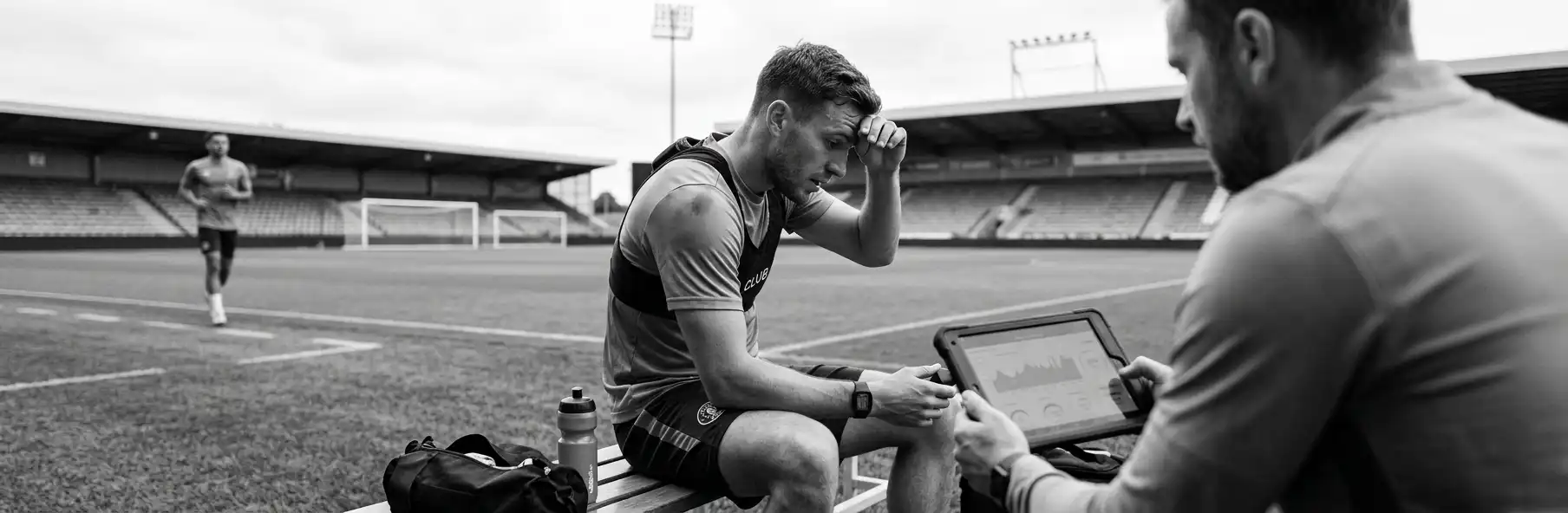
Load Monitoring in Elite Football: Combining GPS, RPE and Match Data
How to combine GPS, RPE and match data for load monitoring in elite football, to manage weeks with multiple fixtures without raising injury risk.
Written by
João Araújo
Physical Education Teacher (FADEUP – University of Porto) · Futsal Coach – Level II · UEFA B License · Master’s in Physical Education
15 years teaching Physical Education in schools, 20 years coaching futsal at youth development level and 5 years coaching football. Federated and amateur football and futsal player.
An elite football team in European competition can play three matches in an eight-day week. No single data source. not GPS, not RPE, not match stats. is enough on its own to decide who’s ready for the next fixture. It’s the systematic combination of all three that separates evidence-based load management from gut-feel decisions.
In elite football, the costliest mistake isn’t training too little. it’s failing to spot in time that the accumulated load from matches, travel and training has outstripped a specific player’s capacity to recover.
Why Load Monitoring in Elite Football Is a Different Challenge
Unlike amateur football, where the main load comes from training, in elite football match load dominates the microcycle; in weeks with two or three fixtures, there’s barely any time left for developmental training, only recovery management. That demands a stricter monitoring system, not a looser one.
The Plan: Combining External, Internal and Match Load
| Data Source | What It Measures | Frequency |
|---|---|---|
| GPS | Total distance, speed zones, accelerations/decelerations | Every session and match |
| RPE (internal load) | Player’s subjective perception of effort | Every session and match |
| Match data | High-intensity actions, duels, real minutes in competition | Every match |
Phase 1: Systematic Collection
Without data collected across every session, including recovery sessions and matches, any week-to-week comparison stays incomplete. Collection has to be routine, not an exception.
Phase 2: Cross-Referencing External and Internal Load
A player can cover the same distance in two matches and feel a completely different level of effort. It’s the cross-reference between GPS and RPE. not either alone. that reveals early signs of accumulated fatigue.
Phase 3: Individualised, Not Collective, Decisions
The same match volume affects players differently depending on age, injury history and position. Rotation and recovery decisions need to be read player by player, not against the squad average.
The Most Common Load Monitoring Mistakes
- Relying on GPS alone and ignoring internal load. two players with the same physical volume can carry very different risk.
- Reviewing the data only after an injury happens, instead of using it preventively week by week.
- Applying the same load threshold to the whole squad, ignoring individual differences in tolerance.
🔧 Useful Tool
Cross-referencing GPS, RPE and match performance data manually is unworkable for an elite squad. SportsLabTools Stats centralises that history per player and per match, surfacing the load pattern that a single data source hides.
Communication with Coaching and Medical Staff
Load data only has value if it reaches the right people in time. A system where the fitness coach, the manager and the medical team review the same numbers in the same weekly meeting avoids contradictory decisions about who should play, rest, or train at reduced load.
Also see: GPS Data in Football: Speed Zones and Distance to Fine-Tune Training. how to read GPS data in detail before cross-referencing it with RPE and match data.
Checklist: Load Monitoring in Elite Football
- GPS data collected across every session and match
- RPE logged per player after each session and match
- Match data cross-referenced with external and internal load
- Load thresholds set per player, not against the squad average
- Weekly meeting between coaching and medical staff to review the data
- Rotation decisions based on trends, not a single match
- System reviewed preventively, not only after injuries occur
Conclusion
Managing load in elite football isn’t about choosing between GPS, RPE or match stats. it’s about building a system where all three intersect systematically. No single data source replaces a decision informed by all of them together, match after match.
Don’t manage your squad’s load off a single data source. Use SportsLabTools Stats to bring GPS, RPE and match data together in one view, player by player.
Optional accelerator · the tool is always free
Reliable stats as soon as the next match
An action taxonomy ready for live logging from the bench, with pitch and goal location already active — heat maps and shot maps without configuring anything.