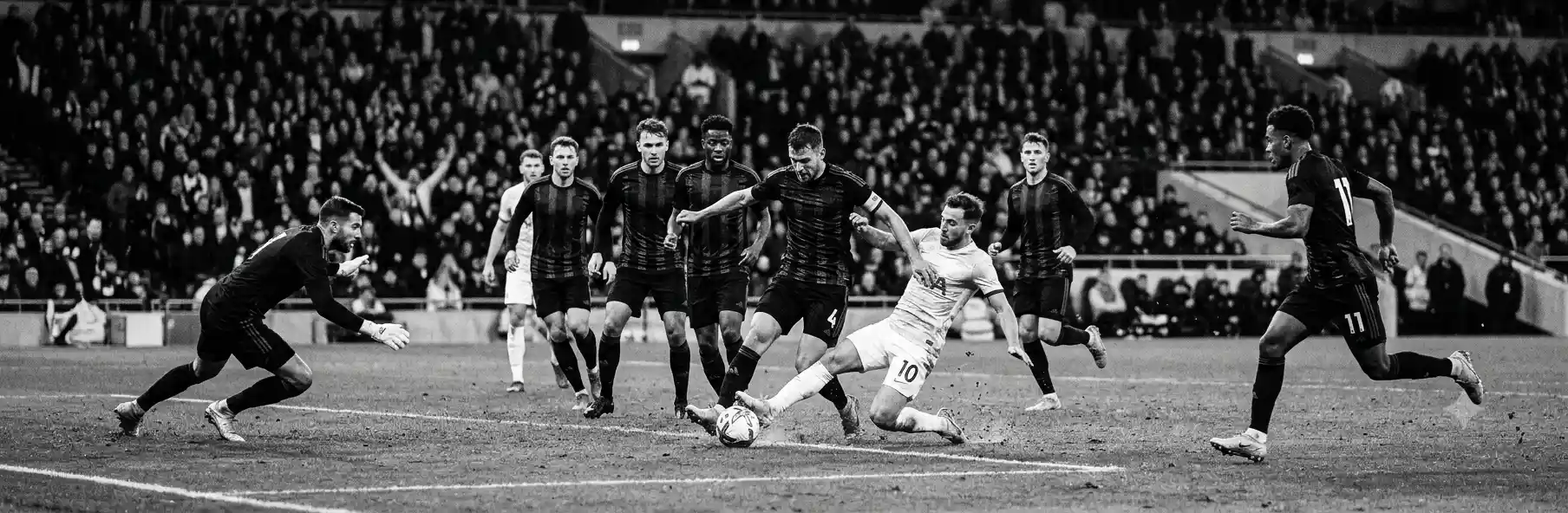
Defending in a Low Block and Hitting on the Counter in Football: The Underdog's Guide
How to defend in a low block and counter-attack effectively in football: compactness, breakout triggers, player profiles and the underdog's tactical variants.
Written by
João Araújo
Physical Education Teacher (FADEUP – University of Porto) · Futsal Coach – Level II · UEFA B License · Master’s in Physical Education
15 years teaching Physical Education in schools, 20 years coaching futsal at youth development level and 5 years coaching football. Federated and amateur football and futsal player.
There is no tactical shame in defending deep, only in defending deep badly. When your squad is inferior to Saturday’s opponent, the arithmetic of the game changes: you won’t have the ball, you won’t dominate territory, and insisting on it is gifting the match away. The low block with an organised counter-attack is the plan that steals more points from favourites than any other, but only when it’s a trained choice, not a resignation.
This article compares the two main variants of the underdog plan and the criteria for choosing yours.
Variant 1: The Passive Low Block (Containment 5-4-1 / 4-5-1)
Strengths
- Maximum compactness: two banks of 4 or 5 with under 25 metres between the back line and the midfield; the central channel closes completely
- Minimal risk: with no pressure on the ball carrier far from goal, there’s no space in behind to exploit; the opposition circulates around the outside of the block
- Energy economy: the team covers less total distance, spending its effort on concentrated defensive actions
- Simplicity: the references (zone, ball, teammate) can be learned in a few sessions
Limitations
- No relief: the team that only defends eventually concedes; accumulated shot volume punishes
- Opposition second balls: with no press-break, the long clearance hands the ball straight back within seconds
- Mental fatigue: defending 90 minutes without the ball demands a concentration amateur sides rarely sustain
When to use it: very large quality gaps, protecting a result in the closing minutes, or away fixtures against favourites with a loud home crowd.
Variant 2: The Mid-Low Block with a Structured Counter-Attack
Strengths
- Regains with intent: the block sits deep, but with defined winning triggers (a pass into the wide channel, the opposition midfielder receiving back-to-goal)
- A rehearsed three-pass breakout: first pass into the feet of the striker or midfielder, second into the channel at speed, third into the finishing zone; the aim is a shot within 10-12 seconds
- Pre-assigned zone occupation: the centre-forward holds and links, the two quick players attack depth through the half-spaces, one midfielder follows up for the second ball
- Constant threat: an opponent who suffers one dangerous counter pushes up with less conviction; the block defends better because the favourite respects the depth
Limitations
- Demands specific profiles: without at least one runner with pace and a centre-forward who can hold the ball up, the counter dies at the first pass
- More complex to train: the triggers and breakout movements need weeks of automation
- Vulnerable to the counter-press: if the first link fails against an opponent who reacts well to losing the ball, the next wave arrives with your block disorganised
When to use it: whenever you have pace up front. This is the variant that turns the underdog into a genuine threat.
How to Choose and Execute: Three Decision Criteria
- Do you have pace up front? With two quick players, variant 2 is almost mandatory. With none, accept variant 1 and make set pieces your primary attacking weapon.
- Does your opponent leave space? Favourites with very high full-backs and a defensive line 40 metres from goal are ideal counter-attacking prey; patient teams with strong rest defence reduce variant 2’s value.
- How much training time do you have? Variant 1 can be assembled in a week; variant 2 needs 3-4 weeks of repeated triggers and breakouts.
🔧 Useful Tool
Counter-attacking movements must be automatic before Saturday. With the SportsLabTools Tactical Board you can draw the three waves of the counter: who holds, who runs, and who follows up. Share them with the squad before training.
Comparison Table: The Underdog’s Two Variants
| Criterion | Passive block (containment) | Mid-low block + counter |
|---|---|---|
| Implementation time | 1 week | 3-4 weeks |
| Required profiles | Collective discipline | Pace + target striker |
| Attacking threat | Set pieces | Transitions + set pieces |
| Physical toll | Low in distance, high in concentration | Medium, with decisive sprints |
| Main concession risk | Accumulated shot volume | Counter-press on the first link |
| Ideal use case | Protecting a result / huge gap | Underdog with pace up front |
Also read: Expected Goals (xG) and xA in Football: What These Metrics Really Tell You: how to measure whether your low block is conceding quality chances or just harmless volume.
Conclusion
The problem is never defending deep, it’s defending deep with no way out. The compact block earns respect; the trained counter earns points. Assess your profiles, pick the variant your players can execute, and drill the breakouts until they’re automatic. Favourites lose titles precisely on the grounds where the underdog knew exactly what to do without the ball, and with it.
Draw your counter-attacking breakouts before the next match. Use the SportsLabTools Tactical Board to define the three waves and show every player his role in the transition.
Optional accelerator · the tool is always free
A library of exercises instead of drawing every one
Packs of 40 exercises per theme, with an animated tactical diagram, four levels of progression, teaching points and success criteria. Import them and they stay in your library, ready to edit and present to the team.