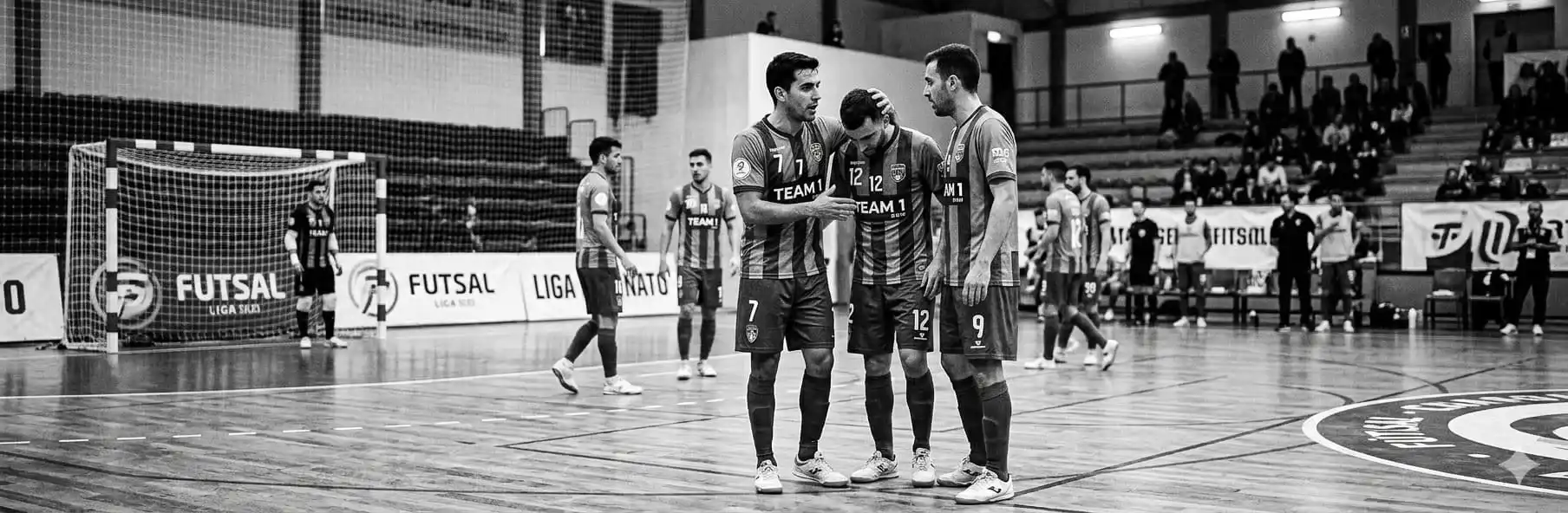
Managing Internal Conflicts in a Futsal Team Throughout the Season
Internal conflicts are inevitable in a futsal team. Learn to diagnose them early, intervene effectively and transform them into group cohesion.
Written by
João Araújo
Physical Education Teacher (FADEUP – University of Porto) · Futsal Coach – Level II · UEFA B License · Master’s in Physical Education
15 years teaching Physical Education in schools, 20 years coaching futsal at youth development level and 5 years coaching football. Federated and amateur football and futsal player.
The selection announcement that sparked discord. Court time distributed in a way two players consider unfair. The squad divided between veterans and younger players who “don’t show enough respect”. Internal conflicts in a futsal team are not the exception. they are the norm in any group with ambition and egos invested in results.
The problem is not the conflict. The problem is the unmanaged conflict, quietly fermenting until it explodes at a critical moment in the season.
Why Internal Conflicts Happen
Conflicts in sports teams have three main origins:
1. Perception of unfairness in resource distribution. court time, call-ups, tactical roles. When a player feels that selection criteria are unclear, resentment grows regardless of whether the decision is objectively correct.
2. Differences in values and norms. veterans with high commitment standards vs. younger players with a different view of what is “enough”. That normative clash is predictable in any squad with age heterogeneity.
3. Role tension. two players with similar profiles competing for the same spot. Healthy competition becomes conflict when there are no explicit evaluation criteria.
Consequences of Ignoring the Conflict
- Low task cohesion: players avoid communicating with each other during the game
- “Strategic” training absences: the unhappy player shows up less
- Factions in the changing room: the group splits into subgroups with opposing narratives
- Collective performance drops in high-pressure games. exactly when cohesion is most needed
The Solution: Core Intervention Principles
- Intervene early: a conflict in the first 3 days is addressable; after 3 weeks it is an entrenched narrative.
- Speak with each party separately before bringing them together: premature joint meetings polarise rather than resolve.
- Separate the behaviour from the person: “this behaviour in training has this impact” rather than “you are problematic”.
- Define the criteria before the conflict, not after: court time distributed by communicated criteria prevents 80% of perceived-unfairness conflicts.
Application: Concrete Strategies
Conflict Over Court Time
Hold an individual meeting with each player at the start of the season with explicit selection criteria. When the conflict arises (and it will), the conversation begins from an existing agreement, not a debate over principles.
Intergenerational Conflict
Create non-competitive shared moments (informal training, team meal) that break faction barriers before they solidify. Proximity reduces the attribution of negative intent.
Conflict Between Two Players
Individual meeting with each one → identify the real interest beneath the stated position → joint meeting focused on how the solution benefits the team, not on who is right.
Silent Conflict (No Verbal Confrontation)
The most dangerous. Identify it through signals: absence of on-court communication, refusing to pass to a specific teammate, closed body language on the bench. Act before the behaviour becomes a pattern.
🔧 Useful Tool
Tracking each athlete’s individual records helps identify behavioural patterns before they become conflicts. The SportsLabTools Athlete Journal allows you to monitor each player’s emotional and motivational state throughout the season.
Special Cases: When the Conflict Is with the Coach
Direct conflict with the coach is the most frequent and the least managed. Two fundamental principles:
- Never resolve in public: technical authority does not survive open debates during training. The difficult conversation happens afterwards, in private.
- Distinguish disagreement from disrespect: a player who questions a tactical decision is exercising critical thinking; one who violates group norms is attacking cohesion. The treatment is different.
See also: The Psychology of the Call-Up: How to Manage Player Expectations: managing expectations from the squad announcement is the first step to preventing internal conflicts.
Checklist: Conflict Management Throughout the Season
| Practice | Implemented? |
|---|---|
| Selection criteria communicated before the 1st matchday | ☐ |
| Individual meetings with each player at the start and mid-season | ☐ |
| Protocol defined for intervening in conflicts (who, how, when) | ☐ |
| Silent conflict signals monitored after each training session | ☐ |
| Intergenerational conflicts addressed with cohesion activities | ☐ |
| Difficult conversations held in private, never in group context | ☐ |
| Group climate review after periods of poor results | ☐ |
Conclusion
An unmanaged conflict does not disappear. it entrenches. The difference between a team that grows through adversity and one that dissolves in it lies in the coach’s ability to intervene early, with method, without avoiding the discomfort of the difficult conversation. Cohesion is not built with good luck. it is built with deliberate decisions.
Monitor your athletes’ motivational and emotional state throughout the season. Use the SportsLabTools Athlete Journal to identify patterns before they become conflicts and act proactively.