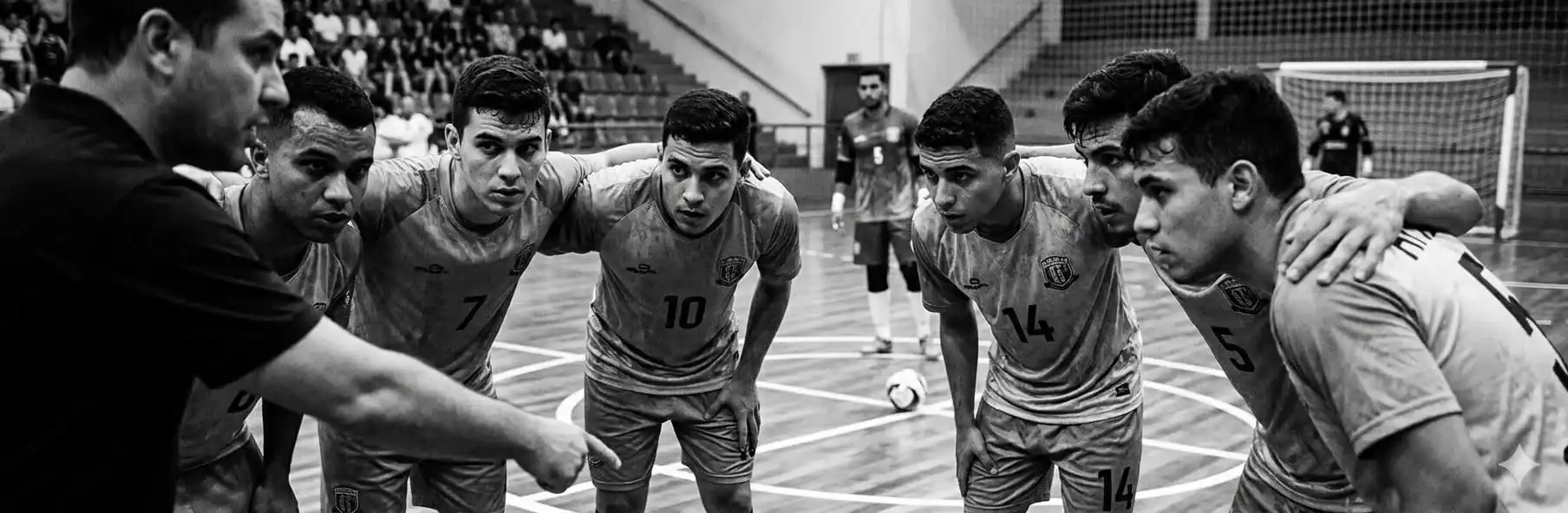
Mental Preparation for Futsal Playoffs: How to Get Your Squad Performing When It Matters Most
Your squad has the quality but freezes in the playoffs? Learn how to mentally prepare your futsal team for knockout stage pressure and decisive matches.
Written by
João Araújo
Physical Education Teacher (FADEUP – University of Porto) · Futsal Coach – Level II · UEFA B License · Master’s in Physical Education
15 years teaching Physical Education in schools, 20 years coaching futsal at youth development level and 5 years coaching football. Federated and amateur football and futsal player.
The squad trained well throughout the season. The quality is there to win. But when the playoffs arrived, they looked like a different team. anxious, passive, playing scared of making mistakes. This isn’t a technical problem. It’s a mental preparation problem. and it has a solution.
This scenario plays out in dozens of amateur sides every season. The difference between a team that performs to its level and one that implodes in decisive moments rarely comes down to individual talent. It comes down to the collective ability to manage pressure, maintain clarity of thought, and execute what was trained when it matters most.
The good news: mental preparation is not an innate talent. It’s a skill that can be trained, structured, and taught. like any other aspect of the game.
Why Decisive Matches Are Different
In knockout football, the context changes. Defeat carries a different weight: you don’t lose points. you lose the season. This reality shifts the internal state of players before they even step onto the pitch.
Pressure activates well-documented psychological mechanisms. Anxiety narrows attentional focus. players stop reading the game broadly and get stuck on details. Risk aversion increases: nobody wants to be responsible for the mistake that eliminates the team, so nobody takes risks. The side becomes predictable, passive, reactive.
The root causes? Undefined roles under high-pressure situations. No pre-established pre-match routine. And fear of failure speaking louder than goal clarity. When a player enters the pitch without knowing exactly what is expected of them in that specific match, the brain fills that gap with anxiety.
Consequences of Ignoring Mental Preparation
The most obvious consequence is underperformance despite quality. the team that “should have won” didn’t. But the impact runs deeper.
An early knockout exit leaves a psychological scar that persists into the following season. Players remember failure more vividly than the wins from the league phase. The narrative “we never deliver when it counts” takes hold in the dressing room and becomes a self-fulfilling prophecy.
Ignoring mental preparation isn’t neutral. It’s choosing the most likely path to underperformance.
The Solution: Core Principles
There are no shortcuts, but there are clear principles that make the difference:
- Role clarity. every player knows exactly what is expected of them in this match, in their position, during transitions.
- Structured pre-match routine. automates context, reduces uncertainty, creates familiarity even in hostile environments.
- Focus on process, not result. “win the next duel” rather than “win the match”. Narrows the time horizon and reduces perceived pressure.
- Error management during the match. the response to mistakes is practised, not improvised. The player knows what to do in the 5 seconds after an error.
- Specific positive communication. not “you’re playing well” but “your pressing is creating space”. Specificity builds genuine confidence.
Application: Concrete Strategies
The Week Before the Decisive Match
Each day has a purpose. Monday: visualisation: imagining match situations and positive responses. Tuesday: role review: every player knows their responsibilities. Wednesday: simplified tactical review, introduce nothing new. Thursday: light activation, relaxed atmosphere, positive energy. Friday: pre-match routine exactly as it will be on matchday.
The week must not increase training load or introduce tactical novelty. It must build confidence through repetition and clarity.
The Pre-Match Routine
Define a fixed routine for all knockout matches: arrival time at the venue, warm-up in the same format, captain’s word, final team talk. When the external context is unpredictable. away venue, hostile crowd. the routine creates a recognisable internal environment. The brain interprets familiarity as safety.
Managing Errors During the Match
The 5-second rule: maximum 5 seconds of reaction to an error (physiological, accept it), then reset and focus on the next moment. The coach is the first to model this behaviour. The bench reaction after an error is the most observed behaviour on the pitch. if the coach implodes, the team implodes. If the coach resets, the team learns to reset.
🔧 Competition Manager
Tracking the playoff bracket, knowing opponents’ tendencies and planning each round in advance reduces uncertainty and frees up mental space to prepare the squad. The SportsLabTools Competition Manager centralises all that information so you can focus on what matters: getting the squad ready.
Special Cases / Nuances
The Team That Has Never Reached This Stage
For sides in their first knockout round, the challenge is framing the situation without adding weight. Avoid phrases like “we’ve never come this far before”. they create pressure where none should exist. The message: “We’re here because we earned it. We play our game.”
Home vs Away in the Playoffs
The visiting team often holds a psychological advantage: no expectation to win, playing with freedom. The home side carries the weight of “having to win”. The management strategy: normalise expectation, focus on process, and prevent the crowd from becoming an additional pressure source.
When the Favourites Feel the Weight of Expectation
Being favourites is a mental trap. The team that “has to win” plays scared of losing rather than hungry to win. The solution: redirect focus to game identity. “we are favourites because we play this way, so let’s play this way.”
See also: The Training Diary as a Self-Analysis Tool for Young Futsal Talents. complements mental preparation with individual reflection tools for each player.
Checklist: Mental Preparation for Playoffs
| Practice | Implemented? |
|---|---|
| Every player knows their specific role for this match | ☐ |
| The pre-match routine is defined and has been practised | ☐ |
| The squad has trained its response to errors | ☐ |
| Communication focus is on process (not result) | ☐ |
| The coach modelled calm and clarity during the previous week | ☐ |
| Dressing room leadership is aligned with the message | ☐ |
| The tactical plan has been simplified for the decisive match | ☐ |
Conclusion
The playoff tie doesn’t just decide the passage to the next round. it decides the identity of the team. A side that learns to perform under pressure, manage errors with composure, and execute with clarity when it matters most builds something that extends far beyond the result of a single match.
That identity persists. It carries over into the following season, into the younger players who are watching, into the culture of the club. Investing in mental preparation isn’t a luxury. it’s the difference between a team with quality and a team that uses it when needed.
Plan each playoff round with organised information and mental focus. Use the SportsLabTools Competition Manager to track the bracket and prepare your squad for each opponent.
Optional accelerator · the tool is always free
Fixtures and standings ready in minutes
Six competition formats with the rules already configured — single and double round-robin leagues, group stages, knockout cups — with tie-breakers, extra time and penalties defined. Replace the team names and generate.