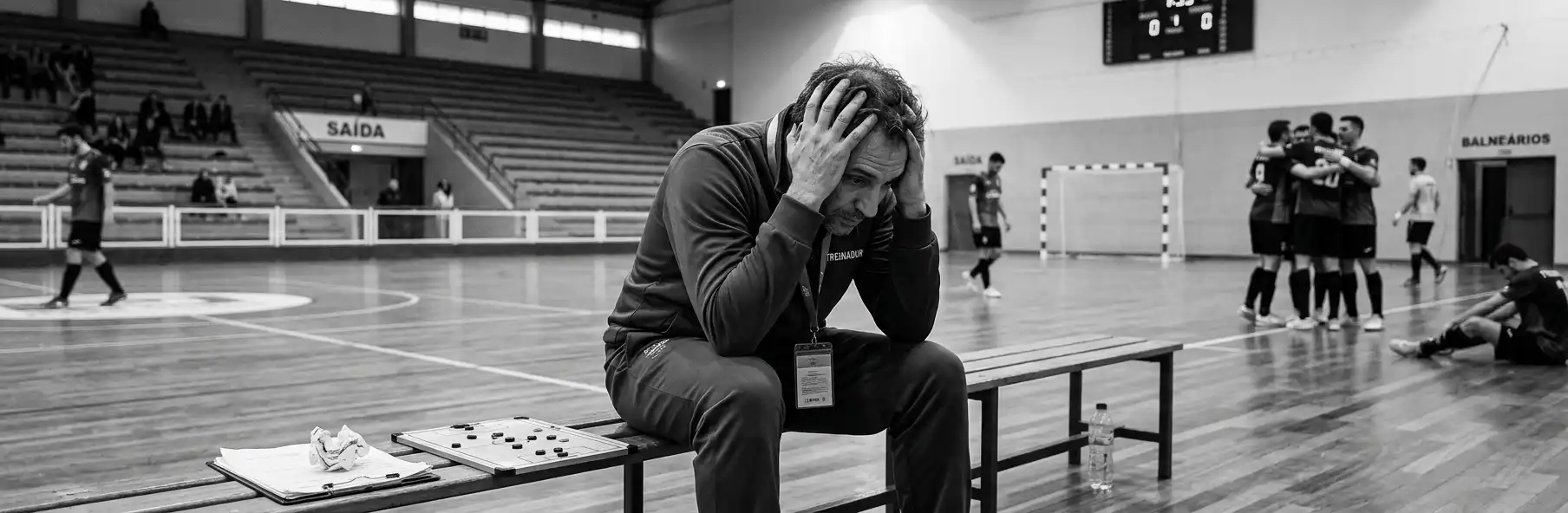
The Night We Went Down: A Futsal Coach's Diary
A futsal coach recalls the night his team was relegated, what he said and shouldn't have, and what he changed in the weeks after so he didn't lose the group.
Written by
João Araújo
Physical Education Teacher (FADEUP – University of Porto) · Futsal Coach – Level II · UEFA B License · Master’s in Physical Education
15 years teaching Physical Education in schools, 20 years coaching futsal at youth development level and 5 years coaching football. Federated and amateur football and futsal player.
Saturday, 11.14pm. The clock in the sports hall in Leeds still read 0:00 and nobody had switched it off. We lost 4-3 on the final day of the National Futsal Series, conceding with 19 seconds left while our goalkeeper was up as the fifth outfield player in a power play. With that result, we went down.
I remember the sound more than the picture. The home fans singing, the referee’s whistle echoing off the metal roof, and then a strange silence on our side of the court. Hugo, captain for four seasons, lay flat on his back in the middle of the court. Dylan, our 19-year-old winger, sat on the bench with his head between his knees. I stayed standing. I didn’t know what to do with my hands.
In the changing room, fifteen minutes later, I said something I still remember word for word: “It’s on me. I’m the one who sent the keeper up.” Then I went out to talk to the chairman and left the group on their own.
What happened that night and over the next 48 hours
At the time I thought taking the blame was what a leader should do. It protected the players, took the weight off them. Now I’m not so sure.
What I realised later, in a conversation with Hugo, was that the line had the opposite effect to what I wanted. The players didn’t feel protected. They felt the coach had given up. One of them told me months later: “It sounded like you were saying goodbye.” And that wasn’t all. By blaming the power play decision, I’d reduced a whole 26-match season to one moment. The players knew we hadn’t gone down because of that goal. We’d gone down because of everything that came before it.
Then came the second mistake. At 2.07am, unable to sleep, I wrote a long message in the team WhatsApp group. Four paragraphs. Thanks, apologies, a half-tactical, half-emotional analysis, and a line about “rebuilding”. Nobody replied for 11 hours. Then two players gave it a thumbs up. Nothing else.
A message like that, at that hour, isn’t communication. It’s venting. And the players, who were going through the same grief, didn’t need to deal with mine as well.
On Sunday morning I went to our own sports hall to collect the ball bag, which had been left in the kit man’s car. Arthur was there, the caretaker who’s been opening the doors for twenty years. He didn’t say anything about the match. He asked if I wanted a cup of tea. We sat for ten minutes in the empty stand, looking at the court where we’d trained three nights a week since August. It was the first time since the final whistle that I could breathe properly. Sometimes the person who helps most is the one who isn’t trying to.
Going down isn’t the same as failing at everything
It took me about two weeks to look at the season with any detachment. When I did, with the numbers in front of me, I saw three things I couldn’t see that night.
The first was that we conceded 11 of our 41 goals in the last five minutes of matches. More than a quarter. That wasn’t bad luck. It was a pattern, and it had a physical explanation: our rotation was short, with two almost fixed quartets, and the second quartet reached the end of matches far more tired than the opposition.
The second was that we’d had the third-best defence in the division up to matchday 14. The collapse came after injuries to our first-choice and back-up defenders, and we never found an answer in that position. It wasn’t a lack of attitude. It was a lack of squad depth in a critical role.
The third was that, over 26 matches, we lost 9 by a single goal. Nine. Turning one of those into a draw would have been enough to stay up.
None of this changes the result. But it changes the story the group tells itself about the season. And that story matters a great deal when it comes to who stays and who leaves.
What I changed afterwards
I couldn’t undo the night. But I could change what came next.
I waited before analysing. There was no review meeting the following week. I set it for three weeks later, with a date and time, and told the group that until then nobody talked about the season. It was the best decision I made that summer. People came to the meeting with clear heads.
I spoke to every player, one to one. Fourteen conversations, between 20 minutes and an hour, in a café near the sports hall. I didn’t start by asking whether they were staying. I started by asking how they’d experienced the season. I heard things I didn’t know. Two players had thought about leaving midway through because of how minutes were managed. A third had been playing through pain for two months and hadn’t said a word.
I showed the numbers, not the blame. At the review meeting I brought the three facts I mentioned above. The goals in the last five minutes, the collapse after the injuries, the nine one-goal defeats. Not to excuse anyone. To show that there were concrete problems with concrete solutions.
I planned the next season with the group looking on. One of the things that weighed most in those conversations was the players seeing that there was a plan. I laid out the pre-season in the SportsLabTools Futsal Planning tool, with more specific conditioning for the closing stages of matches and a three-quartet rotation instead of two, and showed it to them before asking whether they’d stay. The question stopped being “do you want to stay in a team that got relegated?” and became “do you want to be part of this?”.
I looked after the youngest first. Dylan stopped replying to the group chat the following week. It was his mum who rang me, worried: he wasn’t leaving his room. For the fourth goal, he’d been the one who lost the ball in midfield, and he was convinced the relegation was his fault. I met him in a park, no ball, no tactics board, nothing. I showed him on my phone the three mistakes that had happened before that moment, two of them by players with ten more years of futsal than him. I don’t know if I convinced him that day. But he started showing up again. The next season he was the player with the most minutes in the squad.
I changed the first session of the new season. Instead of starting with fitness tests, we started with twenty minutes sitting on the sports hall floor. Each player said one thing he’d learned the season before. Just one. Some talked about tactics, some about family, some stayed quiet and just said “pass”. Then we played a half-hour 4v4 without a single correction from me. It was the loudest session I can remember. I felt that was where the relegation got left behind.
Nine of the fourteen stayed. Of the five who left, three had reasons that had nothing to do with relegation (work, university, moving city). Hugo stayed. So did Dylan.
What I still don’t know how to do well
I don’t know if there’s a good way to talk to a team in the first fifteen minutes after relegation. Maybe the answer is not to talk. Just say “no training tomorrow, we’ll speak next week” and let the players be together without the coach. At the time I thought silence would be abandonment. Now I think the abandonment was going out to talk to the chairman.
I also don’t know whether I’d have done the power play differently. I’ve watched it back dozens of times. The decision was defensible. It went wrong. Sometimes both things are true at once, and learning to live with that is part of the job.
See also: Futsal Squad Management Across a Long Season: Keeping the Group Together Over 30 Matchdays: what I should have done better with the rotation long before the final day.
The following season, we went up. But that’s not what I remember best. I remember the hall clock stuck on 0:00, and realising, too late, that the group needed me less than I thought that night, and much more in the weeks that followed. After the worst night of your season, did you stay with the group or go and talk to the chairman?
Plan the rebuild before you ask players to stay. Use SportsLabTools Futsal Planning to show them next season rather than just promise it.
*This account is based on a real case, but the identities of the people and the club have been protected and some details of the setting have been recreated for illustrative purposes.*
Optional accelerator · the tool is always free
Start the season with the whole year already planned
Macrocycle, monthly mesocycles and weekly microcycles with the real season dates, sessions categorised by focus and technical-tactical blocks, and exercises with animated diagrams. From U11 to Seniors, 1 to 5 sessions per week.