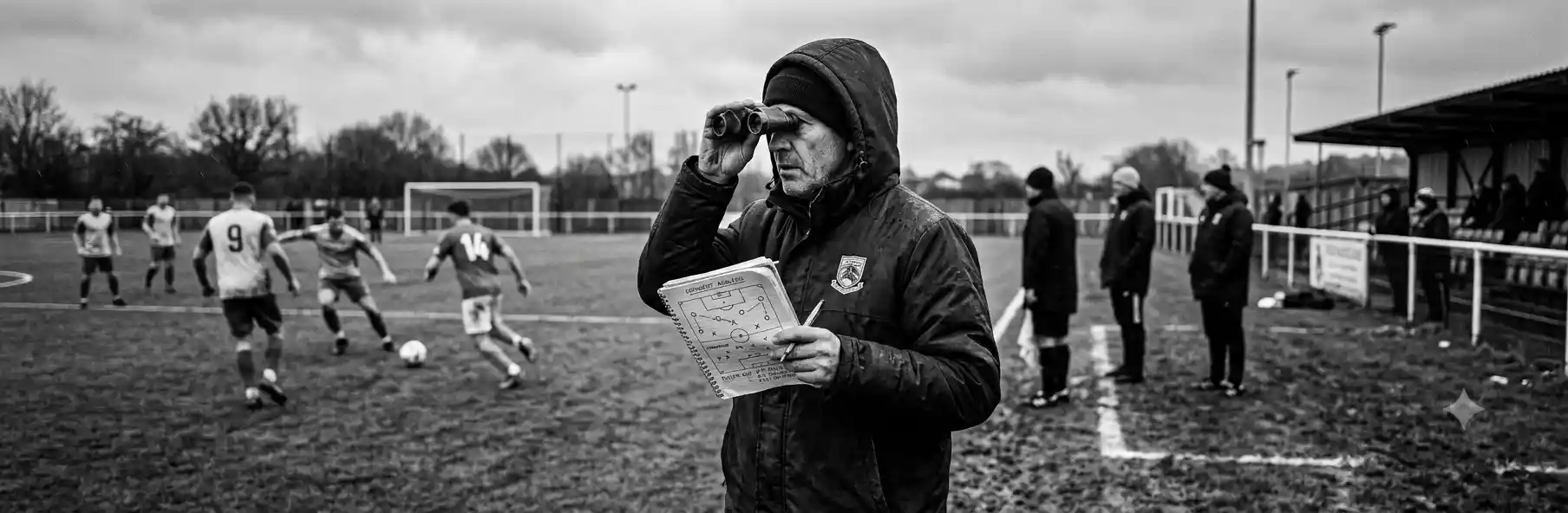
Opposition Scouting in Amateur Football: A Practical Guide on a Shoestring
Guide to opposition scouting in amateur football: what to watch for, how to structure the report and turn the analysis into a game plan in a few hours.
Written by
João Araújo
Physical Education Teacher (FADEUP – University of Porto) · Futsal Coach – Level II · UEFA B License · Master’s in Physical Education
15 years teaching Physical Education in schools, 20 years coaching futsal at youth development level and 5 years coaching football. Federated and amateur football and futsal player.
You don’t need Wyscout or an analysis department to know your next opponent. You need 90 minutes of structured observation. live or on a phone recording. and to know exactly what to look for. The difference between “I went to watch the opposition” and useful scouting lies in the method, not the budget.
This guide gives you the complete method: what to observe, how to record it, and how to turn the notes into a game plan your players can absorb in a ten-minute team talk.
The Problem: Watching Everything Means Seeing Nothing
The classic mistake of the amateur manager watching the next opponent is viewing the game as a fan: following the ball, rating the most talented players and leaving with general impressions (“they’re strong going forward”). Impressions don’t generate game plans. Effective scouting is selective: it hunts repeated patterns, not brilliant moments.
A pattern is a behaviour that repeats 3 or more times: build-up always through the right side, the centre-back who avoids carrying the ball, the corner always delivered to the near post. It’s patterns. not individual talent. that can be exploited tactically.
Core Principles: The 5 Observation Areas
- System and animation. base shape (4-4-2, 4-3-3…) and how it changes in and out of possession; who drops, who pushes on, who pins
- Attacking organisation. where they build (short/long, preferred channel), who the link player is, how they arrive in the box (cross, combination, runs in behind)
- Defensive organisation. block height, pressing (who jumps, when), distances between the lines, full-back behaviour
- Transitions. what they do on losing the ball (press or drop?) and on winning it (go vertical or keep it?); who leads the counter
- Set pieces. attacking/defensive corner routines, marking scheme (zonal/man), takers and preferred targets
For each area, the final question is twofold: where can they hurt us? and where can we hurt them?
Practical Application: The 90-Minute Observation Protocol
First 15 minutes. structure: note the shape in and out of possession, the shirt numbers of the reference players (the organiser, the quickest, the weakest link) and the height of the defensive block.
Minutes 15-45. their attack: focus only on attacking organisation. Log every arrival in the box: where it came from, who was involved, how it ended. By half-time you’ll have 8-12 entries. the patterns are already visible.
Minutes 45-75. their defence: now only defensive organisation and transitions. How do they react to losing the ball? Who doesn’t recover his position? Does the full-back leave space in behind?
Final 15 minutes + stoppages. set pieces and details: corner and free-kick routines, behaviour with the scoreline (do they hold or chase?), emotional tells (who protests, who goes quiet).
Two practical notes: if you only have video, watch the first half at normal speed and the second at 1.5x pausing at key moments; if you can watch two matches, prioritise one home and one away. many amateur sides behave differently.
Common Amateur Scouting Mistakes
- The 5-page report. nobody reads it; the output is 1 page: 3 of their patterns in possession, 3 out of possession, 2 set pieces, 3 ways to exploit them
- Overrating the scoreline of the observed match. the team that lost 4-0 to the league leaders may be superbly organised; judge behaviours, not the score
- Recycling last week’s plan. every plan grows from observed patterns, not templates
- Giving players the full analysis. the squad gets 3 key ideas, not 40 minutes of video; information overload paralyses
- Forgetting your own team, scouting adjusts 10-20% of your game; it doesn’t reinvent your model on a Wednesday
🔧 Useful Tool
Observation notes are worth little if they stay in a lost notebook. With the SportsLabTools Video Analysis tool you organise the opposition clips by category. build-up, transitions, set pieces. and assemble Saturday’s team talk in minutes.
From Report to Game Plan
Analysis is only worth what it changes in training. Translate each pattern into a decision: they always build through the right → our left winger angles the press that way; their full-back doesn’t recover → balls in behind him the moment we turn it over; corners always to the near post → reinforce that zone with your best header of the ball. In the final session of the week, simulate the 2-3 most likely scenarios with the shadow team reproducing the opposition’s patterns.
Also read: Video Analysis in Pre-Season Friendlies: What to Assess Before Competition Starts. the same analytical eye turned on your own team.
Checklist: Your Scouting of the Next Opponent
- Shape in and out of possession identified
- 3+ attacking patterns logged (with confirmed repetition)
- 3+ defensive patterns logged
- Behaviour in both transitions noted
- Set-piece routines mapped (attacking and defensive)
- Report distilled to 1 page with an exploitation plan
- 3 key ideas prepared for the squad team talk
Conclusion
Scouting isn’t a big-club privilege. it’s observation discipline. Ninety minutes with a method beat three matches watched as a fan. Find the patterns, translate each one into a training decision, and hand the squad only what fits in their heads as they walk onto the pitch. The opponent studied properly on Sunday was already beaten on Wednesday.
Build your opposition analysis library. Use the SportsLabTools Video Analysis tool to catalogue patterns and prepare every team talk with real evidence.
Optional accelerator · the tool is always free
Start tagging matches without spending hours building categories
An analysis model with 12 categories and more than 60 actions organised by game moment, already carrying individual/collective context and pitch and goal location. Import it and tag your first clip right away.