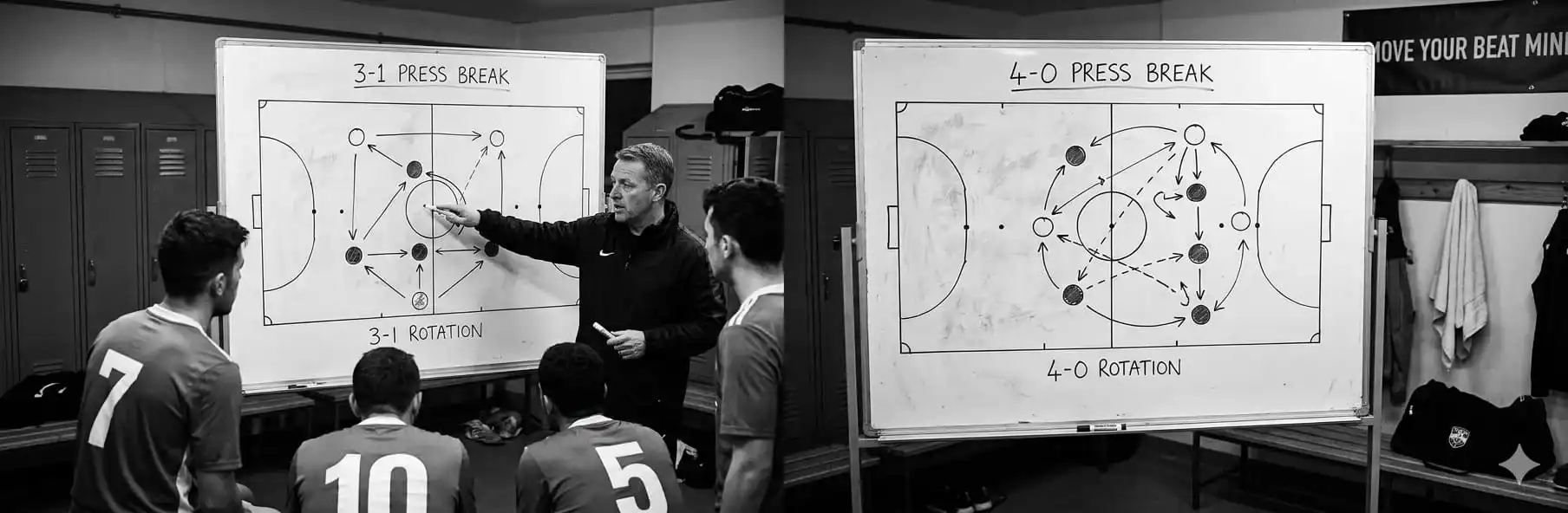
Pressure Exit Routines for 3-1 and 4-0 to Explain in the Dressing Room in Futsal
Learn the pressure exit routines for the 3-1 and 4-0 futsal systems, how to communicate passing lanes, support positions and escape routes clearly and effectively.
Written by
João Araújo
Physical Education Teacher (FADEUP – University of Porto) · Futsal Coach – Level II · UEFA B License · Master’s in Physical Education
15 years teaching Physical Education in schools, 20 years coaching futsal at youth development level and 5 years coaching football. Federated and amateur football and futsal player.
Your team has the technical quality to create chances, but as soon as the opposition press high, you start losing the ball in dangerous areas and conceding avoidable goals. Sound familiar? The solution isn’t asking more from your players individually. It’s having a clear, trained and well-communicated pressure exit routine: both for the 3-1 and for the 4-0.
What It Is and Why It Matters
A high press in futsal is an offensive-defensive strategy where the opposition don’t allow your defensive block to build from the back, pressuring the ball-carrier and cutting the immediate passing lanes. Without an organised exit, the team is forced to play in tight spaces, makes technical errors and loses the ball in risky areas.
A pressure exit routine solves three problems:
- Eliminates hesitation from the ball-carrier
- Ensures players off the ball are always in supporting positions
- Turns the opposition’s pressure into a progression opportunity
Pressure Exit in the 3-1 System
In the 3-1, the pressure exit is built around a triangular structure between the goalkeeper, the anchor and the two wingers.
The Key Support Positions
- Goalkeeper: first line of support. When the anchor is under pressure, the GK must always be available to receive
- Anchor: the exit hub, must move to the wide channel when pressed in the centre, never retreat directly to the GK under pressure
- Wingers: must hold a low position near the touchline, creating a wide triangle with the GK and anchor
- Target/Pivot: temporarily drops to the halfway line to create an additional passing option
The Exit Triangle Principle
Whenever the ball-carrier is pressed, the two nearest teammates must form a support triangle: one on the same line as the carrier and one on the line behind. Never both on the same line, one movement from the opposition eliminates both options at once.
Common Mistakes in the 3-1
- Anchor dropping vertically to the GK without moving wide
- Wingers pushing too high and becoming unreachable for a safe pass
- Pivot not dropping to create the advanced passing lane
🔧 Useful Tool
Before entering the dressing room, use the SportsLabTools Futsal Tactical Board to draw the support triangles of your pressure exit system. Show the support positions for the ball-carrier and define passing lanes for each position, it’s the fastest way to ensure every player understands what to do before stepping on the court.
Pressure Exit in the 4-0 System
The 4-0 has unique characteristics when playing out of a press: because there are no fixed positions, the exit is based on automatic rotations rather than predefined spots.
The Principles of the 4-0 Under Pressure
- Width rule: the most advanced player moves wide to receive safely
- Third man rule: when the first two support options are covered, the third player must be in a position to receive unmarked
- U-shaped circulation: the ball travels on the outside, right channel, baseline, left channel, before entering the central space
The Key Difference vs the 3-1
In the 3-1, roles are more fixed and the goalkeeper is used frequently as an exit option. In the 4-0, the GK is reserved for extreme pressure situations. The team must resolve the exit with the four outfield players, using the mobility that defines the system.
Variant: Exit with False Pivot
In a pressed 4-0, a player can temporarily act as a ‘false pivot’, dropping to the central corridor, receiving and turning away from the press. This creates a one-to-two second window for the team to breathe and reorganise the attack.
Communicating in the Dressing Room
The pressure exit routine should be explained at three levels:
- The principle (“when pressed, we create a triangle / we go wide”)
- Each player’s position (“if you’re the winger and we’re under pressure, drop level with the anchor”)
- The trigger (“when the GK collects the ball, everyone finds their exit position automatically”)
Using a tactical board during the briefing multiplies information retention, players see the movement, they don’t just hear it.
Checklist: Pressure Exit in a Game
| Situation | Correct Action | Mistake to Avoid |
|---|---|---|
| Ball-carrier pressed by two opponents | Pass to support in the wide channel | Dribbling in a closed space |
| GK with ball under pressure | Pass to winger in low position | Long ball without a target |
| Forward passing lane cut | Recycle to GK and reorganise | Holding the ball under pressure |
| Wide exit blocked | Use the opposite channel (quick rotation) | Keeping ball static under pressure |
| Pivot tightly marked | Winger pushes forward to create alternative | Forcing pass to marked pivot |
Conclusion
An effective pressure exit routine doesn’t require faster or more technical players, it requires collective clarity and trained automatism. Whether you play 3-1 or 4-0, the principles are the same: support triangles, width, and a third man always available.
Train the routine, communicate it clearly in the dressing room, and use the Tactical Board to ensure every player visualises their role before kick-off.
Prepare your pressure exit before training. Use the SportsLabTools Futsal Tactical Board to draw support positions and passing lanes with clarity and precision.
Optional accelerator · the tool is always free
A library of exercises instead of drawing every one
Packs of 40 exercises per theme, with an animated tactical diagram, four levels of progression, teaching points and success criteria. Import them and they stay in your library, ready to edit and present to the team.