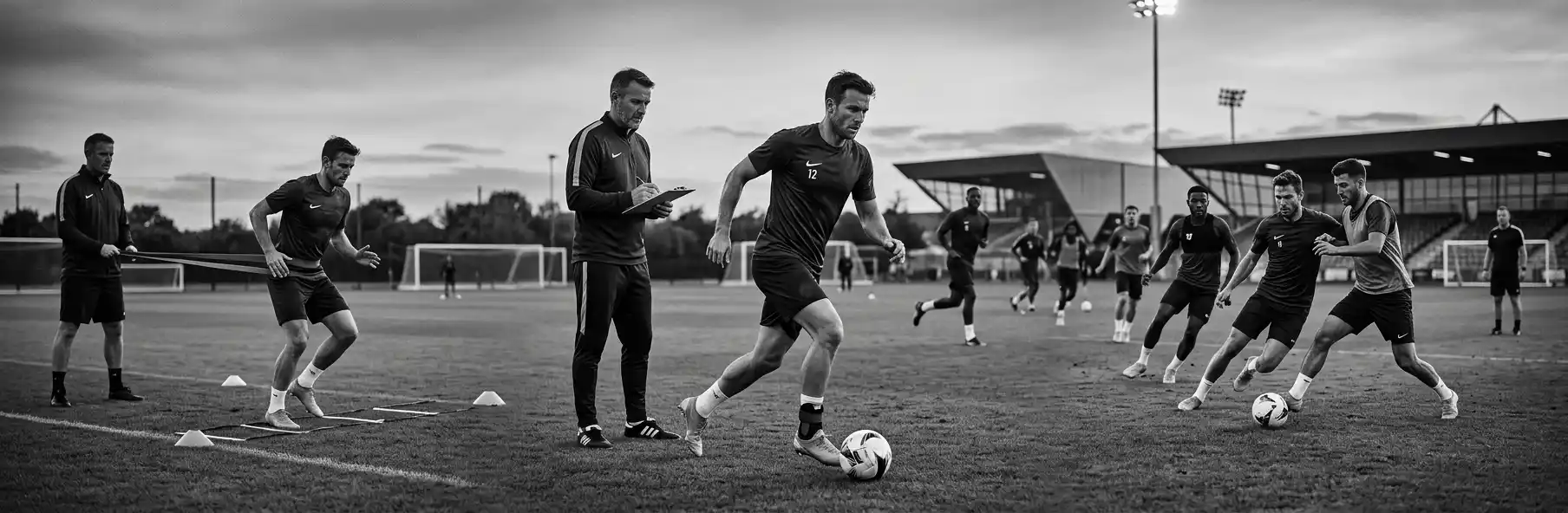
Return to Play After Injury in Football: Protocol for Reintegrating into the First Team
A step-by-step return-to-play protocol for football: load progression, objective criteria, and how to reintegrate a player without risking a relapse.
Written by
João Araújo
Physical Education Teacher (FADEUP – University of Porto) · Futsal Coach – Level II · UEFA B License · Master’s in Physical Education
15 years teaching Physical Education in schools, 20 years coaching futsal at youth development level and 5 years coaching football. Federated and amateur football and futsal player.
A minimum set of objective criteria must be met, not just the absence of pain, before an injured player returns to competition. Muscle injury relapse rates in football sit around 15-20% in the first two months after return, and the most common cause isn’t a poorly treated original injury, it’s a rushed return, without structured progression or clear discharge criteria.
Why Return to Play Is a Different Challenge
Unlike a pre-season progression, where every player starts from a similar baseline, returning from injury deals with a player who’s lost weeks or months of specific training, has asymmetric strength deficits between the two limbs, and often feels psychological pressure, his own or from outside, to speed up timelines his body isn’t ready to meet.
The Plan: A 4-Phase Reintegration Protocol
| Phase | Focus | Progression criterion |
|---|---|---|
| Phase 1. Isolated rehabilitation | Strength, mobility, motor control without the ball | Strength deficit under 10% versus the healthy limb |
| Phase 2. Individualised pitch training | Progressive running, changes of direction without opposition | Completing maximal sprints symptom-free |
| Phase 3. Partial squad integration | Small-sided drills with controlled contact | Tolerating a volume equivalent to 70-80% of a full session |
| Phase 4. Full squad training | Complete team session, including contact | Two full sessions symptom-free before match inclusion |
Phase 1: Isolated Rehabilitation
Before any pitch work, the player needs to recover comparable strength between the two limbs. Testing for “zero pain” alone isn’t enough, a pain-free player can still carry significant strength deficits that expose him to a new injury under maximal effort.
Phase 2: Individualised Pitch Training
Running progression should follow increasing volume and intensity, with changes of direction introduced only once maximal linear sprints are tolerated symptom-free. Skipping this phase to “save time” is the most common and most costly mistake.
Phase 3: Partial Integration
The player joins small-sided drills with controlled contact, but still at a limited training-load volume compared to the rest of the squad. This phase tests tolerance to the unpredictability of a real match, in a still-manageable environment.
The Most Common Mistakes in Return to Play
- Using the calendar alone as the criterion: “it’s been 6 weeks” doesn’t replace objective physical criteria
- Ignoring the asymmetric strength deficit: pain disappears before strength is fully restored
- External pressure to speed up the return: board or fans push for timelines the body doesn’t respect
- Lack of communication with the player about the process: uncertainty about the timeline increases anxiety and fear of reinjury
🔧 Useful Tool
Every phase of the return needs documented criteria, not the day’s “gut feeling”. The SportsLabTools Athlete Journal lets you log symptoms, tolerated loads and the player’s progression phase by phase, with a history visible to the entire coaching staff.
Final Adjustment: Managing the Fear of Relapse
Even with physical criteria met, many players return with residual fear of getting injured again, a factor that alters movement patterns and paradoxically increases the risk of a new injury. Explicit conversations about this fear, not just about physical condition, are part of a well-managed return.
See also: In-Season Injury Prevention in Football: Load Management in Weeks with 2 Matches, how to manage the reintegrated player’s load in the weeks following his return.
Checklist: Return to Play After Injury
- Strength deficit between limbs under 10%
- Maximal sprints tolerated symptom-free
- Changes of direction tested without opposition before contact drills
- Collective training volume tolerated progressively
- Two full sessions symptom-free before match inclusion
- Each phase documented, not just tracked by calendar
- Explicit conversation about fear of relapse
Conclusion
Return to play isn’t measured in weeks on a calendar, it’s measured in physical criteria met and confidence rebuilt. A well-managed return costs a few extra days now, but avoids losing the player again a month later to a preventable relapse.
Don’t leave the return to the mercy of urgency. Use the SportsLabTools Athlete Journal to document every phase of the process and decide with data, not with a calendar.