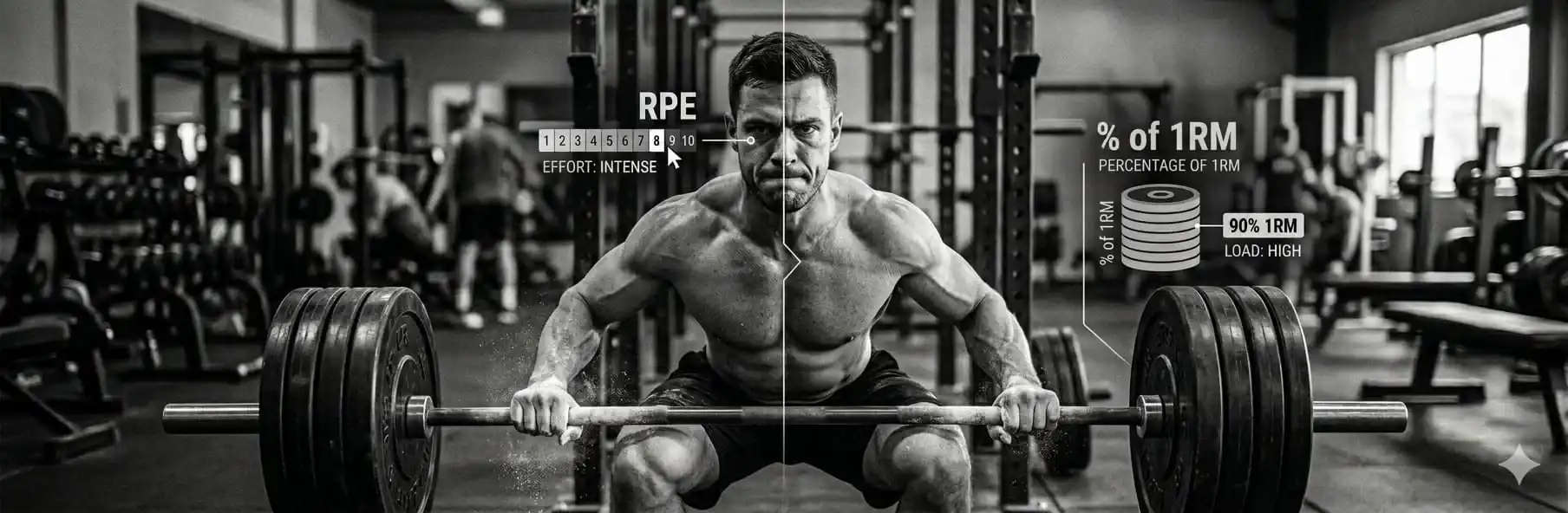
RPE vs. % of 1RM: Which Intensity Method Should You Use?
RPE and percentage of 1RM are the two main ways to prescribe intensity in strength training. Understand the technical differences and find out which suits your level and goals best.
Written by
João Araújo
Physical Education Teacher (FADEUP – University of Porto) · Futsal Coach – Level II · UEFA B License · Master’s in Physical Education
15 years teaching Physical Education in schools, 20 years coaching futsal at youth development level and 5 years coaching football. Federated and amateur football and futsal player.
When a coach says “do this exercise at 75%”, a question immediately arises: 75% of what? What if your maximum today is not the same as it was three weeks ago? What if you do not even know what your current maximum is?
This is where two intensity regulation systems for strength training come in: percentage of 1RM and RPE. Both have solid scientific grounding. Both have limitations. And choosing between them, or combining both, depends on the athlete’s level and the training context.
What Is 1RM and Its Percentage?
The 1RM (one-repetition maximum) is the maximum weight an athlete can lift in a single repetition with correct technique. From this value, percentages are calculated for different training objectives:
| % of 1RM | Training Zone | Typical Reps |
|---|---|---|
| 55–65% | Muscular Endurance | 15–20+ |
| 65–75% | Moderate Hypertrophy | 10–15 |
| 75–85% | Hypertrophy/Strength | 6–10 |
| 85–95% | Maximum Strength | 2–6 |
| 95–100%+ | Maximum Strength / Power | 1–3 |
Advantage: objectivity. The athlete knows exactly how much weight to put on the bar.
Critical limitation: 1RM is not stable. It varies with sleep, stress levels, nutrition, recovery state, and even the time of day. A 1RM measured under ideal conditions can represent 10–15% more than actual capacity on a fatigued day.
What Is RPE?
RPE stands for Rate of Perceived Exertion. Originally developed by Swedish researcher Gunnar Borg on a scale of 6 to 20, it was later adapted for strength training on a 0-to-10 scale (Mike Tuchscherer’s scale):
| RPE | Meaning |
|---|---|
| 10 | Absolute maximum, nothing left |
| 9 | Could have done 1 more rep |
| 8 | Could have done 2 more reps |
| 7 | Could have done 3 more reps |
| 6 | Could have done 4+ more reps |
A modern variant is RIR (Reps in Reserve): simply the number of reps left in the tank. RPE 8 = 2 RIR.
Advantage: real-time autoregulation. Training adapts to the athlete’s current state, not to what it should be under ideal conditions.
Critical limitation: it requires calibration. A beginner athlete does not yet have the internal awareness to accurately gauge their RPE. They may think they are at RPE 9 when they are actually at RPE 7, and vice versa.
When to Use Each Method
% of 1RM. Best for:
- Beginner to intermediate athletes: they need an external reference to understand intensity
- Structured programmes with load undulation: when planned progression is paramount
- Powerlifting/strength competitions: where percentage specificity is required by the programme
- Group settings: the coach can prescribe universal loads
RPE. Best for:
- Advanced athletes: with calibrated self-perception and the ability to autoregulate
- High-stress periods (exams, travel, upcoming competitions): when the athlete’s capacity fluctuates significantly
- Accessory or isolation exercises: where testing a true 1RM is impractical
- Individualisation: allows each athlete to work at their true intensity for the day
The Smart Combination
The most robust approach is to use both together: percentages as the anchor, RPE as the validator.
For example: “Do 4 sets of 5 reps at 80% of your 1RM. If RPE reaches 9 or above on the early sets, reduce the weight.”
This system uses the objectivity of 1RM as a starting point and the autoregulation of RPE as an adaptive safety mechanism. It is the preferred approach of most advanced strength programmers.
The Final Question
If you have to choose just one, answer honestly: do I have enough training experience to accurately assess my own effort?
If the answer is “not yet”, start with percentages. If the answer is “yes, I know my body well”, RPE will adapt your training more intelligently than any percentage table ever could.
Planning futsal training sessions with the right intensity starts with having the right tools. The SportsLabTools Futsal Tactical Board lets you visually organise and communicate exercises and training sequences, integrating intensity management directly into each session’s structure.
Intensity is not what the table says. It is what your body does with that stimulus on that particular day.
Optional accelerator · the tool is always free
A library of exercises instead of drawing every one
Packs of 40 exercises per theme, with an animated tactical diagram, four levels of progression, teaching points and success criteria. Import them and they stay in your library, ready to edit and present to the team.