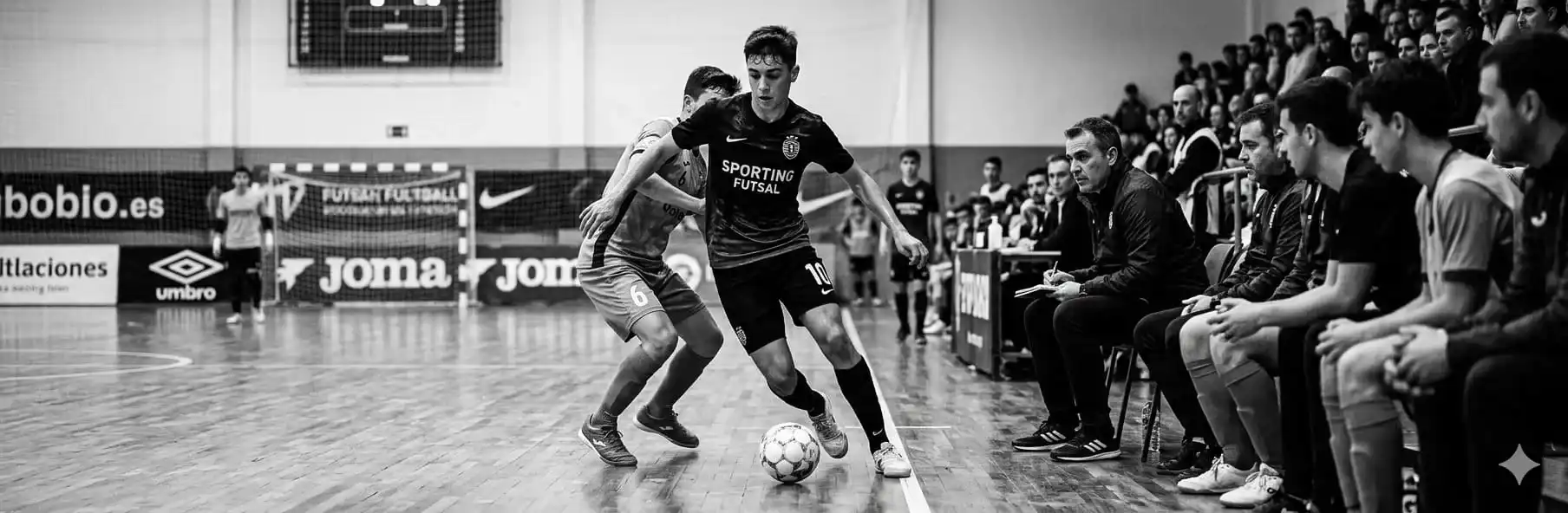
What Scouts Look for in a Young Futsal Player
Find out which criteria scouts assess in a young futsal player, from technique and tactical intelligence to mental profile and behavioural attributes.
Written by
João Araújo
Physical Education Teacher (FADEUP – University of Porto) · Futsal Coach – Level II · UEFA B License · Master’s in Physical Education
15 years teaching Physical Education in schools, 20 years coaching futsal at youth development level and 5 years coaching football. Federated and amateur football and futsal player.
Being watched by a scout in a youth match can change a young athlete’s career. But what does a scout actually assess during those 40 minutes? The answer goes well beyond a goal scored or a flashy assist. The best futsal scouts evaluate a combination of attributes that reveal not only the player’s current level, but their development potential.
Technique: The Non-Negotiable Foundation
In futsal, individual technical quality is amplified by the constant pressure of a reduced playing area. A scout assesses specifically:
- First touch: does the player receive the pass with quality? Does he control without wasting time? First touch under pressure is one of the most revealing indicators of technical potential
- Passing: accuracy, timing and variety. A young player who only passes to the safe option shows limited growth potential; one who risks the penetrating pass reveals game understanding
- Ball control: balance, speed on the ball, ability to protect possession in tight space
- Shooting: technique and placement, but more important than power is the quality of decision before the shot
Important note: youth scouts are not looking for technical perfection, they look for the capacity to learn and the natural ease with which the player executes fundamental skills.
Tactical Intelligence: Seeing the Game Before It Happens
Tactical intelligence is the attribute that most differentiates elite from ordinary players, and the hardest to coach if it is not naturally present.
Scouts observe:
- Off-ball positioning: is the player always in the right position? Does he move to create passing lanes?
- Transition reading: does he react quickly to losing the ball? Does he cover defensive space instinctively?
- Decision-making: does he choose well between shooting, passing or carrying? How quickly does he decide?
- System understanding: does he understand his role within the collective system or does he play individually?
A 14-year-old with tactical reading superior to a 17-year-old is a sign of exceptional potential.
Physical Profile: What Can Be Developed
In youth futsal, scouts know that physicality is highly malleable. They are not looking for the tallest or strongest player, they look for:
- Reaction speed: the time between stimulus and response in 1v1 situations
- Acceleration and explosiveness: ability to create and exploit space in 2–3 steps
- Pressure resistance: does the player maintain technical quality at the end of the match?
- Coordination: fluidity of movement, balance, body control
A player who is physically average but has superior technique and excellent tactical reading is a profile the best scouts recognise immediately.
Attitude and Mental Profile: The Decisive Factor
Many technical talents never reach a professional level for psychological and behavioural reasons. Scouts therefore assess with equal rigour:
- Response to mistakes: how does the player react after losing the ball or missing a shot? Does he drop his head or immediately recover?
- Defensive commitment: a player who only wants to attack and does not defend is a red flag
- Team posture: does he play for the team or for himself? Does he communicate with teammates?
- Bench behaviour: how does he react when he does not play? With what energy does he enter the match when substituted?
- Coachability: does he accept corrections from the coach? Does he incorporate feedback in the following moments of the game?
🔧 Useful Tool
Youth coaches who want to track and record their players’ development across the season can use the SportsLabTools Futsal Stats to document individual match performances and build an objective record per player.
Checklist: Attributes Scouts Assess
| Attribute | What They Observe |
|---|---|
| Technique, first touch | Quality under pressure |
| Technique, passing | Accuracy, timing, variety |
| Technique, shooting | Decision quality and placement |
| Tactics, positioning | Off-ball, creating passing lanes |
| Tactics, transitions | Reaction to losing the ball |
| Physical, speed | Reaction time and acceleration |
| Mental, response to mistakes | Resilience and recovery |
| Mental, team attitude | Playing for the collective |
| Mental, coachability | Accepts and incorporates feedback |
Conclusion
Futsal youth scouts are not looking for the perfect player, they are looking for the player with the greatest growth potential. Solid technique, early tactical intelligence and a strong mental profile are the three pillars that carry the most weight in an observation. The goal scored impresses. The behaviour after losing the ball reveals.
If you are a youth coach, use this framework as a reference for your athletes’ development. If you are a young player, work on the attributes the best scouts value most.
Document your players’ development with real match data. Use the SportsLabTools Futsal Stats.
Optional accelerator · the tool is always free
Reliable stats as soon as the next match
An action taxonomy ready for live logging from the bench, with pitch and goal location already active — heat maps and shot maps without configuring anything.